

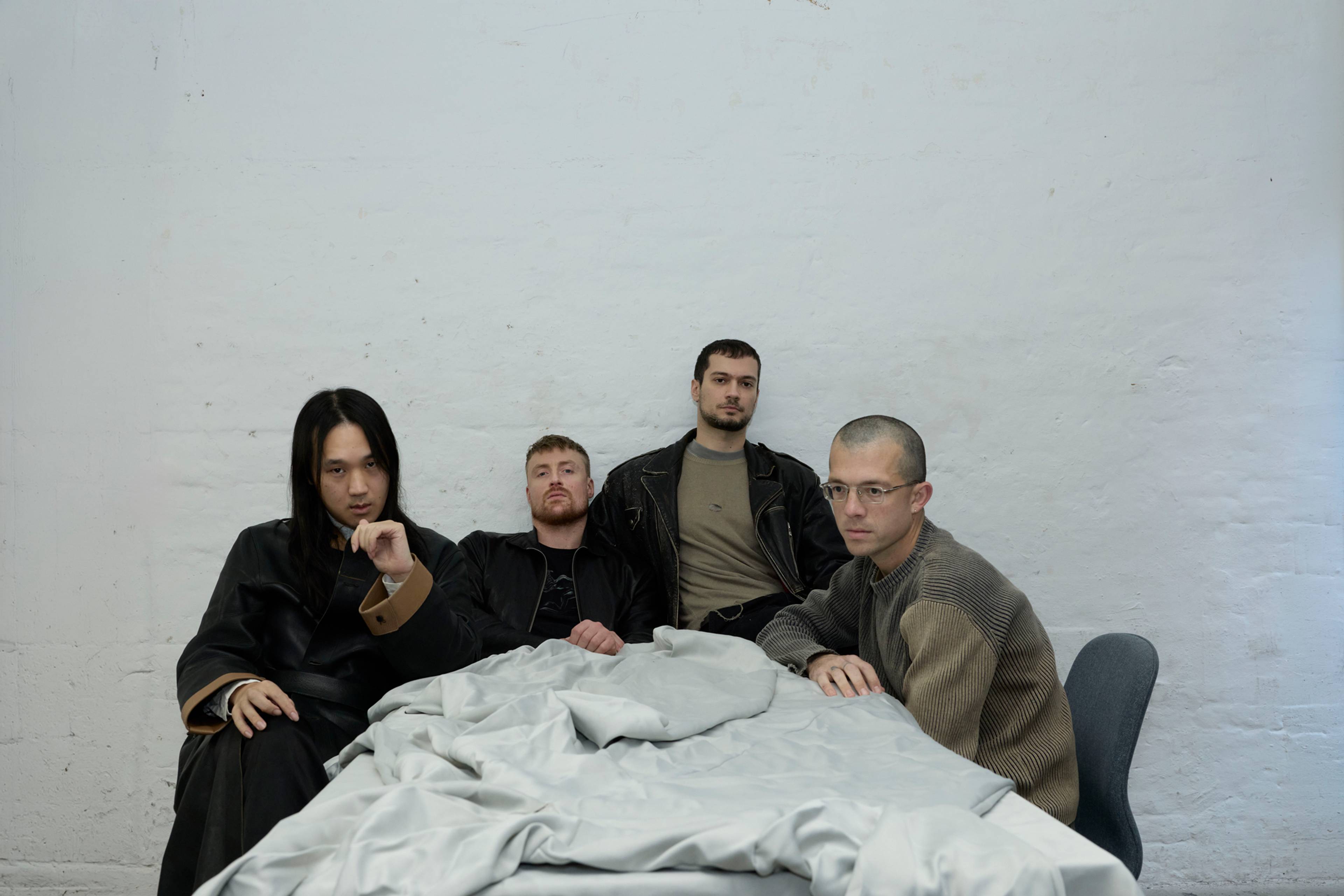
33 offers unsteady music for unsteady times, delivered with a preternatural sense of the ways that space, light, and sound can come together, offering transcendence. The group, founded by Billy Bultheel (*1987) and Alexander Iezzi (*1987) in 2021, recently doubled in size with the addition of Ivan Cheng (*1991) and Cem Dukkha (*1991). Their new album, Tripolar (2026, Haunter Records) was forged from the sonic shards of marathon recording sessions during a Berlin residency where the artists “put everything on the table,” from niche industrial-music references to hurdy gurdies. The nine-track album lurches from baroque string arrangements to squelching synth lines to a queer, dirge-like closing ballad “Babymusicc.” On lead single “Worry Days,” Iezzi sings “It pains me so” in a Trent Reznor-esque wail. The accompanying video reads like security camera footage of an alien invasion at their studio – fitting images for their own paranormal music activity.
Equally important to 33’s growing lore are their live shows. The group prefers to play spaces designed for ecstatic experience. The first time I saw them perform in a 17th- century cathedral, the group crept around pews and dangled from the pulpit amid flashbangs of electricity and noise. With 33, music is sculpture.
For their new album, loosely themed around mental health, 33 developed a new live show that I caught recently at REWIRE, an avant-garde music festival in Den Haag. The audience piled into the theater on a rain Sunday afternoon, slightly hungover, with open ears and a willingness for headbanging. The show, which had debuted a couple weeks earlier at the Volksbühne in Berlin, is “conceived as a situational rearrangement of the album’s material rather than a playback event.” In practice, this meant more pared-back arrangements – fewer Björk-like string and horn interludes and more heavy jam sessions where the song structure broke loose into screaming-on-knees, clarinet and guitar roars, and lots of heavy strobes.
All four members are self-possessed artists in their own right, so when we connect to discuss the world of 33, the artists dredged up a nagging line of self-questioning: Is 33 an “art band” or a real band? Where does the art stop and the band begin? As the squad irons out where they want to fit in the definitional landscape, their high drama musical influences and penchant for emotional performativity on stage leave some clues. They’re not going “trad” any time soon.
[Film credit: Ona Julija Lukas Steponaitytė, Ssi Saarinen, and Iida Jonsson]
Andrew Pasquier: I love your 33 band shirts.
Alex Iezzi: We just got them today. It’s official.
Cem Dukkha: It’s not just some weird art project ...
Billy Bultheel: It’s a BAND.
Andrew: What has the transition been like? You went from two to four.
Alex: I think it’s been natural because we’ve never played a live show without Ivan. It’s like naming your situationship!
Billy: And Cem was an accidental child?
Alex: Our new boyfriend.
Billy: We’ve actually been working on this record, Tripolar, for quite a while – since 2023, three years. The March release was just the big reveal.
Andrew: Tripolar was assembled by editing hours and hours of recording sessions full of improvisation. How does that work?
Ivan Cheng: I’m not media-trained. Billy, you go.
Billy: We had this sound studio at Callie’s, a residency program in Berlin, where we brought all our instruments together on a big table. We had an open session each day, recording for six hours in the studio. It’s not improvisation in the classical way of a jazz band. It’s us fucking around, checking out how certain effect boxes and layering work. We rented a range of instruments: different guitars, drums, hurdy-gurdies …
Alex: CDJs, glockenspiels.
Cem: We had the idea to make four superlong tracks – one for each day at the studio, exploring a mood. But then it boiled down into, like, songs.
Andrew: Once the contours of a track were clear, would you rerecord it?
Ivan: Most of what you hear was there from the first sessions. I was not part of the Callie’s sessions. I actually think Cem was in 33’s Instagram bio before I was, and I was like, “Oh, that’s weird, since I play live with you regularly!”
Billy: Uh oh. Haha.
Ivan: But anyways, during our first show together at Trauma Bar in Berlin in 2022, it felt a bit like we were trying to reproduce these sonic cut-and-pastes. The project had the feeling of being a file-sharing collective. A computer thing. During that first moment playing live together, our various neuroses about being an “art band” versus being a “real band” emerged.
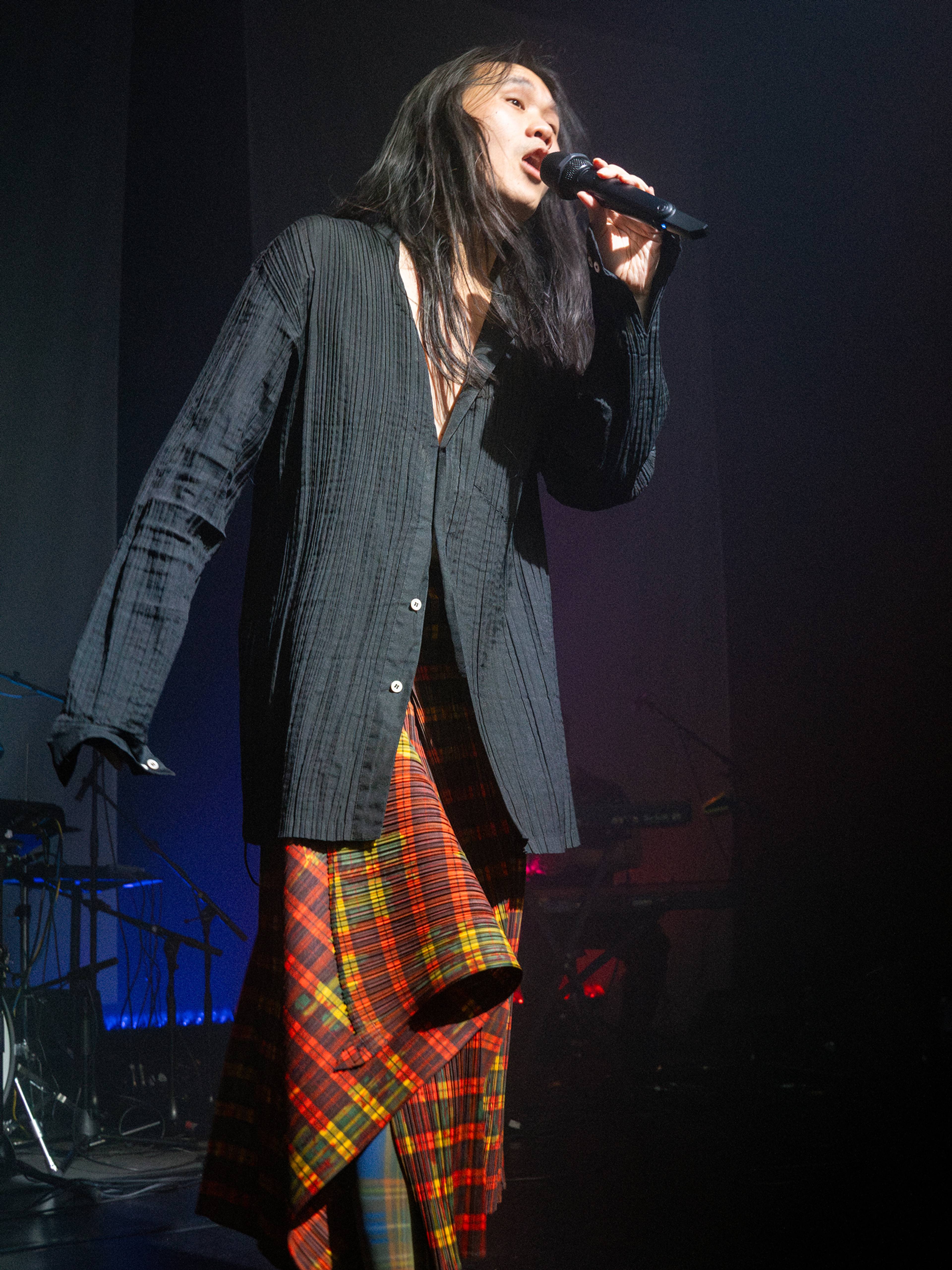
Ivan Cheng performs with 33 at Rewire Festival, the Hague, 2026. Photo: S*an D. Henry-Smith
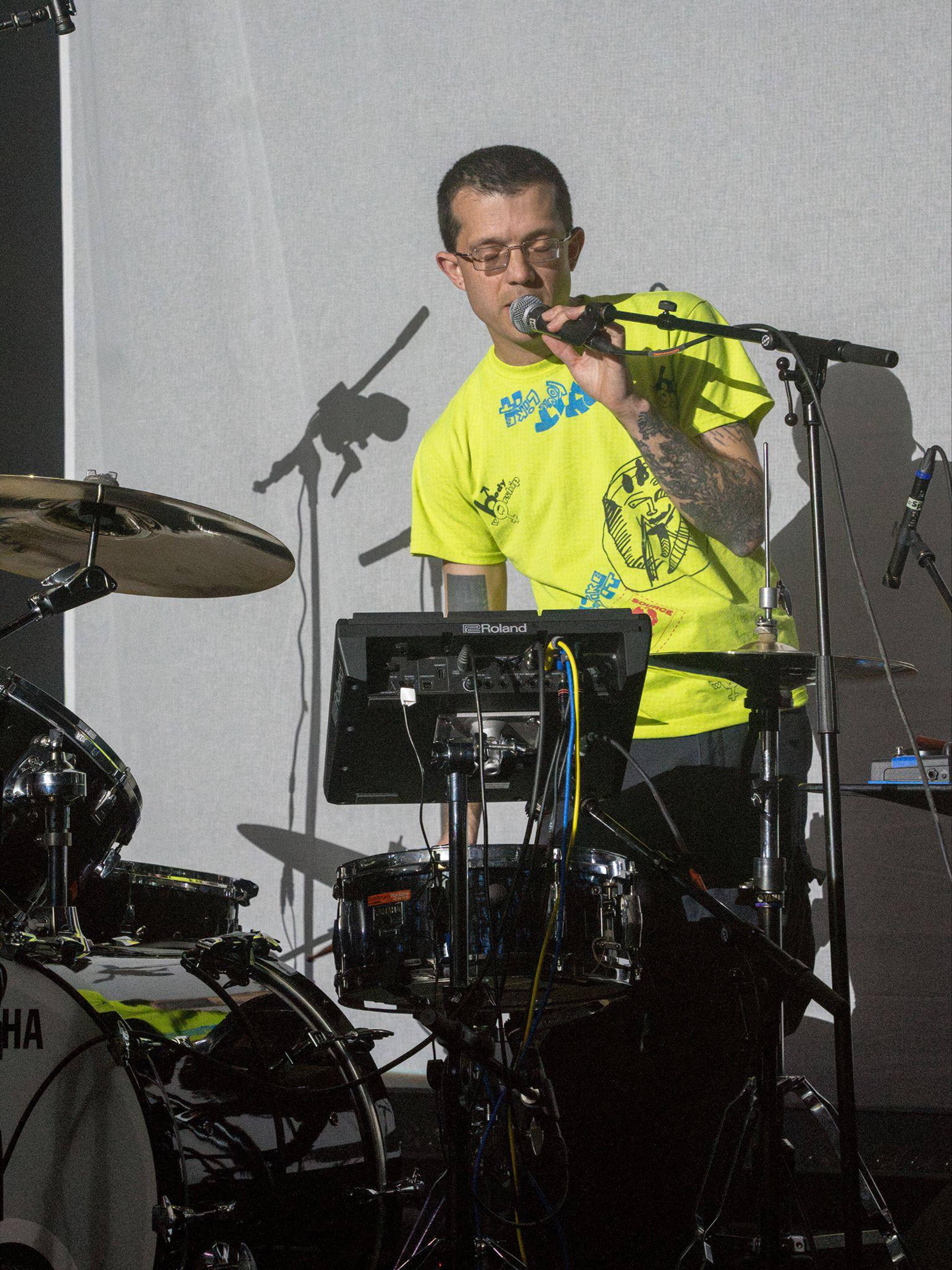
Alexander Iezzi performs with 33 at Rewire Festival, the Hague, 2026. Photo: S*an D. Henry-Smith
Andrew: Let’s discuss the difference.
Alex: See, I think we have a complex where we’re constantly trying to prove that we’re not an art band and that we’re just a band where everybody who plays in the band is an artist.
Ivan: But that’s just a classic “art band” logic. People are sick of being an artist, they just want to be a band.
Billy: While we all like this idea of having fun performing together, we are each very ambitious about bringing in our own influences. We aim for a level of musical complexity, bridging acoustic music with industrial music, pop with experimental.
Alex: Of course, we’re taking the craft of making music seriously, but a band is also a space where Ivan can be very cringe, Billy can be very cringe, I can be very cringe.
Ivan: You put your finger right on it, Alex. What we’re trying to be is extraordinarily cringe.
Andrew: Are you succeeding?
Ivan: See, what I love is that, in a band, you’re able to enter this steadily reproductive space. It’s not the mode in which most of us typically engage with our practices. Except for Cem, maybe. Cem, when you are moving around the world, throwing parties, being a DJ, what is the level of responsiveness to context that you’re trying to build into your approach?
Cem: DJing is still a very isolating process. It’s not comparable at all. I do respond to the crowd, but at the end of the day, it’s still just my own set. It lacks the dissolving of egos and coming together around ideas that I enjoy with 33.
Billy: There’s also the question of engagement. How we want to engage with other artists, with audiences, with a stage – as a band, all these questions are collectivized. There’s a playfulness in thinking about how we want to present our music. Less overthinking.
Alex: The “band” context is also widely understood: you go on a stage, you play music into a crowd, people watch, there are groupies backstage.
Mediocrity called your name / she wants you back – “Crying Song”
Andrew: If you had to define the 33 groupie, who are they?
Alex: Just our boyfriends and girlfriends.
Billy: Well, I was called “Daddy” when we performed in Italy. By an Italian girl on ecstasy.
Alex: You were proud of that!
Andrew: What’s the optimum drug to take to see 33?
Alex: Monkey dust?
Ivan: Dramamine. And cough syrup.
Andrew: In your live shows, how do you approach choreography, light, and architecture?
Billy: First, we have to credit Periklis Lazarou, our amazing and invisible fifth member.
Alex: He’s our light designer who helps develop the live show. The stage design.
Ivan: Somewhat surprisingly, people like to sit down to listen to us play. It can’t be underestimated how much flashing strobe lights can have a major impact on what you see and how you feel.
Andrew: OK, so I assume there was no moshing at your Volksbuhne show in March? It’s a traditional theater setting.
Cem: I would have loved moshing.
Billy: Maybe next show!
Ivan: Although we were playing in a theater, I think we are inclined to want to play in epic spaces, from churches to huge post-industrial halls. Currently, both our technical rider and our set design with Periklis are tuned towards spectacle. Sure, there’s a queer element, but there’s also an unflinching pleasure in bigness. While there are moments of intentional subtlety or contour, we’re quite comfortable with extreme contrast.
Andrew: I first saw you perform in a Dutch cathedral [Nieuwe Kerk, The Hague, 2023], and I find there’s a spiritual dimension in your performances. Light is used in this ritualistic way. How do each of you relate to spirituality? Is there a religious resonance in the project?
Alex: I grew up in an atheist household, so I only discovered what was interesting about religion once I went to college. For me, this resonance is exciting because it’s never something that I was traumatized by. Churches were spaces where culture was created for thousands of years. It feels exciting to be invited into that tradition. We played this show in Czechia [PAF Olomouc, 2023] where the set design featured strobes attached to this metal scaffold structure in front of a Baroque colonnade at the center of a church.
Ivan: But guys, would you still be happy if we weren’t playing in specific rooms? Would we ever do a club tour?
Alex: I would love to, but we’re still billed as an “art” or “performance” thing.
Cem: Yes, but we’ve changed. Since joining, I think I looped everyone up a bit. The sound is much warmer, and easier for a general audience. It was way more austere before.
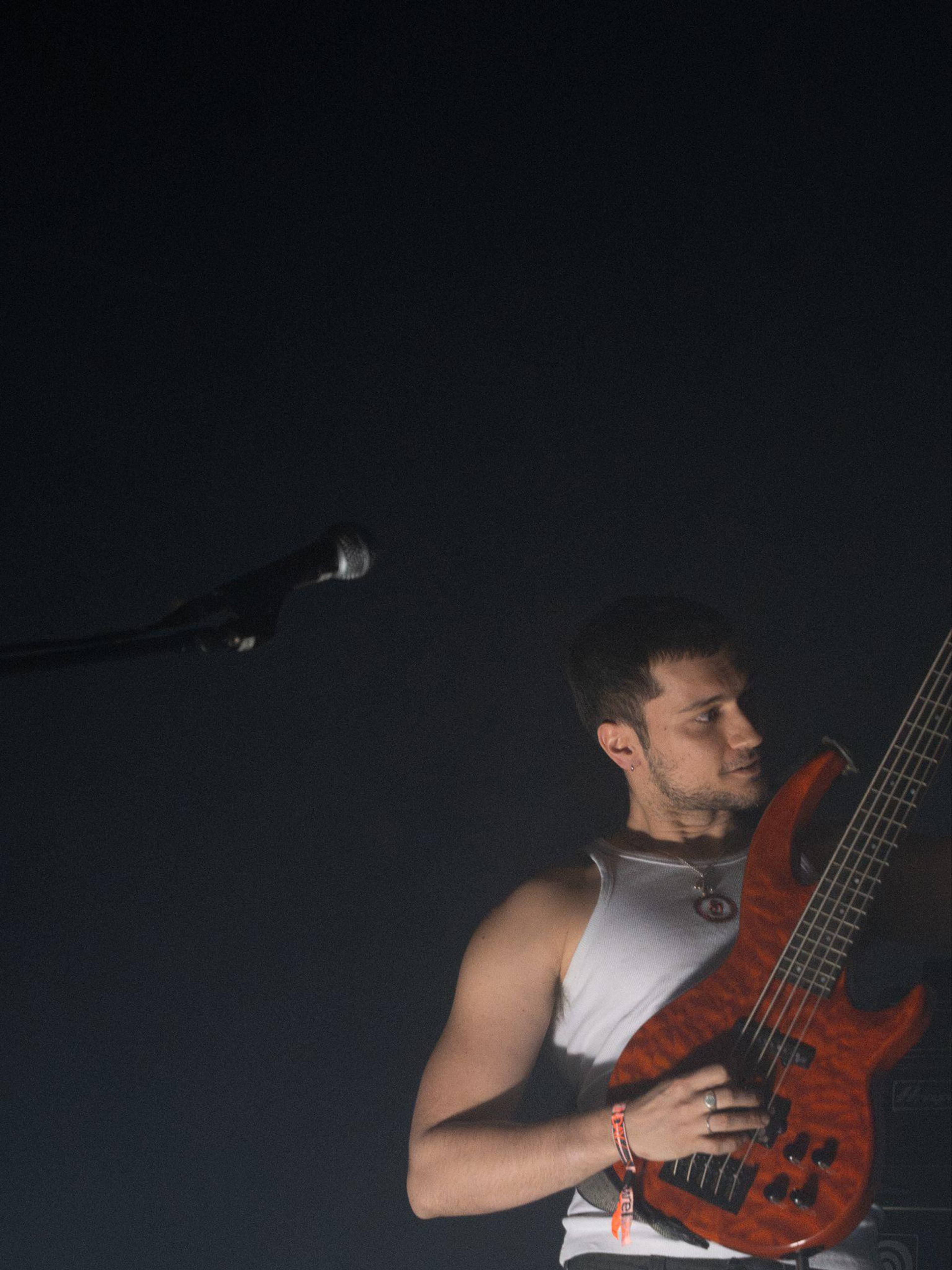
Cem Dukkha performs with 33 at Rewire Festival, the Hague, 2026. Photo: S*an D. Henry-Smith
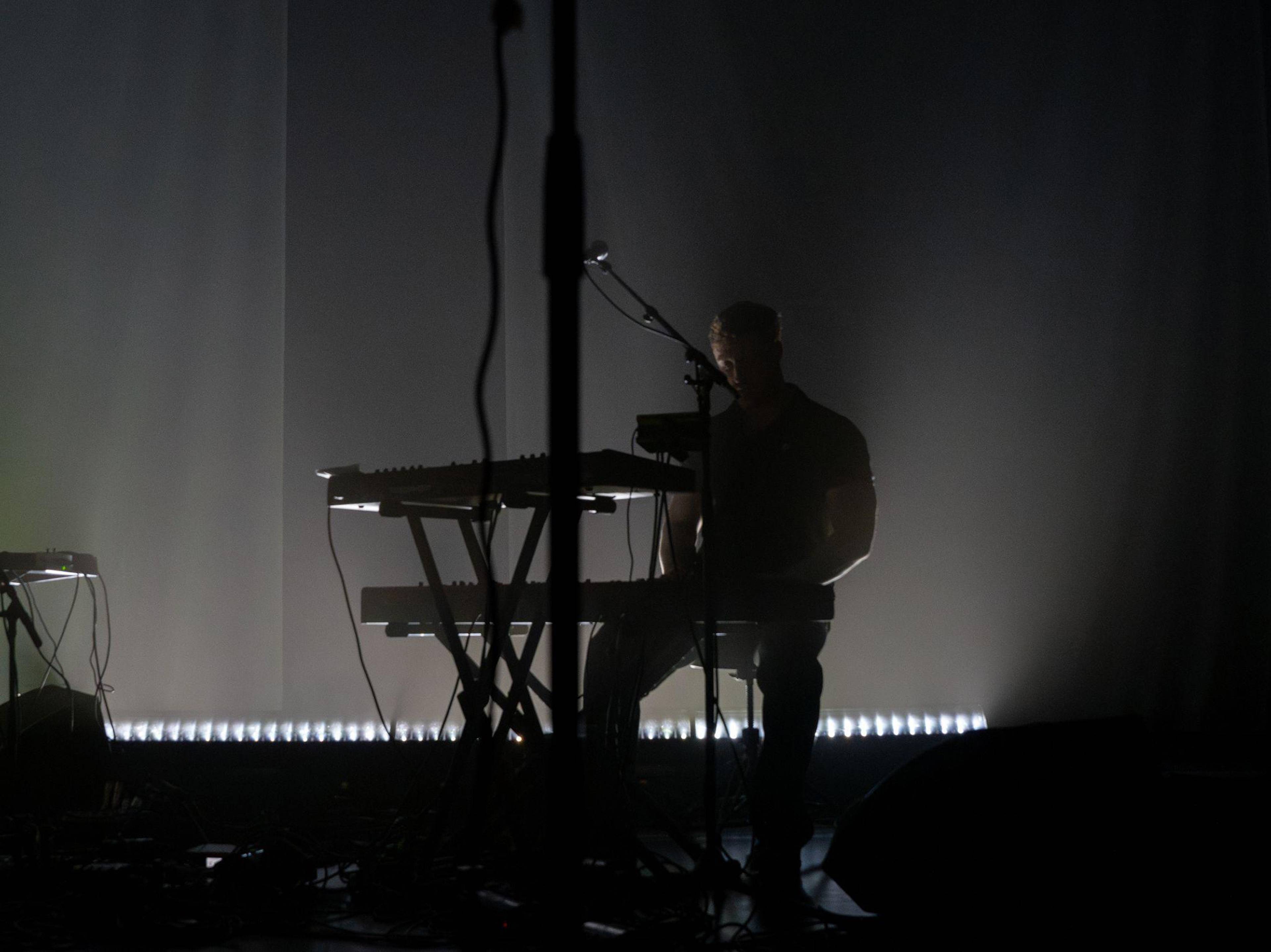
Billy Bultheel performs with 33 at Rewire Festival, the Hague, 2026. Photo: S*an D. Henry-Smith
Andrew: Would you say you’re trying to deliver an ecstatic experience to people?
Ivan: I wouldn’t say that at all. In a 100% non-toxic way, when we put together the recent set, it felt like boys playing around and having fun in a very trad-ish way. It’s not particularly intellectual. It’s not with criticality that we’re playing in religious spaces. We’re doing what we do while letting it spatially transpose or scale.
Andrew: How do you square this “trad boys having fun” element with the new album’s focus on mental health and sickness?
Ivan: I don’t see how one precludes the other. We’re interested in how we’re able to find positions of solidarity with people dealing with mental disorders. I don’t think what’s said in the album press release is at odds with what we’re saying when we’re together.
Andrew: I’m not accusing you of that. I’m just interested in the dark framing of Tripolar. The lead track is called “New ADHD” …
Billy: Back in our recording sessions at Callie’s, we were thinking a lot about how mental states or afflictions could inspire music. That’s where the tracks “Mania,” “New ADHD,” and “Crying” come from. The title of the album came later. We realized the recordings had a sort of schizoid energy – a bipolarity, or rather a “tripolarity.” Something you can never really trust because the style switches constantly.
Alex: I think a lot about the connection between naming and diagnosis. What kind of preconceived notions comes with the act of diagnosis? At the time we were initially recording, I was also making a film. In one key scene, the main character is reading out a medical diagnosis. I think all of us probably have our own – and maybe not super varied – political views about how mental health is framed in contemporary society, or how neurodivergence is discussed. My online feed is filled with it. Everybody thinks more about these things post-Covid.
You’re the boss of me I love you / working is my life – “Mania”
Andrew: If you had to name one musical group that is the biggest influence on 33, who is it?
Alex: For me, Slipknot. Slipknot is interesting because there is spectacle built into having a band that’s nine people. When you look at their live concerts, there are members on stage who also don’t do anything. I like this kind of energy: it’s okay to step aside and let other people have their moment. To just hold a flashlight or scratch a CDJ. Slipknot does it all – they have multiple vocalists, they have auxiliary percussion, they have CDJs, they have dancers. I think the first album came out [Slipknot, 1999] when I was like fourteen. It was big for me. I’m still a fan.
Billy: I assumed that we would all say Coil. They’re an eclectic, gay band that works between industrial and experimental music. Lots of sampling.
Alex: Also, Coil’s proximity to art is important, to artists like Derek Jarman.
Cem: I would have said Coil, too. I’m also hugely influenced by Massive Attack. Production-wise, there are quite a few similarities, starting with the desire for multiple collaborators and guest vocalists.
Alex: And isn’t Robert Del Naja [founding member of Massive Attack] Bansky?!
Ivan: No, he’s not.
Alex: It’s the most solid conspiracy out there about Banksy.
Ivan: Do you not read the news? It was just revealed who Banksy really is. God bless him. Back to influences, I’d say the Japanese pop-punk band Shonen Knife, maybe. Or the Black Eyed Peas. These answers show a bit what we were saying about all being devoted fans of very different things.
Andrew: Last question: How much do you care about pleasing your audience?
Cem: We still have to build that audience.
Alex: I think we do care, but we don’t necessarily always hit the mark.
Billy: So, the conclusion of this interview is we’re cringe and missing the mark?!
Andrew: You tell me!
Billy: I think the problem is that we’re trying to please many different audiences, and therefore we don’t really please anyone. We’re not making nasty house music, or hardcore. We’re in these in between spaces, which we really love.
Cem: A 33 track is never a perfect example of the genre, rather it’s a bastardization.
Ivan: I really do think we’re interested in trying to meet our audience. We’re not deliberately trying to fuck with them. We’re not edging them or trying to torture them with our musical proposition. At the same time, we also didn’t cut anything off the album in the end. There’s no garbage bin.
Alex: This is what I meant when I was talking about “cringe” earlier. We choose to push through musical ideas that we might not like at first, or that not all of us are comfortable with. A band requires a form of acquiescence. You have to take the L sometimes.
Cem: Group transcendence through individual pain.
Alex: Cringe will set you free.
Billy: This is still a huge internal discussion. How pop should we go? This question has been a big part of creating this album.
Andrew: From art band, to punk band, to pop stars?
Alex: Hard maybe.
33’s debut, Tripolar, is available for purchase as a digital album and a limited-edition vinyl from Bandcamp and is streaming on Spotify.