

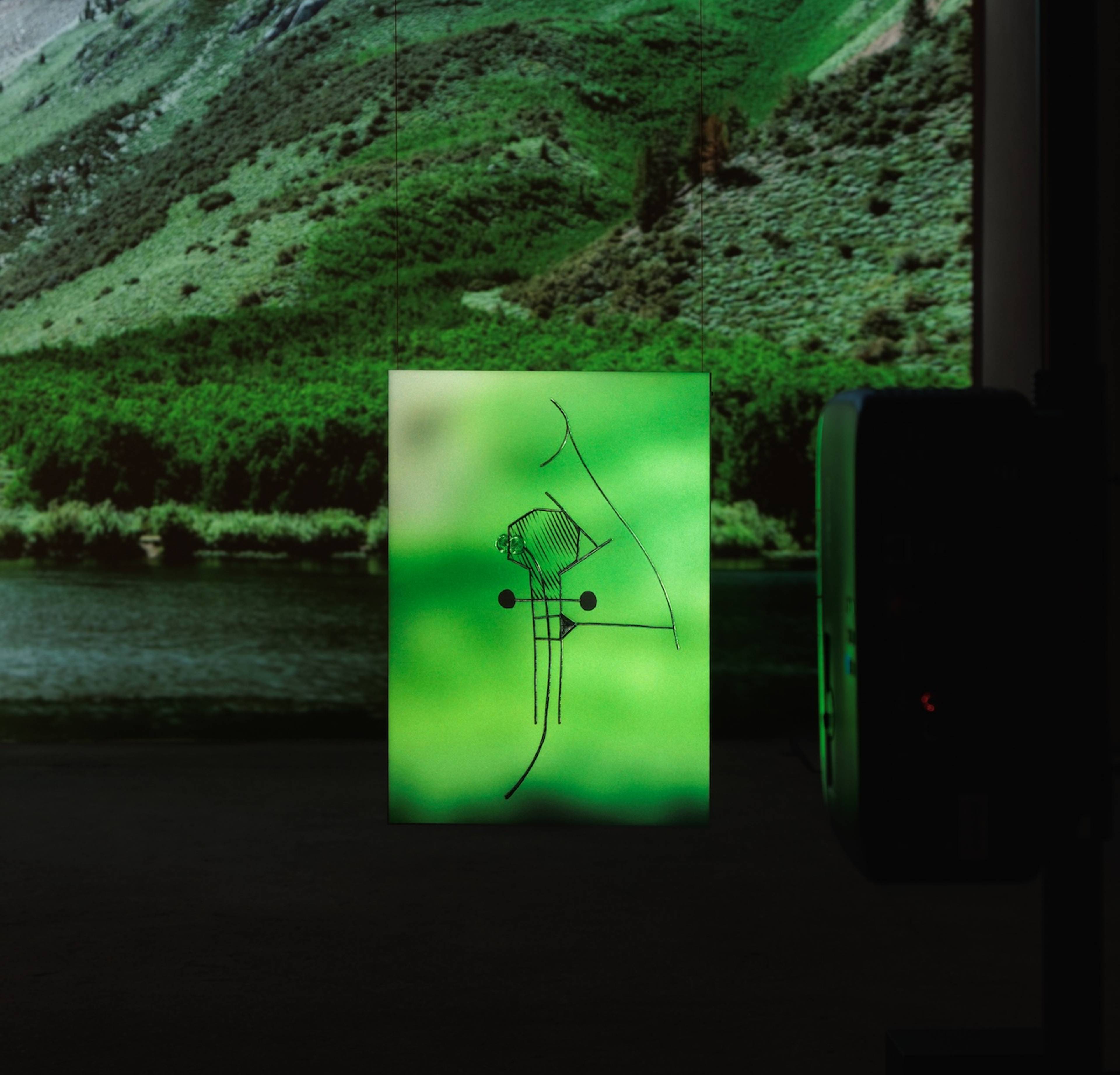
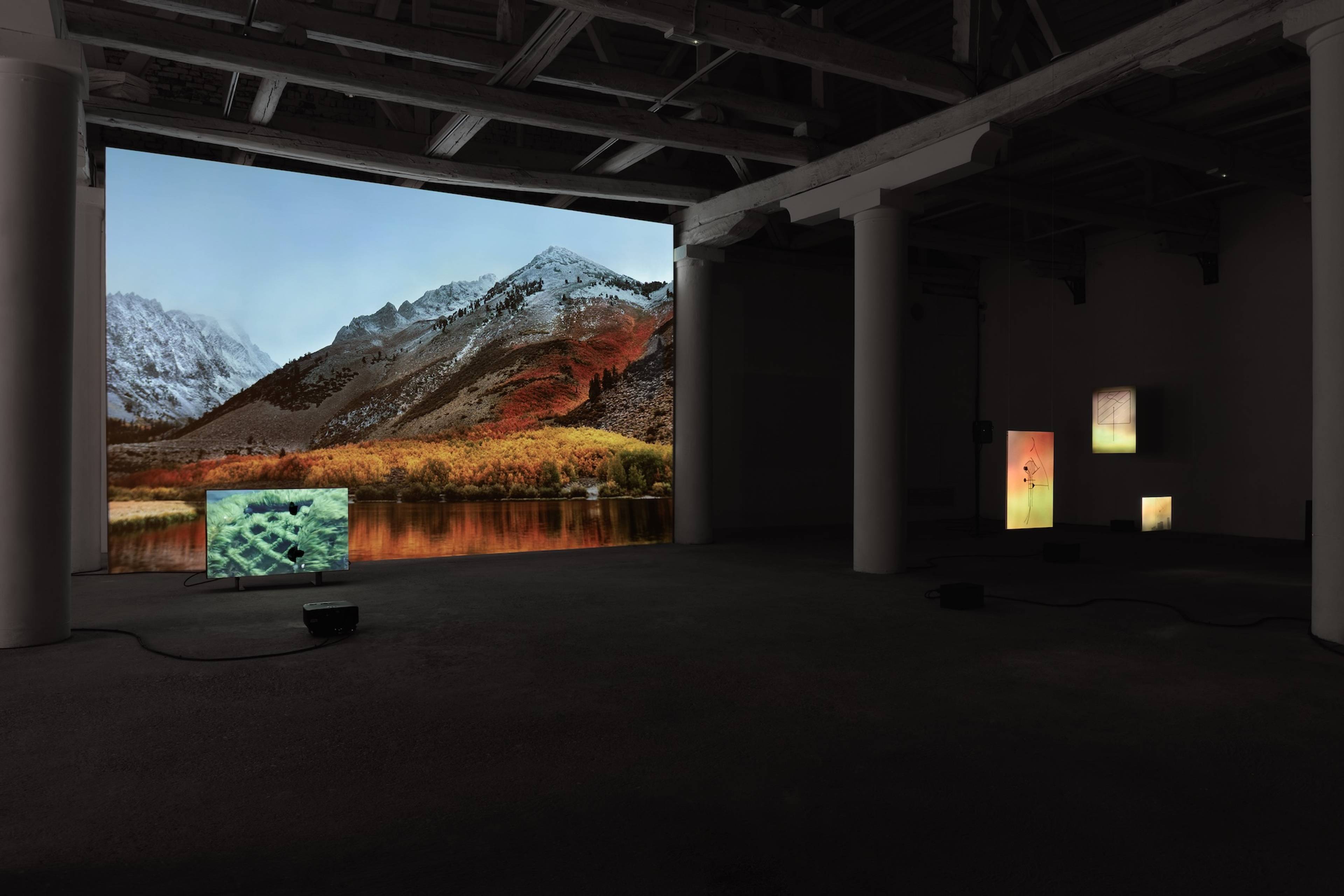
The centerpiece of RedSkyFalls, Alexandre Estrela’s (*Lisbon, 1971) show at the Portuguese Pavilion of the 61st Venice Biennale (2026), is a gigantic screen displaying an idyllic landscape: still water, reflecting bright autumn trees against snow-capped peaks. It feels both familiar and strangely vague, until it clicks – it’s the stock wallpaper from a 2017 Apple operating system, capturingNorth Lake in California’s High Sierra mountains. And, for those who are oblivious to the reference, the cursor is there too. “Pure appropriation,” Estrela jokes. “Just a screenshot of my own computer.”
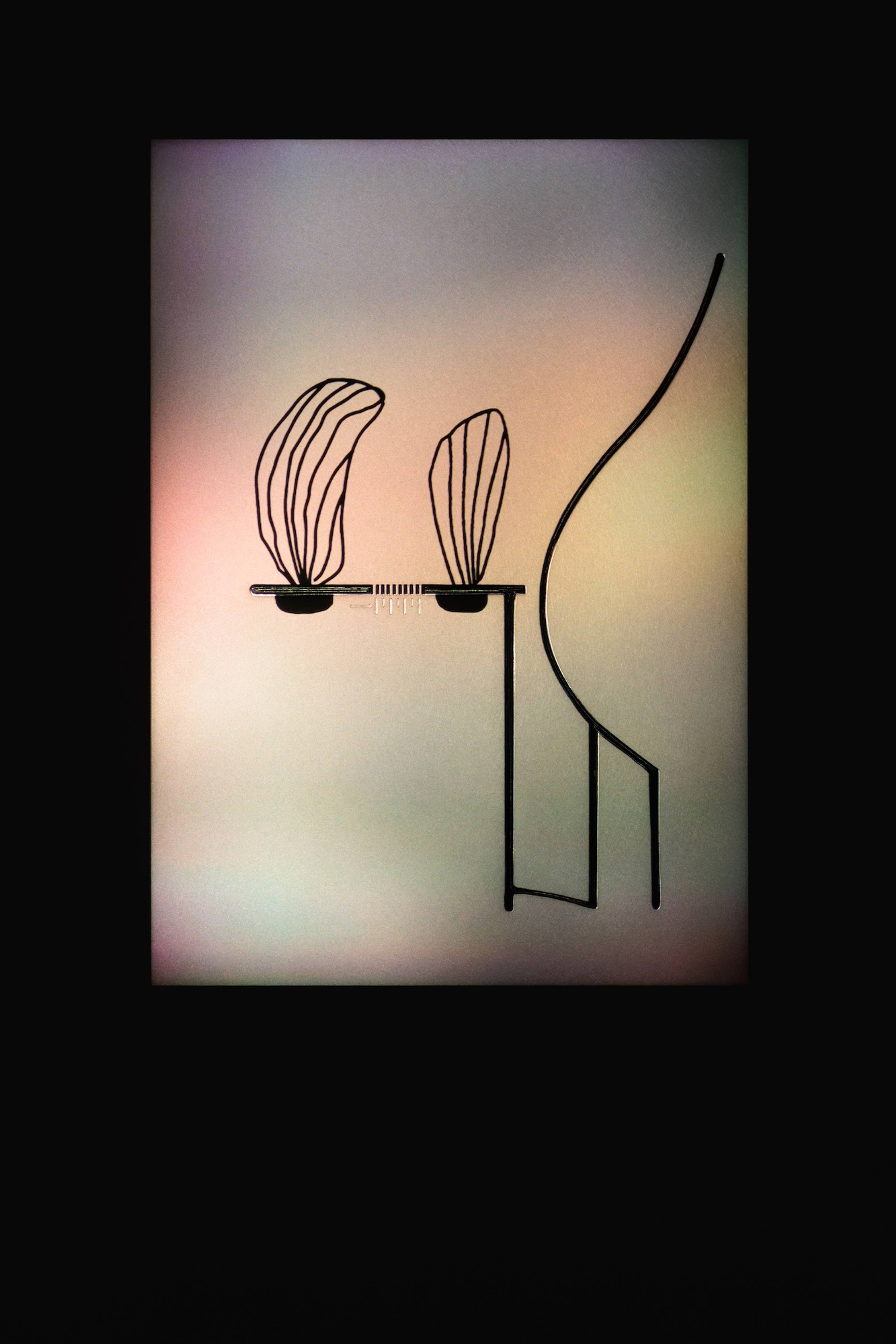
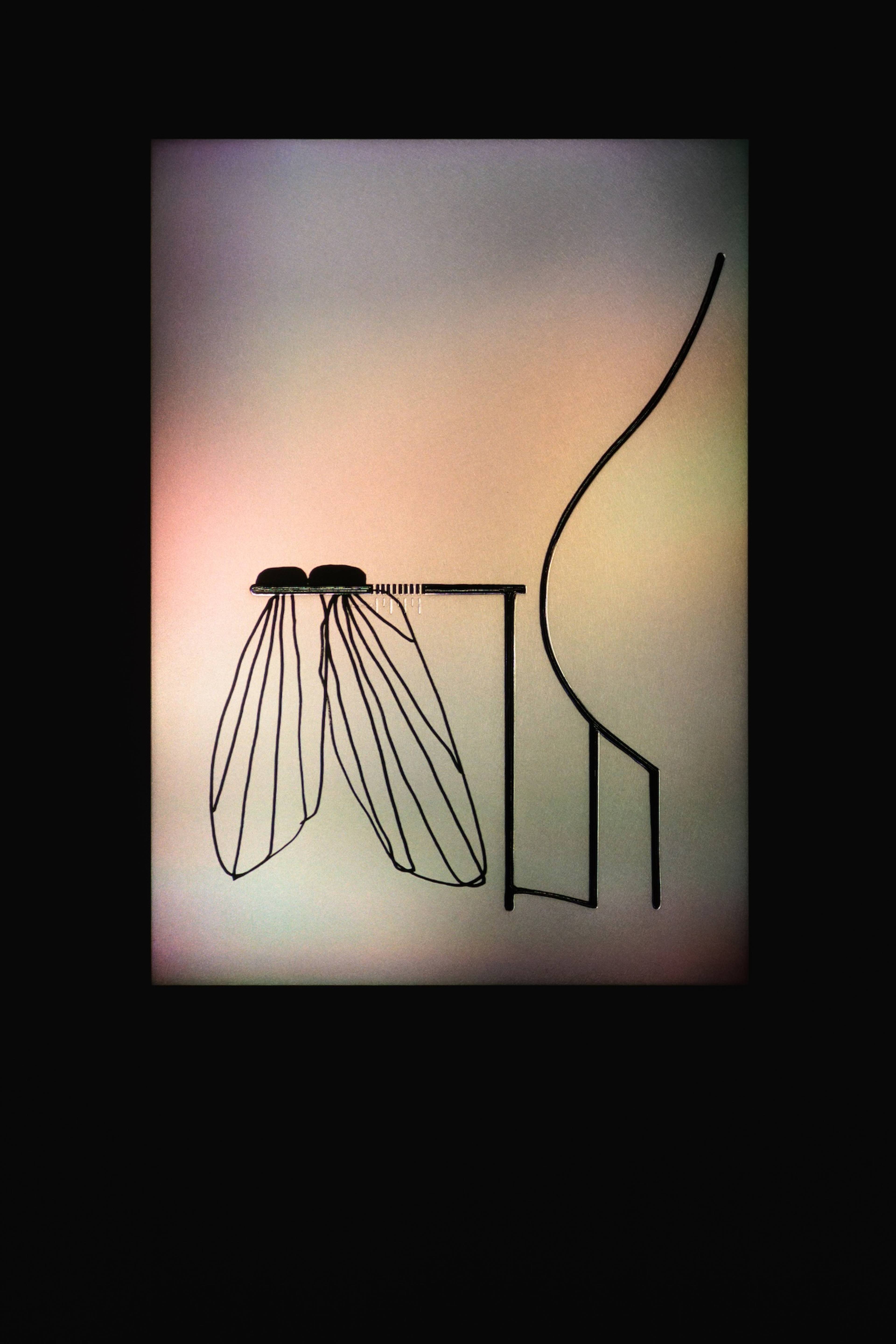
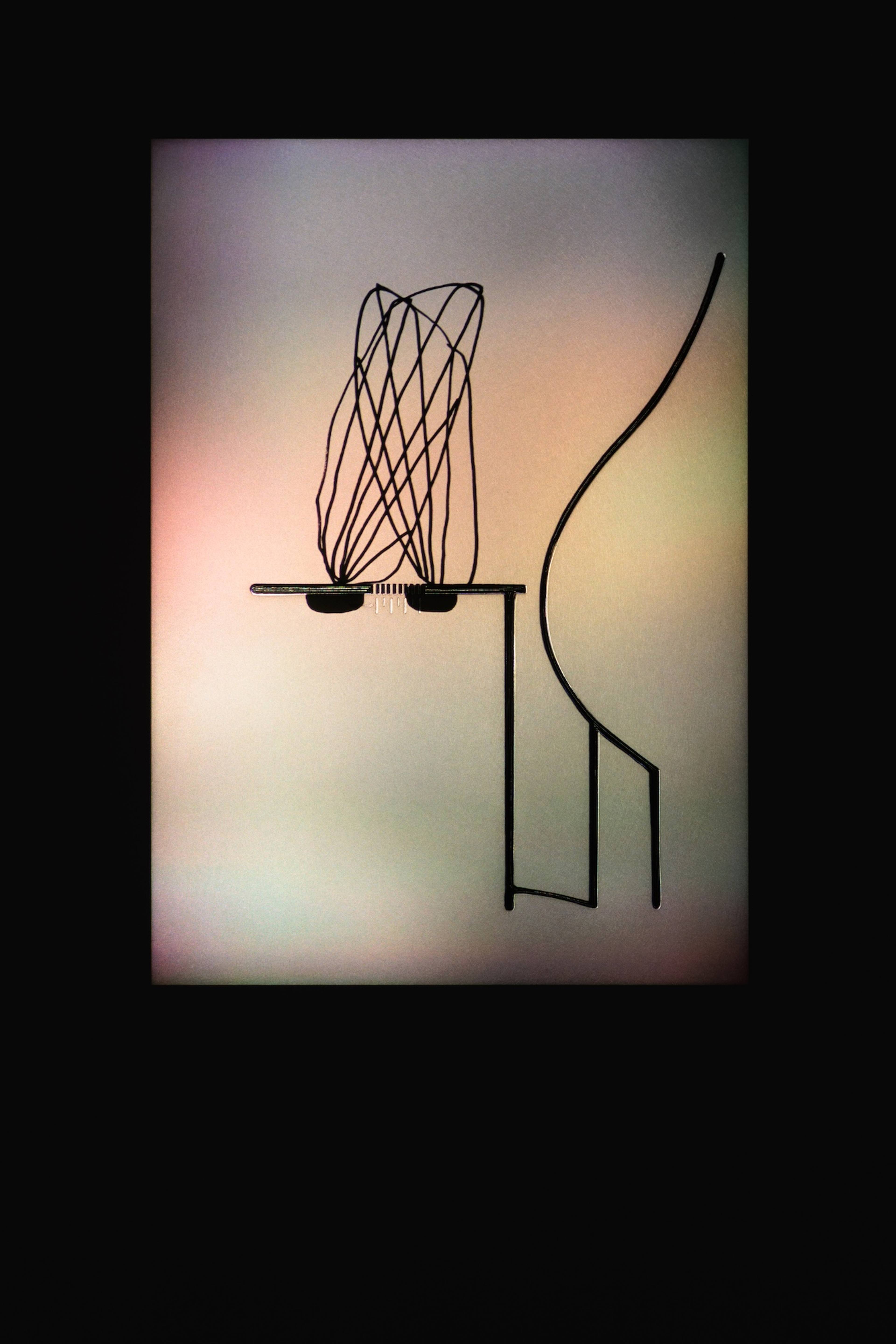
Then, suddenly, an earthquake somewhere in the world triggers a violent burst of sound in the room, and the entire exhibition responds. The season inside the desktop image shifts; autumn is gone, replaced all at once by spring. Distributed around the room are Réplicas: six smaller screens showing digitally animated tiny creatures, sketched with a zany, raw, abstract quality. Though they may not be immediately recognizable as real animals, their movements and behaviors are modeled on data from actual worms, fruit flies, and zebrafish larvae, moving to the earthquake as they would in nature.
Throughout the Venice exhibition, Réplicas will be shown in cities located in seismically active zones: San Francisco, at CCA Wattis Institute; Los Angeles, at REDCAT; Lima, at the Lima Art Museum; Mexico City, at the University Museum of Contemporary Art; and in Lisbon, at Galeria Zé dos Bois. Projected onto an aluminum panel, each of these animations will float free of the context of RedSkyFalls and create a perceptual ambiguity: are we watching a representation of an earthquake, or experiencing its actual physical effects?
Clara Drummond: What made you decide to put a stock wallpaper at the heart of the exhibition?
Alexandre Estrela: Microsoft was the first company to grasp that the ancient practice of gazing at the sky might translate well into a computer screen, which is itself a kind of window. Anyone who used a PC in those years remembers the default wallpaper of Windows XP, Charles O’Rear’s iconic photograph of a green hill beneath a blue sky [Bliss, 1996]. Steve Jobs, who was himself an amateur photographer, brought a similar sensibility to Apple. And with these two companies, a vision of a certain American landscape, almost paradisiacal, hardened into a visual trademark. In RedSkyFalls, the enlarged High Sierra desktop image tweaks the logic of the Romantic sublime. What we face is a stereotype, and at this scale, it becomes immersive and overwhelming: a landscape image we seem to inhabit, like the small figures in Caspar David Friedrich’s paintings.
CD: There’s something ironic about it, looking at supposedly raw nature through a screen.
AE: There was a paradigm shift during the 16th century, when it was declared that there were no more lands left to discover, specifically within a European perspective shaped by colonial expansion and territorial conquest. The idea of the “last frontier” emerged in the American continent. Previously, paradise on earth tended to be represented as a cultivated garden or orchard; then, particularly after the genocide of Indigenous populations, it became associated with wild, unspoiled nature. Paradise was never simply “natural,” but always shaped by historical projections.
Since as early as the 19th century, landscapes like California’s High Sierra have been instrumentalized, imagined as territories of regenerative wilderness, where the modern white man could rehabilitate the virility weakened by urban industrial life.
CD: It’s a perverse kind of propaganda.
AE: Yes! Since as early as the 19th century, landscapes like the High Sierra have been instrumentalized, imagined as territories of regenerative wilderness, where the modern white man could rehabilitate the virility weakened by urban industrial life. In the US, the creation and expansion of national parks in the late 19th and early 20th centuries often relied on the displacement of Indigenous peoples, whose presence complicated the fiction of untouched nature. To follow the line of argumentation of Eduardo Viveiros de Castro, the Brazilian anthropologist: the moment they put on a pair of jeans, an Indigenous person ceases to be recognized as such, and therefore loses the right to their land. The authenticity demanded of them is a trap, an exterior construction that freezes them in time, in order to preserve the myth of natural purity. But you are right to mention the perversion of the image: this depiction of unspoiled nature means, in fact, a digital landscape powered by a tremendous expenditure of energy, an environmental disaster multiplied across millions of computer screens.
CD: A very loud sound breaks out in the Portuguese Pavilion the moment an earthquake occurs. What’s the technology behind that?
AE: The piece uses data retrieved in real time from agencies that track global seismic activity. An earlier version of the work drew from the United States Geological Survey, but budget cuts under the Trump administration made these resources inaccessible, so that, until we switched to European agencies’ output, the piece fell briefly silent. Seismic activity is erratic by nature, and is among the hardest things to predict: the planet is continuously shaking – there are, on average, two or three earthquakes per hour – but sometimes, thirty minutes go by with nothing happening. The system proved its responsiveness during the press conference for RedSkyFalls in Lisbon, when a 5.5-magnitude earthquake in the Indian Ocean startled the audience and made the conference nearly inaudible.
CD: Does your work take on new meaning as far-right governments cut funding for arts and science?
AE: I really see my work as a form of artistic investigation, not so different from scientific research; I don’t illustrate the world. There is a propagandistic pressure on artists to become illustrators, which I find difficult to tolerate. I am at the Venice Biennale through a state-funded competition, and I believe basic artistic (and scientific) research should be publicly funded, though I am not opposed to private support, so long as that’s done without constraints. In the US, conceptual artists were once sustained through the university system, which employed them to teach. But that structure is crumbling, and there is less and less room for art that is truly independent of the market. Making curiosity-driven art in the current political environment is a form of resistance.
CD: What’s the role of the animations on the smaller screens – what you called Replicas?
AE: I’ve always been drawn the pursuit of a new visual language through rhythm, of organic movement through abstraction, as in the experimental animations of [German Dadaist] Hans Richter, or of [New Zealand kinetic artist] Len Lye. I wanted a different kind here, one in which movement is drawn from real animals; the data is provided by behavioral neuroscience laboratories, including the Orger Lab [Champalimaud Centre for the Unknown, Lisbon], the Straw Lab [Institute of Molecular Pathology, Vienna], and the Murthy Lab [Princeton Neuroscience Institute]. Working from drawings of mine that vaguely resembled creatures, with parts suggesting eyes, tails, or wings, I began to imagine bio-engineered artificial sentinels. The result felt so alive that I went further, imagining for them different inner states, like before, during, and after different threats – in this case, of an earthquake.
CD: How is it possible that animal behavior can serve as a reliable seismic indicator?
AE: The idea of predicting earthquakes from animal behavior has existed for thousands of years. In the 1960s and 70s, particularly in China and Japan, this empirical tradition was systematized by scientists who used animals to monitor seismic activity. They observed and recorded deviations from normal behavior, then compared these deviations with the seismic-activity record in order to look for correlations. However, the problem with this type of research is that it relies heavily on a subjective interpretation of what may or may not constitute anomalous behavior. Even so, in 1975, there was the famous case of Haicheng, east of Beijing, where this type of prediction proved successful, and approximately ninety thousand people were evacuated before the main tremor.
CD: A big mark in Portugal’s history was the earthquake that occurred in 1755. Does your work have some connection with it, and with that moment in history?
AE: The earthquake happened during the Enlightenment, and for many thinkers, including deeply religious ones, explaining it as divine punishment was simply unacceptable. Framing disasters as “natural” phenomena effectively exonerated God and rulers alike, and demanded empirical explanations instead. That rupture between nature and religion is really only visible in retrospect, probably as more of a historical simplification than as a clean break – the era was full of contradictions, myth, science, and para-science all tangled together. There’s also something very Portuguese about how central the earthquake remains to collective memory: any Lisbon tuk tuk [auto rickshaw]guide will bring it up with a kind of historical pride, despite all the tragedy.
___
Alexandre Estrela
“RedSkyFalls”
Portuguese Pavilion of the 61st Venice Biennale
9 May – 22 Nov 2026