
David Claerbout (*1969), the Belgium-born new media artist, is an artist with whom I have always felt a strong kinship, mainly in that both of our practices center the matter of time. I recently traveled to Luxembourg to see “Five Hours, Fifty Days, Fifty Years,” a comprehensive exhibition of his work organized by the Konschthal Esch, that allows for a very generous encounter with his oeuvre. The show looks in depth at David’s relationship to the image and to representation-through-images, as well as to questions of vulnerability, absurdity, and duration, thematized and narrated in works that enmesh a highly photographic register within digital constructions of reality.
Julieta Aranda: I’ve been trying to look at your exhibition’s gestures, or how the installation is ordered, in terms of time. I don’t mean chronological time, but rather in the sense of how time becomes a material in your work. I want to approach this conversation from that angle, which is already there in the title of the show: “Five Hours, Fifty Days, Fifty Years.”
David Claerbout: With a whopping 2,500 square meters at our disposal, we decided to fully lean into this abundance, not just spatially, but temporally as well. I did something quite unorthodox by accepting co-curator Ory Dessau’s proposal to show some of the works twice. That meant compromising projection quality in some cases, because every duplicated work effectively doubles the budget. The effect is uncanny: two floors that look almost identical. Visitors walk in, and go: “Wait, didn’t I just see this?” before doing a U-turn and heading back out, while in fact they’re actually five hours later in film time. That was at the heart of our approach: generous space, generous time.
JA: How many works did you double?
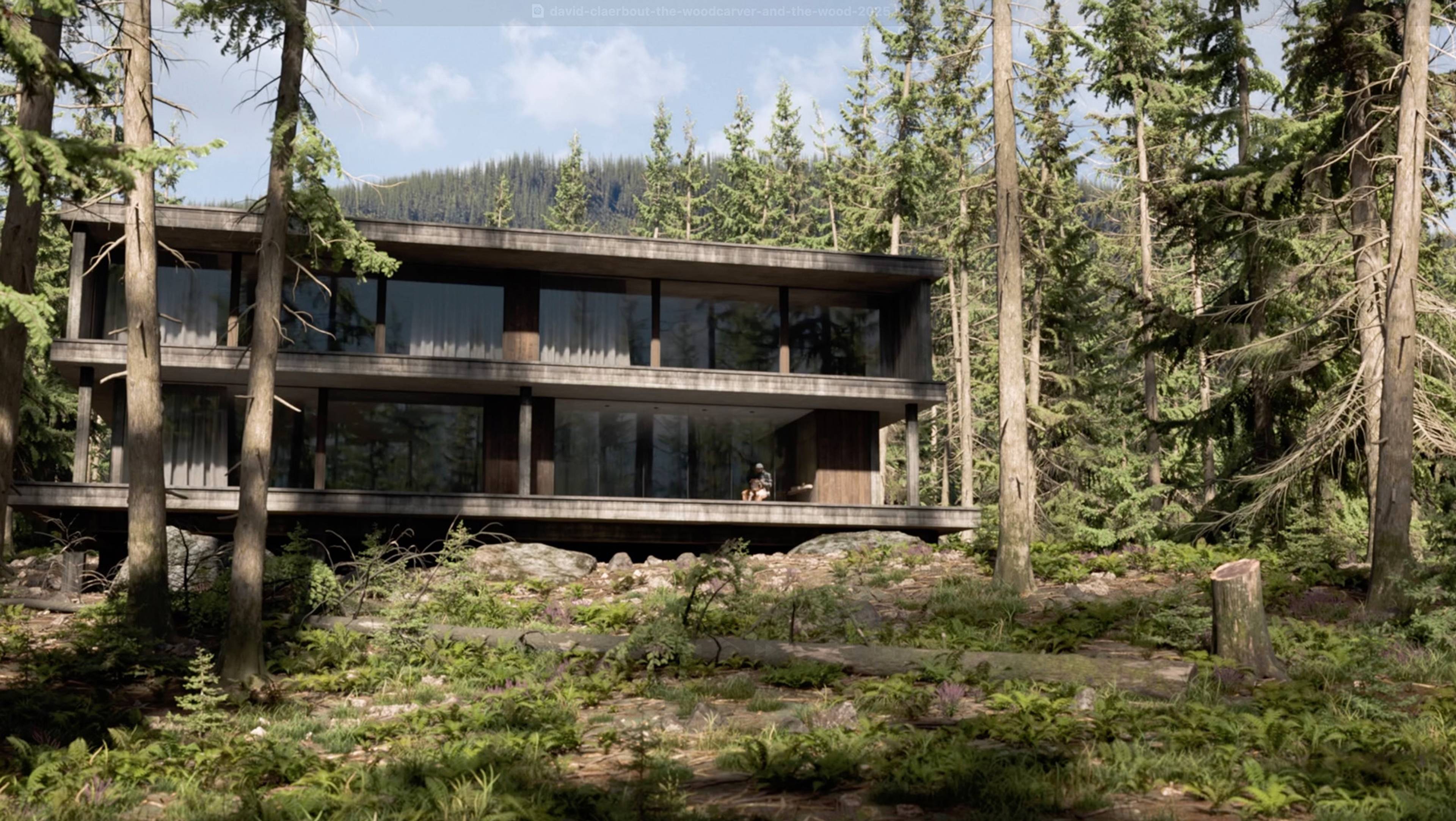
DC: I think about four of the roughly fifteen works being shown: Bordeaux Piece (2004), Olympia (2016), Backwards Growing Tree (2023), and The woodcarver and the forest (2025), all works in which I have engaged with extreme duration.
For me, this was very experimental. I probably wouldn’t permit myself to do this in another context, but here, I felt free to play. We didn’t conceptualize it too much at first, but I came to see it as an opportunity – a chance to unsettle chronological time. The best way to do that is to pretend you’re cooperating with it – to create the impression you’re aligned with it – because the truth is, we’re trapped inside it anyway.

Olympia (The real time disintegration into ruins of the Berlin Olympic stadium over the course of a thousand years), start 2016, two-channel real-time projection, color, silent, HD animation, 1000 years
JA: I see a particular relationship between Olympia (The real time disintegration into ruins of the Berlin Olympic stadium over the course of a thousand years) and Backwards Growing Tree – when they are placed together, something else emerges. Of course, you don’t expect anyone to watch them for their entire duration [editor’s note: Backwards Growing Tree is five years long, Olympia one thousand years]; that’s not the point. They’re moving images, and the moving image is time. Not just because there’s a beginning and an end, but because with these particular works, there is no real possibility of a loop.
Backwards Growing Tree is five years long; is the tree it five years old?
DC: Actually, I suspect it’s much older. When I found the tree in Italy while hiking several years ago, I spent about fifteen minutes with it and never went back. I had been looking for the tree for many years. When I found it, I knew it.
The tree is slightly malformed, because it grows on a hill, exposed to the wind; the climate there is harsh. It looks forever-young because it has a hard life – it’s always shredding branches. While I was looking at it, one suddenly snapped, which sparked the idea to recreate it in the film. But of course, what is central here is the absurdity of waiting to detect changes in a tree.

The woodcarver and the forest, 2025. Installation view, Konschthal Esch, Esch-sur-Azette, 2025. Photo: Christof Weber
JA: There’s something similarly absurd in Olympia, about waiting one thousand years for Berlin’s Olympic Stadium to turn into a ruin. But beyond its inherent absurdity, something I find very poignant is that the works have opposite temporal flows: Olympia moves towards its end; Backwards Growing Tree moves towards its beginning.
DC: I noticed that the interest in the work is related to the perception of time in the place where it is shown. In some contexts the perspective was distinctly Western: owning, appropriating time; elsewhere, the work resonated with a more Buddhist view of time as cyclical. Same piece, different readings.
My secret pleasure was imagining a collector who is, let’s say, seventy years old when he acquires the work, and seventy-five when the work “ends.” The uncomfortable question then becomes: “What did I do in those five and a half years, apart from growing older?” After all, I only gave him a slowly shrinking tree. It’s a bit like The Picture of Dorian Gray (Oscar Wilde, 1890).
It’s a very discreet work. Only at the very end do you discover that the film has been running backwards. None of the visible phenomena – the wind, the clouds, the rain – give this away. But after five years, when two figures arrive and pull the tree out of the ground, one realizes that they were planting it.
I try to let the images have several narratives, instead of having power over a single, final one. And this is, of course, futile – completely utopian.
JA: Looking at your works together, there is a sense of vulnerability in your subjects. In earlier works – The Stack (2002), Sunrise (2009), Oil workers (from the Shell company of Nigeria) returning home from work, caught in torrential rain (2013) – this vulnerability is anchored in the human subject, and it hints at social inequalities. Then, in later works, the environment begins to creep in. The vulnerability extends beyond the human, both in terms of non-human beings and of the environment. And yet, it is always people that produce these vulnerable conditions. I don’t know if “political” is the right word to describe this, but there is something that has to do with justice or ethics or balance, that I could feel moving through the exhibition.
DC: Yes. And that’s where the question of representation becomes unavoidable. If I think about The Stack, there is a glorious interplay of light unfolding around this homeless person that is sleeping in the darkness of the foreground. The critique is always: “There is this comfortable Belgian artist, glorifying the sublime beauty of the light, just like 18th- and 19th-century landscape painters would have idealized the peasant with the cart and the cow …” I’ve never believed we have that kind of power over the image. Personally, I feel I should try to approach the motifs in an image as if I was its caretaker, and I try to let the images have several narratives, instead of having power over a single, final one. And this is, of course, futile – completely utopian. These works are exercises in beginnings, and perhaps little more than that – the political component is real, but it’s not everything, and more often than not, it remains in the background.
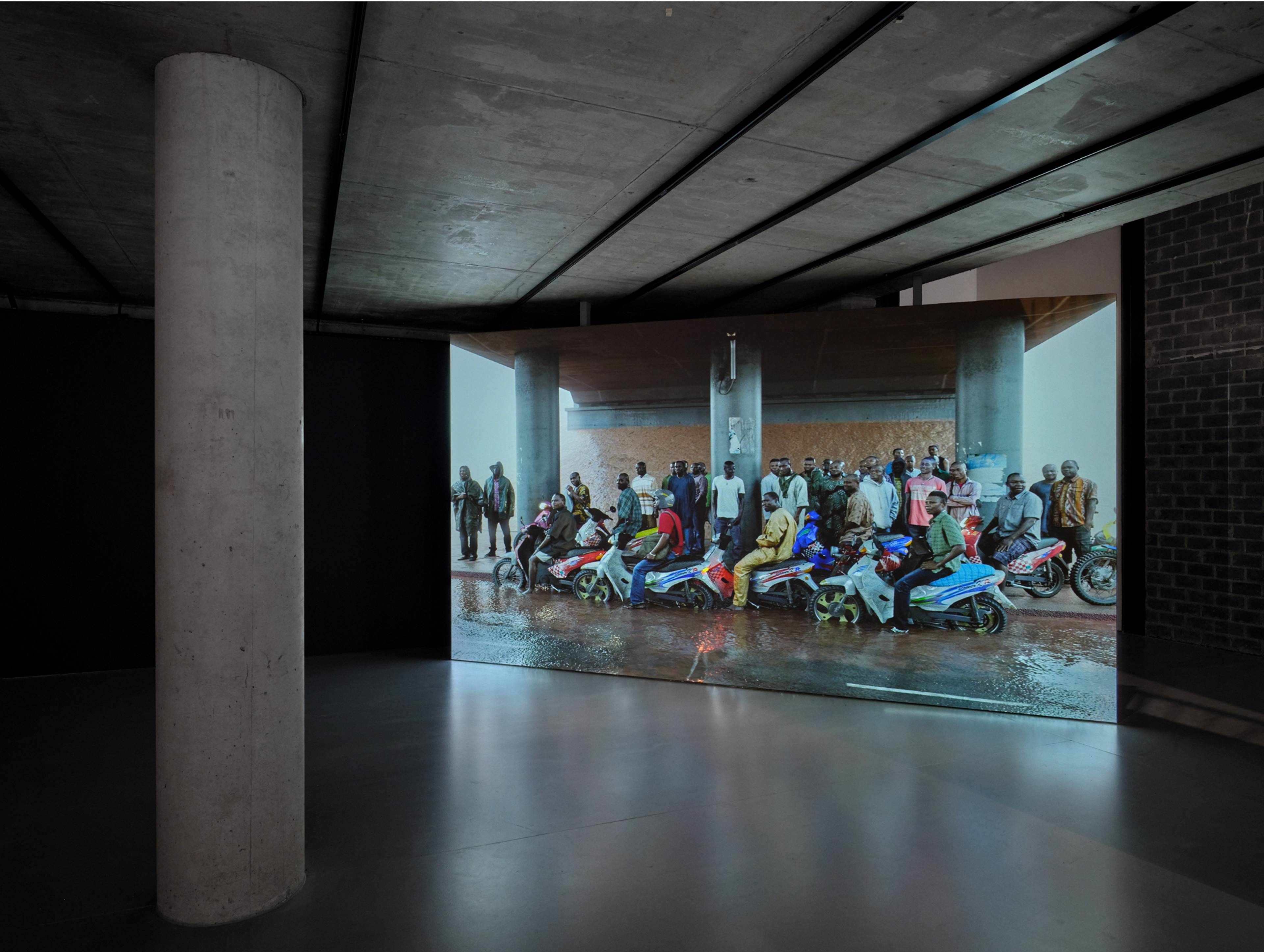
Oil workers (from the Shell company of Nigeria) returning home from work, caught in torrential rain, 2013, single-channel video projection, HD animation, color, silent, endless
JA: How do you put together “being a custodian of the image” with how time plays in your work?
DC: Well, I don’t believe in the arrow of time. I think it’s a very convenient proposal – our technology is built around it – but it’s still a fallacy. There’s a reason why I work with images that appear to be photographic. They inspire trust – you think you know how to relate to them because you know the apparatus. Yet I treat the surface of the image as a world that ultimately remains inaccessible to us. When you go to an exhibition, you look at images, and become absorbed by them. I always insist on introducing something into the images, so that, sooner or later, you realize there is something artificial about the proposal. I belong to a school of thought that insists: these are representations. They tell us something about our time, but they are unable to carry us away.
JA: But even if you don’t believe in the arrow of time, it plays a role there, doesn’t it?
DC: Time is the only real encounter, even if it often happens with a delay. It may even be necessary to go home, leave the exhibition, and only then allow the work to reach you. I try to resist the call to deliver emotions on the spot.
What is much more important to me is the missed encounter. Sometimes it’s literal. The woodcarver, for example, places you inside a building, and it’s quiet; then, it moves outside, where it’s sunny and the air is full of birds. You’re always meeting the character in an “off” timing. It can be frustrating, but it’s deliberate.
JA: I would like to hear about your relationship with digital imaging technologies, and how you use them to present transformation and decay.
DC: Digital decay is a subject that interests me a lot. The digital – and its relatives, the virtual and software – are bound together by the same promise: the promise of an immaculate future. A future that cannot be destroyed, only updated. It’s one of the last remnants of modernity.
Yet I keep wondering what’s behind this promise. Is it a willingness to let go of matter, dirt, weight, history? Are we ready to turn around and tear all of that down? The shift from hardware to software – does it really make life lighter? Or is it destructive? It’s very difficult to answer this question. Whatever you say, you’re probably partly wrong. That’s why I work with motifs like the Olympic Stadium – you know where it is and what it is, it’s heavily inflected with political significance – or deliberately simpler ones, like trees.
We still lack a culture of thinking about aging in software or virtuality. Everything is constantly covered up by updates. Yet digital ruin is already there – we just don’t want to see it.
There’s a reason why I work with images that appear to be photographic. They inspire trust – you think you know how to relate to them because you know the apparatus. Yet I treat the surface of the image as a world that ultimately remains inaccessible to us.
JA: You sometimes see it in museum acquisitions, of works made for Netscape or for Flash. How do you preserve something that no longer runs?
DC: Exactly, the reality of digital technologies is that they are in transition. When I was young, I was thinking about digitizing memories. Was it to remember better, or to forget better?
At one point, I began seeking answers in biology. Technology, of course, follows money, but it also echoes our understanding of the nervous system. When the recent AI wave hit, I was initially skeptical. Later, I found myself impressed by the analogies between artificial intelligence and neuronal processes. That’s quite genius.
I recently reread a passage by psychiatrist and philosopher Iain McGilchrist on the brain and language. He argues that our political systems and digital binaries mirror an imbalance in how we attend to the world: a tilt toward focused, manipulative attention at the expense of wider, contextual awareness. Whether metaphorical or not, that idea has guided much of my work – this tension between caring for organic life and immersion in digital systems.
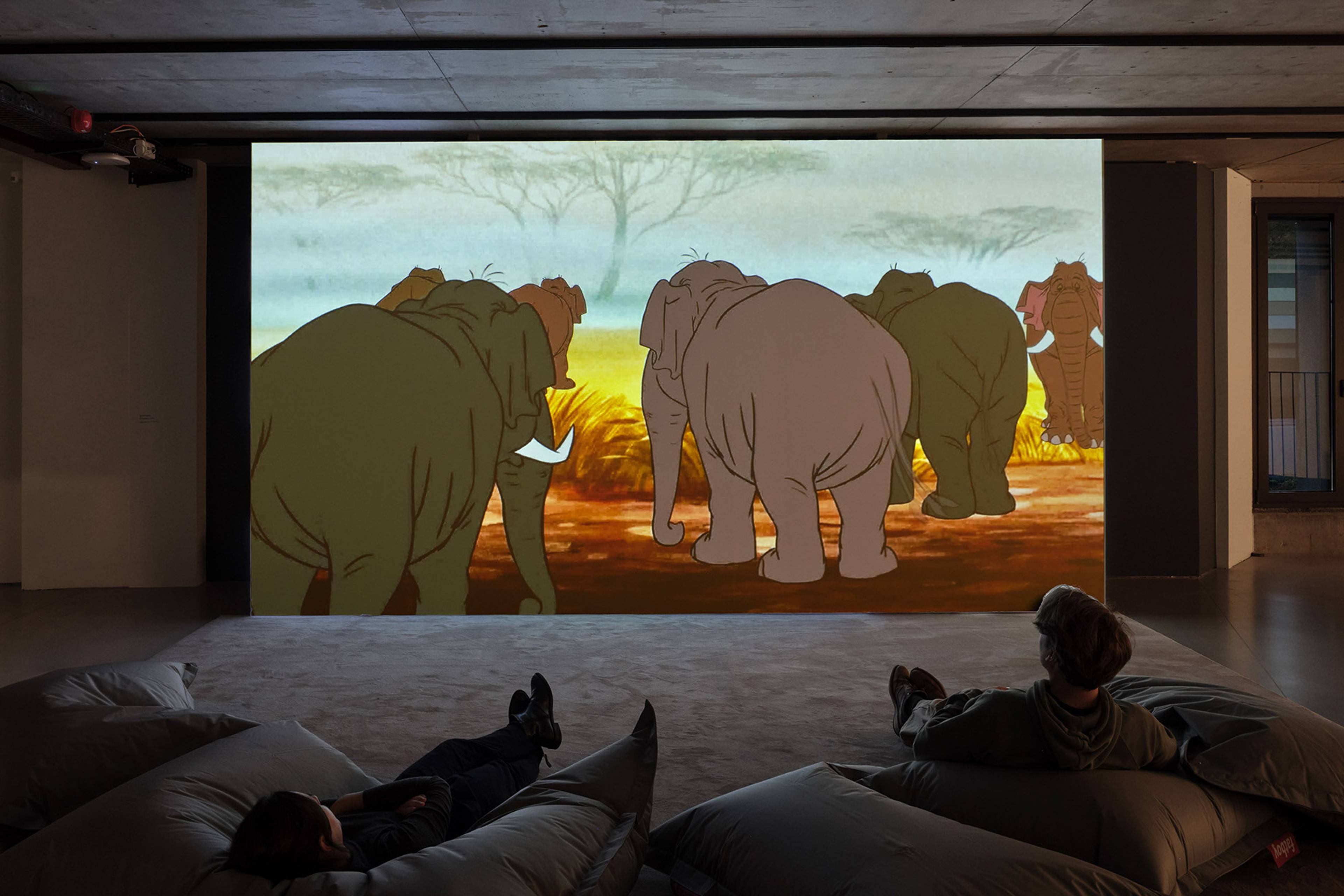
The pure necessity, 2016, single-channel video projection, 2D animation, color, stereo audio, 50 min. Installation view, Konschthal Esch, Esch-sur-Azette, 2025. Photo: Christof Weber
JA: I want to move toward forests, because of how they recur and are transformed throughout your work. Seeing them together, I was struck by the transformation from one forest to another. In The woodcarver, a living forest becomes a forest of spoons. You never directly show the former being chopped, yet the progression is clear.
DC: I’m very interested in the background. In Disney’s The Jungle Book (1967), the budget went into animating movement, creating animals that could behave like humans, while the background artists were forced to reduce the forest or jungle into a handful of repeating motifs.
That contradiction – a jungle built from poor, recycled trees – fascinated me. For The pure necessity (2016), we used an algorithm that erased all the human traces, and kept the background. It worked precisely because the vegetation is endlessly repeated. It felt like a living metaphor: the background, time and again, is always the one being sacrificed.
Industrial forests are another example. They look efficient, but they are fragile, like chickens in a factory farm.
JA: That difference in time registers came up for me too – like the idea that, unless we share the same temporal scale, we can’t recognize another form of life.
DC: Exactly. We constantly construct the world we live in: at least half of what we observe is what we project. That’s why images are so powerful – and so dangerous.
The digital – and its relatives, the virtual and software – are bound together by the same promise: the promise of an immaculate future. A future that cannot be destroyed, only updated. It’s one of the last remnants of modernity.
JA: Thinking about The woodcarver, the introduction of man-made tools felt significant. There’s a pleasure there, but also something disturbing.
DC: In a way, it’s like an ASMR video. They promise restoration and healing, but they are actually industries of extraction: you’re meant to feel good while something is being consumed. Something similar happens with The woodcarver and the forest. There are moments in the film where you see thousands of spoons, and the woodcarver turns into a kind of serial killer. The work is not about pointing a finger; it’s fully complicit in the destruction. Plus, I consume your time, and I spent plenty of money while making that film. The point is to let it grow slowly on the viewer – until you realize that pleasure and destruction were tangled together all along.
This was also my first, subtle use of generative AI. We designed parts of the imagery with AI, filmed traditionally, and then fed the material back into AI systems. The artificiality approaches quietly; you only see it if I want you to see it. It’s too early for me to say exactly what The woodcarver will become for me, but I know I didn’t want spectacle.
JA: I also noticed that there are a lot of birds in your work – heard more often than seen.
DC: People often ask me if I know a lot about trees or birds. I actually try not to. I don’t want to master them. The dream is not knowledge, but attention.
Birds are a bit of a provocation. What narrative can you expect from them? Somehow, my remaining ambition is to be remembered as the artist who exchanged narrative for bird sound.
JA: To wrap up, I want to talk about The Close (2022), where I see you return to the very vulnerable human subject of your early films, but this time, with a sense of historical perspective.
DC: The Close has a lot to do with the history of the camera. I wanted to make an untraceable transition between the beginning and the end of the technology of the camera lens, while also thinking about how to deal with an image in all its extensions. How could I work with a small child, not just dealing with the image of the child, but to actually care for the child himself, which is the desire that comes to the surface. Even more pathetically, it’s a silent film about a poor child, somewhere in the 1910s, where poverty becomes a kind of muteness: no money, no voice, as voting voices were only for the upper layers in society. At the end – knowing people might accuse the work of nostalgia – the film is carried by the music of Arvo Pärt, which makes it sound like a beginning. But these visual metaphors belong together: voicelessness, light, care. The moment you have an image, you have light, you have a future.

David Claerbout, 2024. Courtesy: Studio David Claerbout
David Claerbout
“Five Hours, Fifty Days, Fifty Years”
Konschthal Esch
, Esch-sur-Azette, Luxembourg
18 Oct 2025 – 22 Feb 2026