

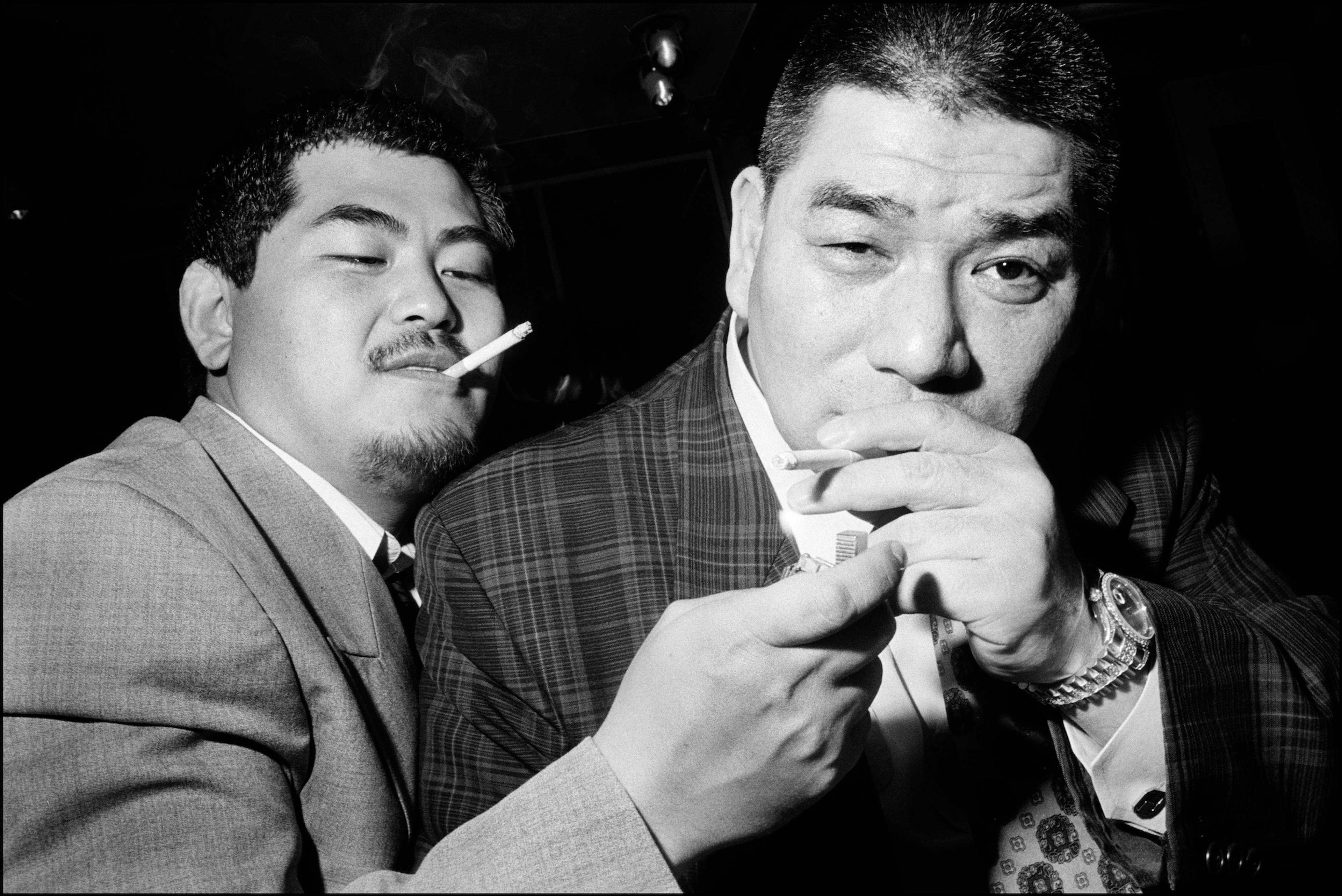
Like him or not, Bruce Gilden (*1946) has spent nearly six decades doing what most photographers wouldn’t dare: getting as close to his subject as humanly possible. His exhibition “Why These?” now on view at Fotografiska Berlin, gathers forty-one pictures selected by the artist, spanning his early black-and-white street photos through his more recent shift to large-format digital color images. The first thing Bruce said to me when I entered his sunny, plant-filled home in upstate New York, where he lives with his wife, Sophie, was, “I’m not in the mood.” The second thing he said was, “You look like a Democrat,” while arresting me with a puckish smirk. We spoke about the creative potential of the body’s limitations, whether confrontation can be its own form of empathy, and why street fighting is the perfect analogy for making his best work.
Danielle Ezzo: You’re known for your physical approach to shooting. Is that still true at age seventy-nine?
Bruce Gilden: Look, you have to live. There are changes that one makes, okay? I can’t do what I did at forty or fifty – it’s just impossible. Even though I can still walk the streets and everything, I’m not as fast. I can’t bend as low.
You have to be smart enough to know what you can and can’t do. Plus, you can’t do the same kind of work forever – even if my pictures look similar, they’re not the same, because I’ve adjusted my ways of working. If you look at certain people – I’m not going to mention names – some people, who are very good, keep doing the same exact kind of work [over their career], and it’s just not as good. You lose the passion, you know?
Early in my career, I read a comment: when you photograph with love, you can do it your whole career. That’s bullshit. I’m a competitor, and I like to compete, even when I can’t anymore. I’m not going to be like the old boxer who comes back and gets knocked out; that day hasn’t come yet. I can still do it.
Working the Mixed Martial Arts (MMA) fight at the White House for GQ the other day was like photographing with my hands tied, because you couldn’t use flash, and you had to be in a designated area. I had only a 28mm lens and a 35, and obviously, without wearing my glasses, I don’t see as well. But I often don’t use my glasses when I shoot, because it happens so fast. You just can’t focus and see at the same time. It’s not what you’d expect of me, but I got a couple of pretty good shots.
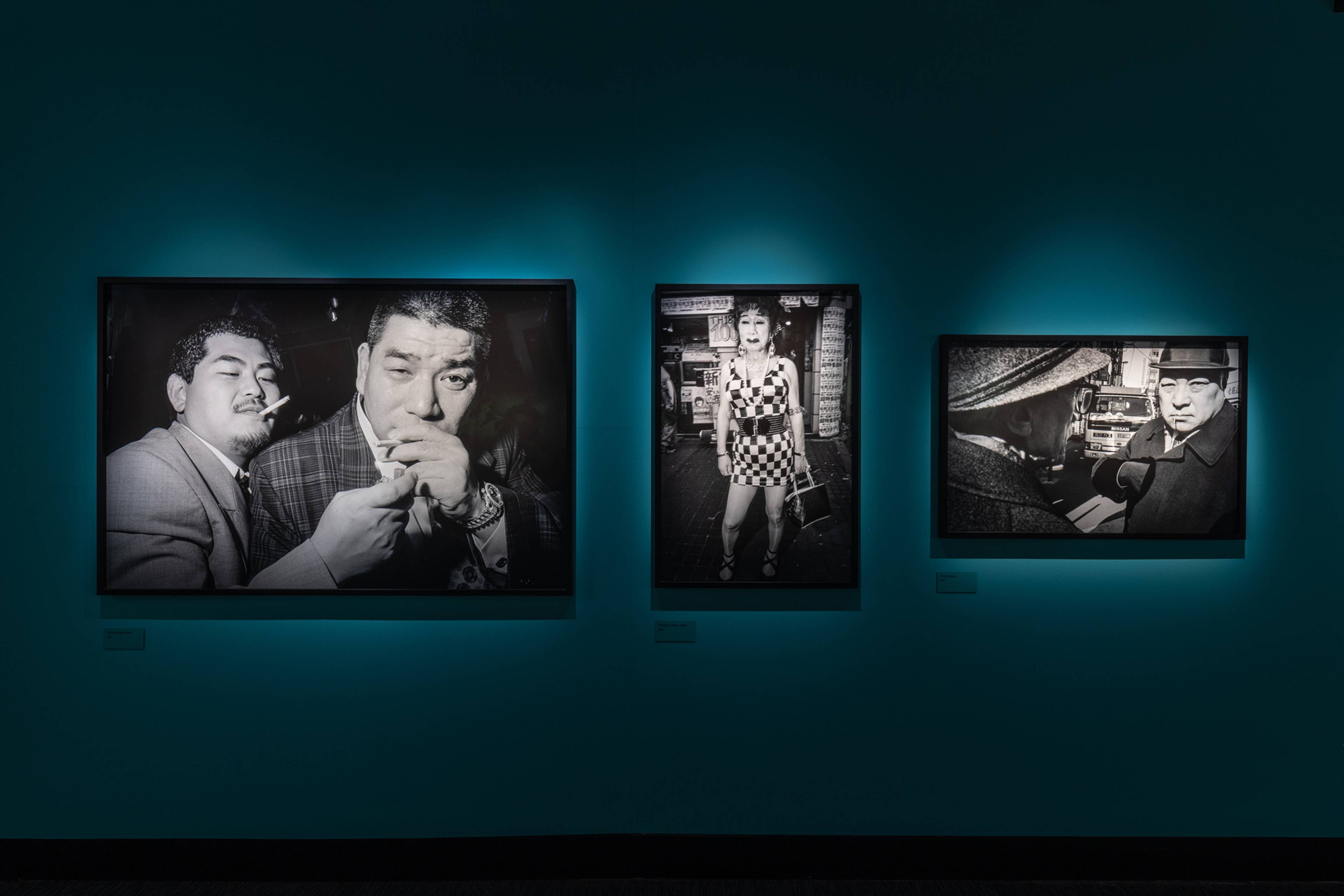
View of Bruce Gilden, “Why These?” Fotografiska Berlin, 2026
DE: Good art requires risk. Even with constraints, you’re putting yourself on the line. What do you find risky right now?
BG: I’m still interested in the same kinds of people, and I think the reason why I do it well is because that’s who I am. My father was a racketeer type – pinky rings, thick hair, glasses, a fighter, you know? I’m the same kind of character. I played sports. I was pretty good, not professional, but a good schoolyard player, and I played hard. I always street-fought above my weight, so over the last couple of years, I’ve figured out that my photography is an outgrowth of me – I’m that person. So, I photograph who I am.
I learned how to work a certain way, where I can use these lucky accidents, but I’ve anticipated their possibility. Before you snap the shutter, you’re not waiting for the perfect position of the subject, you know what you’re looking for. The basic framing is there, you don’t know how the whole thing is going to play out. It’s not luck, you make your own luck. And you know what? Nothing is easy, whether you photograph regular people or gangsters. I can go into a room with one hundred gangsters and find the two who are interesting. The other ninety-eight aren’t. I know what I’m looking for, even if not exactly; I’m able to comprehend it, see it, and then get it. That’s my strength.
DE: It sounds like photography is an extension of your gut, like a knee-jerk reaction. Your exhibition “Why These?” recently opened at Fotografiska in Berlin. Tell me: why these images?
BG: Because I like them.
DE: Okay, simple.
BG: The show in Berlin looks really good, especially the color pictures. There’s enough space in the galleries to back up and look at them, and the lighting is very good, too. I’m very particular, very critical of things.
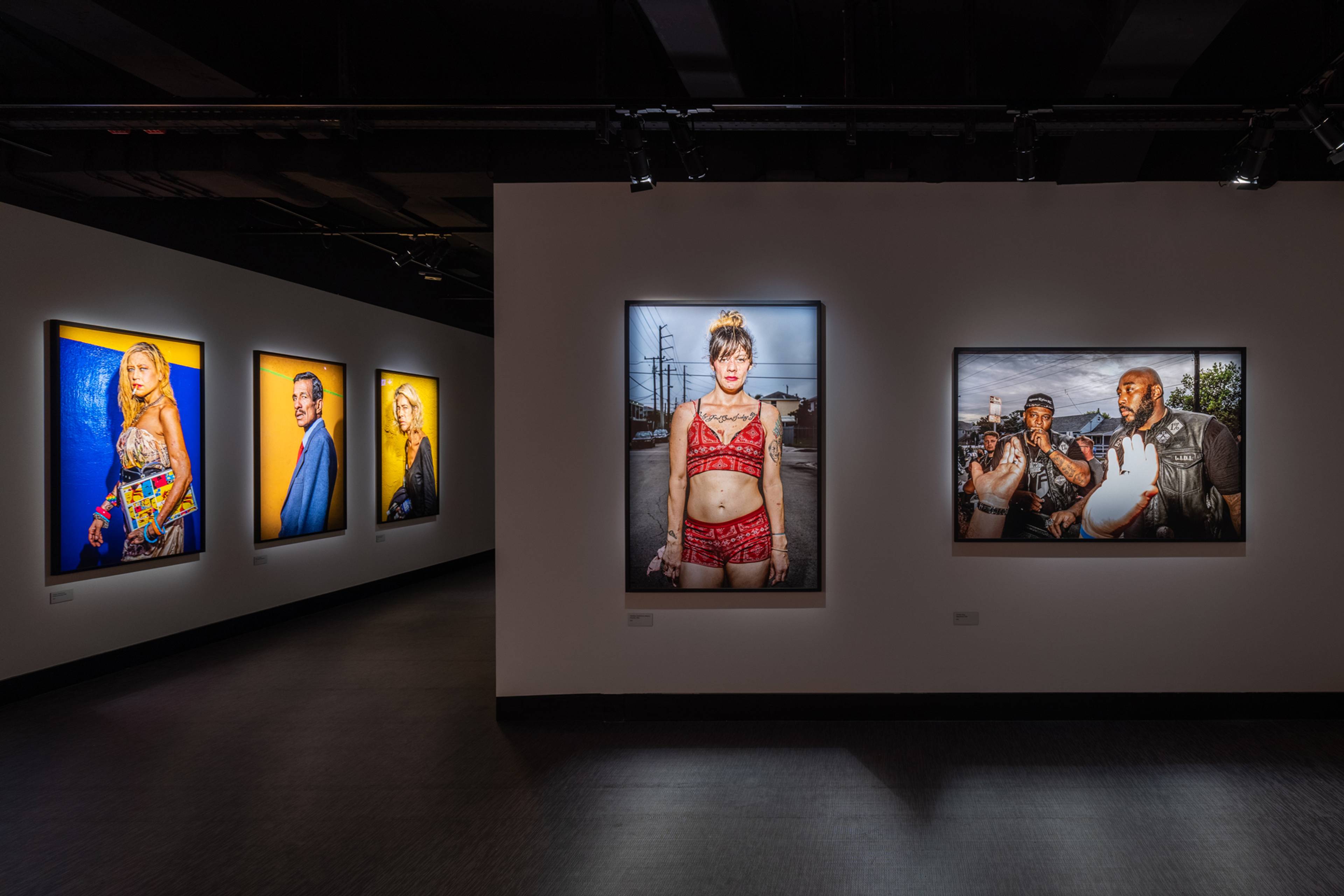
View of Bruce Gilden, “Why These?,” Fotografiska, Berlin, 2026
DE: Do you think it’s harder to take a good photo today, with the immense amount of images already in circulation?
BG: Not if you have something in you and you work hard and you spend a lot of time thinking about it. People sometimes think, Oh, you know, he’s a loose canon. I’m not a loose canon. I know what I’m doing. Everything has been planned. I don’t mean every step, but I learned by looking at other people’s pictures, the photographers I like. Then, I learned by looking at my pictures, and I think the details are what’s most important. I can look at a picture and tell you why it’s good and why it’s not good, and I think I know what I’m talking about.
I was looking for a lens that would enable me to do good portraits, and when I found one, I said, “Wow, there it is. I knew it was right there.” Only took twenty years to find it, but eventually, if you’re enough of a bulldog, you’ll come up on something.
DE: It sounds like good taste can be taught, but you have to be willing to work.
BG: I don’t know. I don’t think it’s innate. The question is: Who are you? Do you have anything in your head, in your soul? If you don’t – forget it. I don’t care how much you look; the pictures aren’t going to be good. When I first picked up a camera, I read the quote by Robert Capa, “If it’s not good enough, you’re not close enough.” That resonated with me.
DE: Is there such a thing as too close?
BG: For me? If it’s in focus, it’s close enough. It’s not just about being close. I see something, and then I prefer to be close.
You can call me confrontational if you want to, I’m comfortable in that. But I don’t do it to be confrontational. When it’s good, you get the soul of the person in the picture. I’m looking to capture their soul.
DE: Is there something that you think people should know about you or your work that doesn’t come through?
BG: Like, when I went to the White House for the MMA fight, they were amazed. I went over to Sean Duffy, the US Secretary of Transportation, and he hugged me because I told him something. All the guys came over to me, and they said, How the hell did you do that? Everybody has a different way of working, of dealing with people, and you know why one person can do this and another person can’t. Some of the photographers who have bad-mouthed me – it’s not even a question of my ability, because I have a tremendous amount of ability. I’m one of the best in the world. You could publish that all you want – I don’t care. So, the thing is, I worked hard to get to that point.
Most people my age can’t still photograph the way they used to, even some of the people that I admire. One of my favorites does old-man pictures. I don’t do old-man pictures. And what I mean by “old-man pictures” isn’t a put-down; it’s about changing your way because you can’t do it anymore. I figured out a way to still be able to do it, but that’s also because I’m a bulldog. I have a competitive drive. If you’re in the arena, you know, you’ve got to perform; there are no excuses.
DE: You’ve got to show up. I get that. Having a body is sometimes an obstacle, but it may also be an advantage, because being relentless makes the work better. You’re pushing through something, pushing past your limitations.
BG: Yeah, I can understand that. That makes sense. You’re intelligent. Let me tell you something: I sit here at home, and I’m bored, okay? Really bored. I’ve been sitting here, and I’m stiff. I get up, I can’t walk. I overdid it the last two weeks: France for ten days, home for two days, Washington, DC for two days, then Manhattan for two days shooting fashion for CRASH Magazine, staying up late at night. I came home, I couldn’t even walk. But if you put something in my head, I have to go do it. I’m going to make it happen.
DE: We spoke about what it takes to make a good image. What do you think is your most iconic photo?
[Sophie Gilden, Bruce’s wife, opens a folder of images on the computer, and shows me one of a corner of a building with the light from Haiti.]
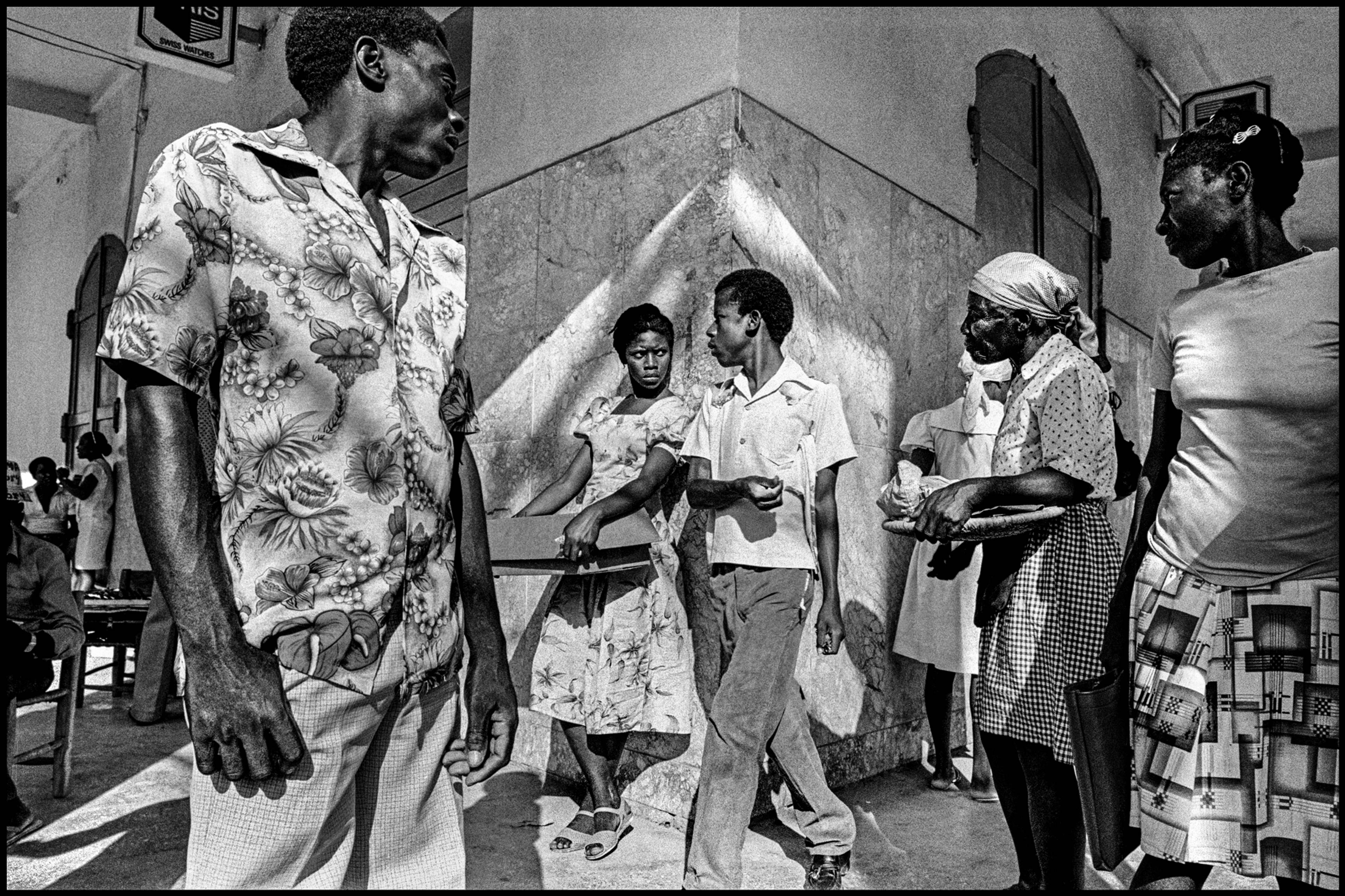
Bruce Gilden, untitled work, Haiti, 1989, gelatin silver print
BG: When I arrived in Haiti for the first time in 1984, for Mardi Gras, I turned to my companion and said, “Where have I been my whole life?” I went back to Haiti seventeen times over eleven years. But after the earthquake in 2010, this building was no longer there, and I was so unhappy, because that made the picture – the light you see. But I did my homework beforehand. I looked at pictures that I had made the year before, and I said, I’m going to go to that same corner because there are a lot of people there. This was not what I had in mind; I wanted more of a crowd, but I got this.
[Sophie shows me another photo: a woman crying at the cemetery]
That’s at the cemetery, but you need gumption to photograph there. I work my way step by step. I see what I can do, and each time I go back to a place, I go further. It’s the same with the bikers; I go further and closer, further and closer, because I see what people accept and what they don’t. When I started photographing, I wanted everything to be perfect, but when it looks too perfect, it looks staged.
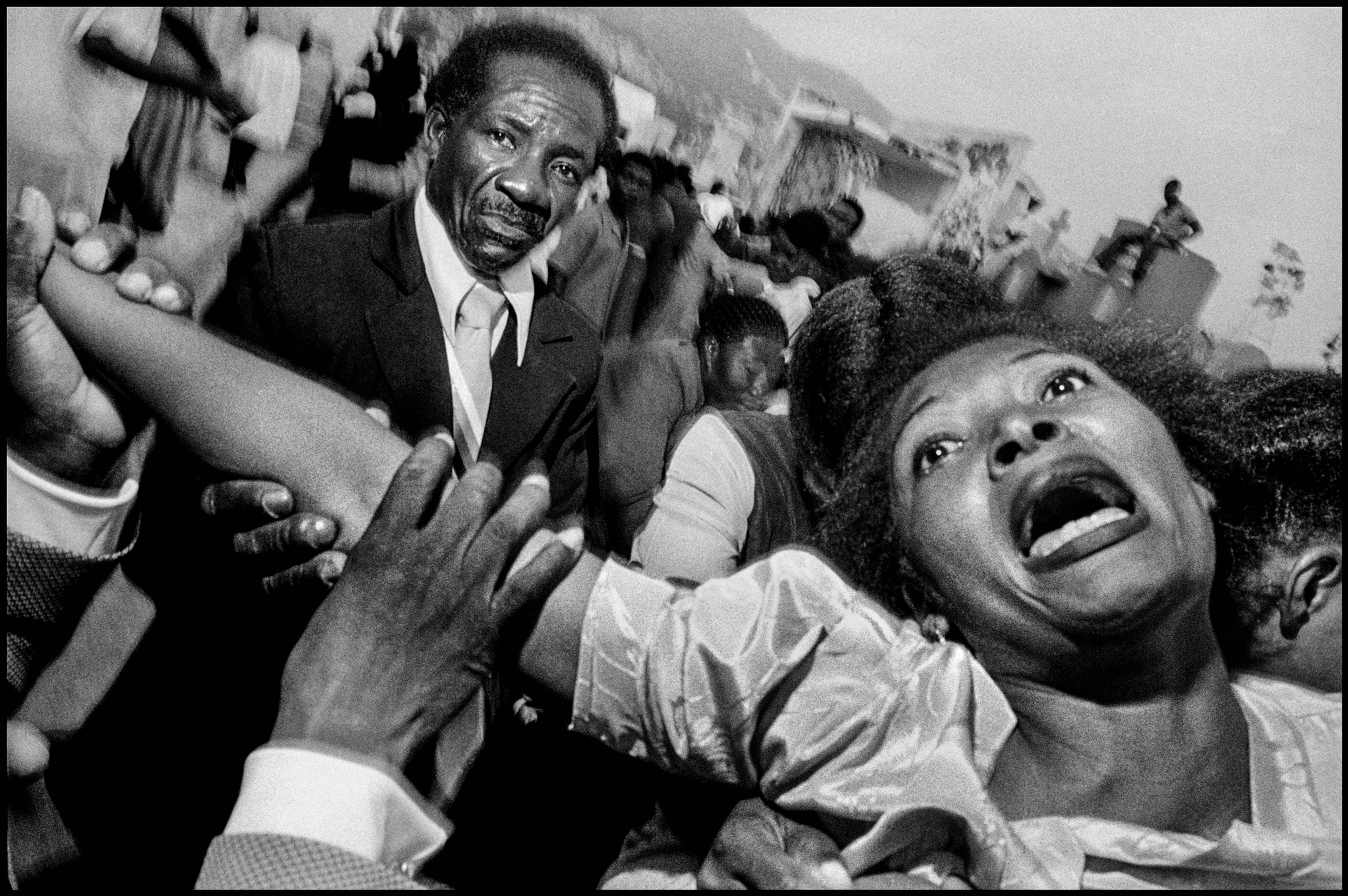
Bruce Gilden, Haiti, Port-au-Prince, Cemetery, 1988, gelatin silver print
DE: There’s a French phrase for something being beautiful but a little ugly. I think it’s jolie laide. An imperfect beauty. I love this phrase, and I think it’s what you’re getting at …
BG: Yeah, because what I find beautiful, other people generally don’t.
DE: You spoke earlier about your color photos at Fotografiska, and you really love how they look in this particular show. What have you learned by working with color?
BG: One thing I thought when I was doing a lot of black-and-white was that color was easier. But they’re actually both hard, because color is more dramatic. When you have a big red thing in the frame, it kills everything; you learn that by doing. You can’t sit in the chair and tell me you know that. It’s impossible, just like you can’t tell me that people today know about the street when they’re on their phone all the time. Because how the fuck do you know what’s going on behind you?
DE: I don’t think you can.
BG: You can’t, right?
I think the reason why I do it well is because that’s who I am. My father was a racketeer type – pinky rings, thick hair, glasses, a fighter, you know? I’m the same kind of character.
DE: Photography directs attention. As a street photographer, you show viewers someone they’d otherwise scroll past. That's a generous act, even an empathetic one. But given your confrontational style, your work isn’t usually described that way. I’d argue the empathy is there because you’re willing to meet your subjects where they are, and that comes from curiosity. So, what can we learn from confrontation?
BG: You can call me confrontational if you want to, I’m comfortable in that. But I don’t do it to be confrontational. When it’s good, you get the soul of the person in the picture. I’m looking to capture their soul.
Now, look. Having said that, there are photographers that can do a different style, and they can be very good at it, but it’s not who I am. When I took physical education at New York University, they put us in gloves, and one guy went to the nurse, the other guy got knocked down, and the guy told me, “You’re not boxing, you’re street fighting,” you know, because I was just pummeling. I went in like Mike Tyson, you know – boom, boom – but that’s who I am. And I think I have more empathy than all these people combined, because I don’t intellectualize.
When I was a kid, I wanted to read all the books because I didn’t have a good educational background. Now, I hear what all these intellectuals have to say, and I’m almost laughing. I mean, I respect people who are intelligent and educated, alright. But the thing is, you’re either talking about life, or you’re talking about ideology. You can’t fit one into the other.
I’ve been working for many years with drug-addicted sex workers in bad areas of Bogota, Colombia; Kensington, Pennsylvania; or Overtown, Florida. When you go to these bad areas, you have to be a certain way, or they’ll eat you alive. If I walked in there with my glasses on, looking like a nerd, I’m not walking out of there because I know that in five minutes or fifteen minutes, someone’s going to come out with a machete and cut my head off. So, you have to be streetwise. I go where I’m comfortable, where people are comfortable with me.
DE: The word “confrontation” gets a bad rap, but I actually think there’s something to it, and this goes back to the idea of friction: we have to contend with how people are different from ourselves, even if, perhaps, you get a little bruised in the process.
BG: If you can’t say something to someone without being protected by a screen, then you shouldn’t be dealing with that person. It’s like Mike Tyson and me: am I going to tell Mike, you’re this, you’re that? No! He’ll kill me. Listen, as my uncle said to me when I was a kid, you only got to worry when they stop talking about you, so you want to talk, talk – just don’t put your hands on me.
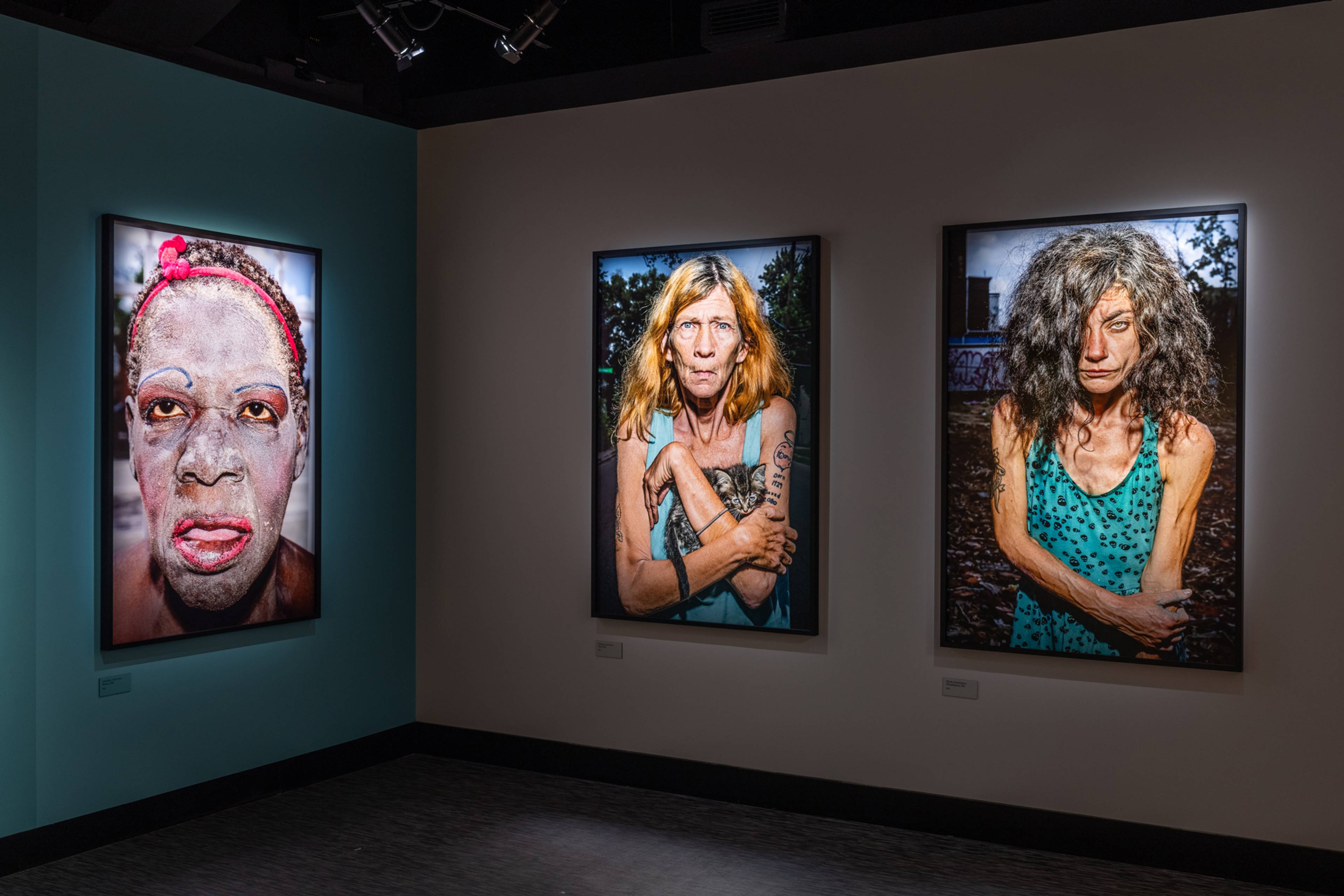
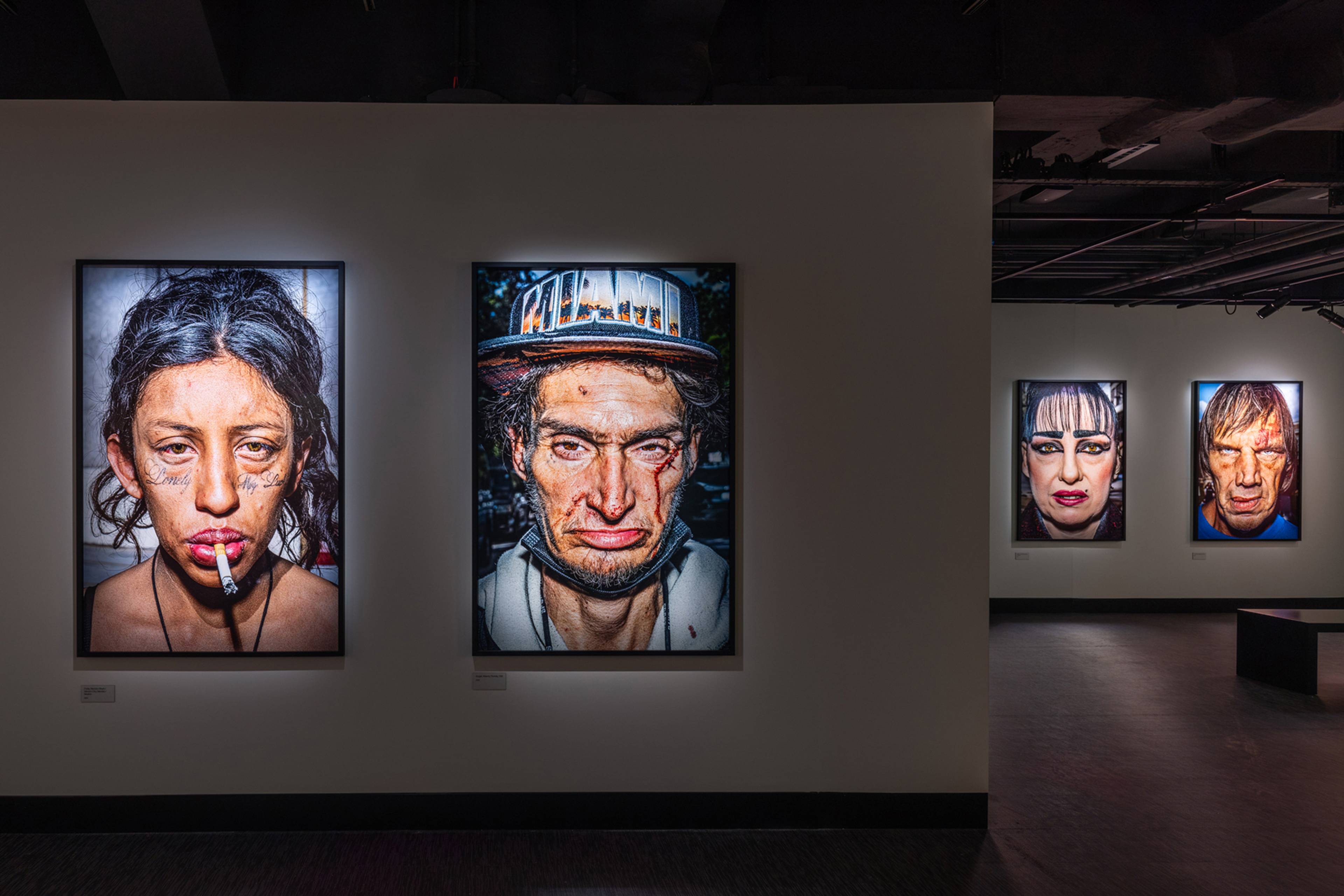
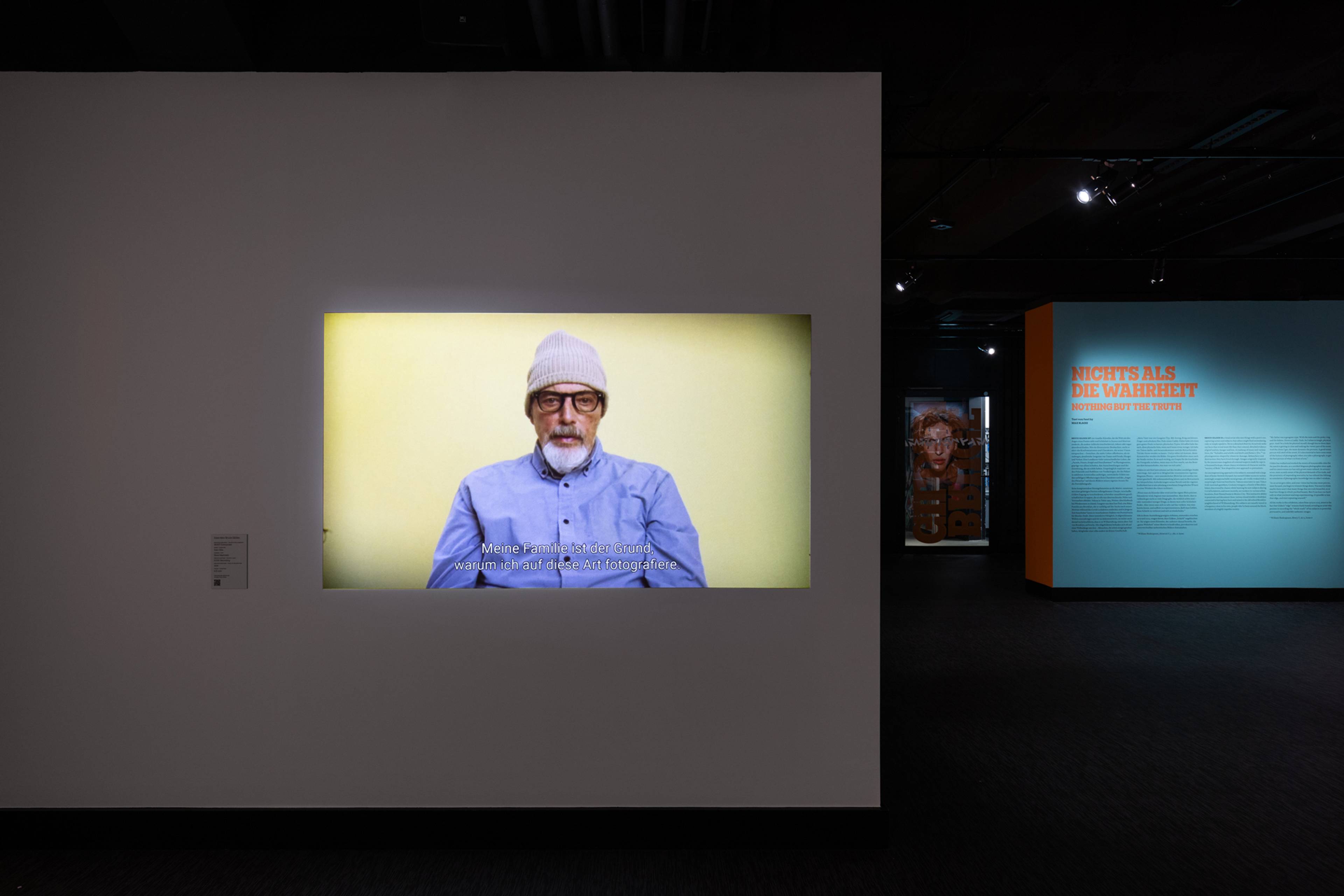
Gilden, in video: “My family is the reason why I photograph this way.”
Bruce Gilden
“Why These?”
Fotografiska Berlin
25 Apr – 23 Aug 2026