

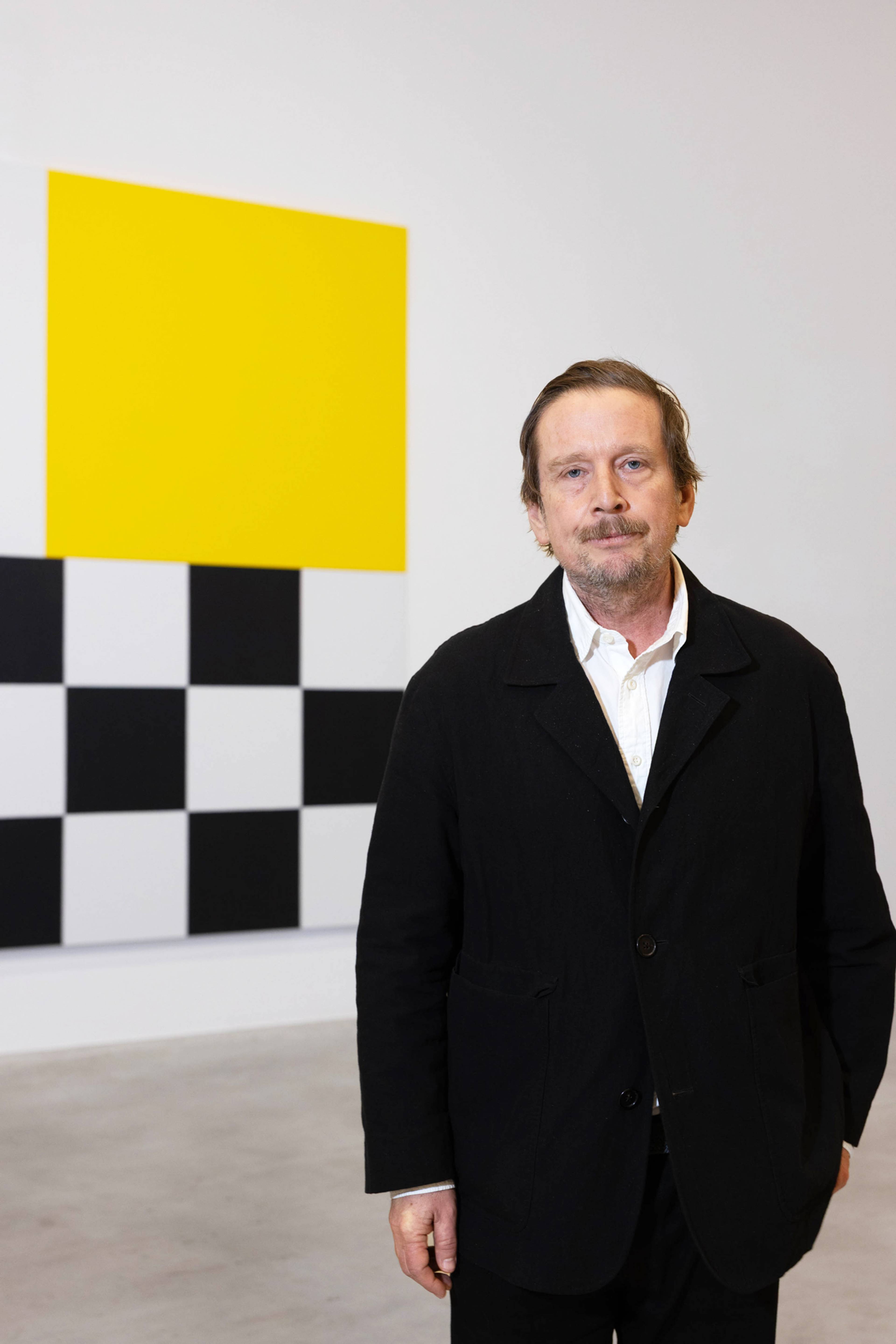
Christian Egger: I had the pleasure of attending your recent lecture in the nude-drawing class at the Akademie der bildenden Künste Wien (Academy of Fine Arts Vienna, “die Bildende”), where you gave an overview of your artistic career. You showed images of some earlier works that, while absent from your survey here in Krems, definitely have some affinity to your more recent paintings.
Joe Bradley: The show in Krems is focused mostly on the last ten years, but it includes a few earlier works. I can see some of my early impulses coming back, especially in these tall-standing figure paintings, which took me a bit by surprise.
CE: You mentioned that there could have been various scenarios for this exhibition.
JB: If there were four other shows covering this timeframe, they could be four very different-looking shows. When curator Florian Steininger and I began to think about this, I was partial to the idea of focusing more on recent work, rather than trying to put together a true mid-career survey.
CE: If you’re having a show abroad, do you feel any expectations to be representative of US artists, or specifically of New York artists?
JB: It feels different than staging a show in New York, I guess because New York is my city, my peers and friends are all there and I’m familiar with the way things work. It’s more fraught doing a show in New York. It almost feels like being on death row: if the show goes well, you are granted a stay of execution.
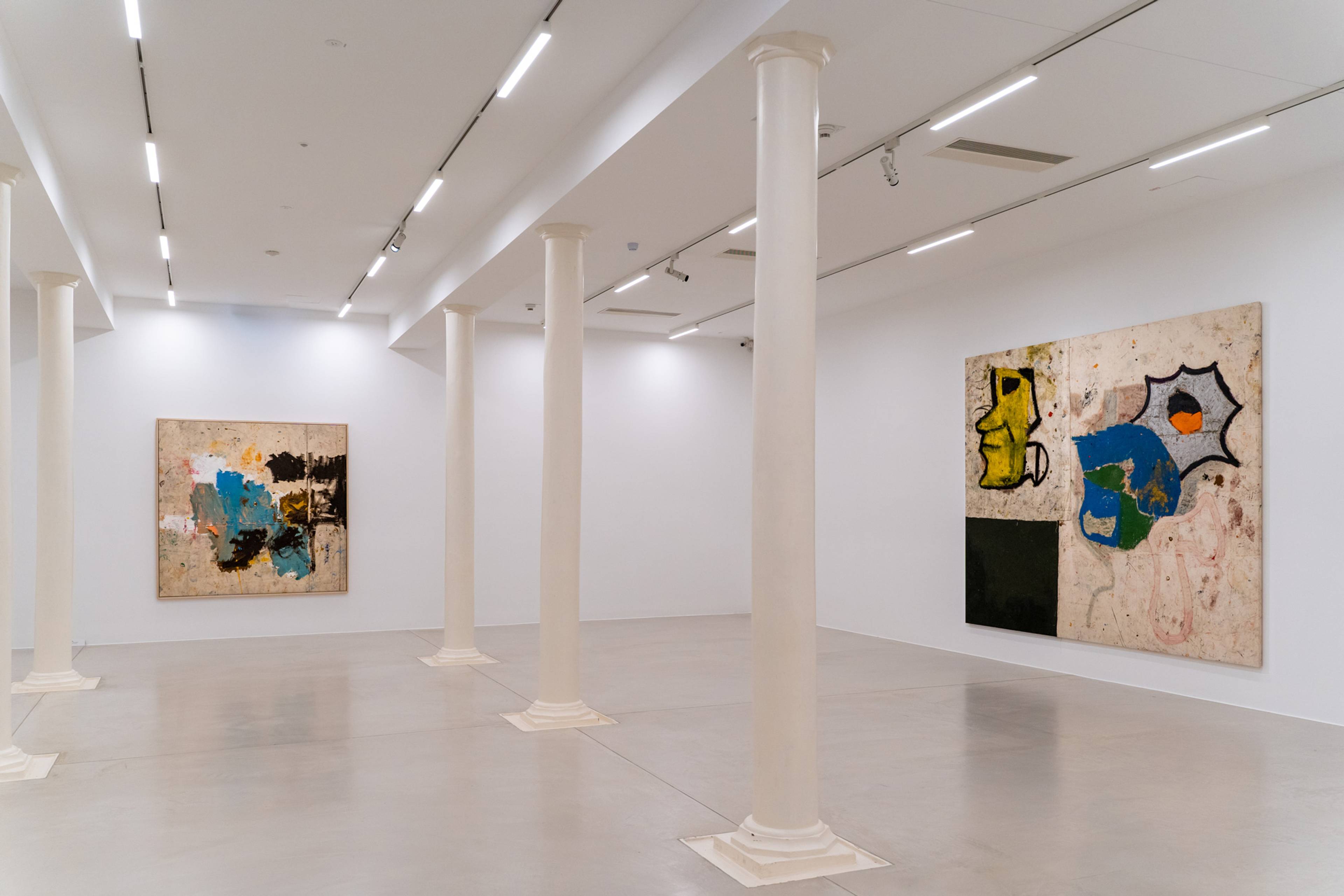
Left: Joe Bradley, Builder, 2015; right: Norman, 2012. Installation view, Kunsthalle Krems, 2025. © Kunstmeile Krems. Photo: Agnes Winkler
CE: Just because you mentioned death row: it’s quite rare that a museum is next to a prison. The Karikaturmuseum Krems even put up a Simpsons poster once as an advertisement on the prison walls …
JB: We should mention that Kunsthalle Krems is next door to a maximum-security prison!
CE: You felt safe during the exhibition setup?
JB: I did feel safe, though Florian was telling me a little bit about the ax murderers that have done time here. He mentioned an Austrian serial killer who was locked up here for years. When he got out, he flew to the United States and killed a few prostitutes.
CE: That was Jack Unterweger – a very famous case. Partly, because it was one of the first that involved profiling – investigators recognized the way the victims were strangled – to connect the murders internationally. He had started a career as a writer the first time he was in prison, and actually had quite an audience.
Your early influences had more immediate contact with comics and underground music, is that right?
JB: I grew up in a small town in New England. Comics were more available there than fine art, which I didn’t really encounter until much later. I was drawing quite a bit as a kid, and I was into these nasty trading cards, Garbage Pail Kids and Dinosaurs Attack, which had this lurid sort of b-movie-type horror aesthetic. There was also MAD magazine. Then as a teenager, I got turned on to underground comics, to Robert Crumb and the whole Bay area scene of the 1960s. In the 90s, there was a flourishing of underground comics in the States with —
CE: Fantagraphics Books?
JB: Exactly, which published Daniel Clowes’s series “Eightball” (1989–2004) and Peter Bagge’s “Hate” (1990–2011). So, I was just reaching out, looking for signs of life in pop culture, stuff that felt kindred in attitude, in its humor and sensibility. I also really gravitated towards punk and hardcore, which is perfect music for angry fourteen-year-old boys. It’s remarkable that something so “out there” could come from suburban kids in middle America.
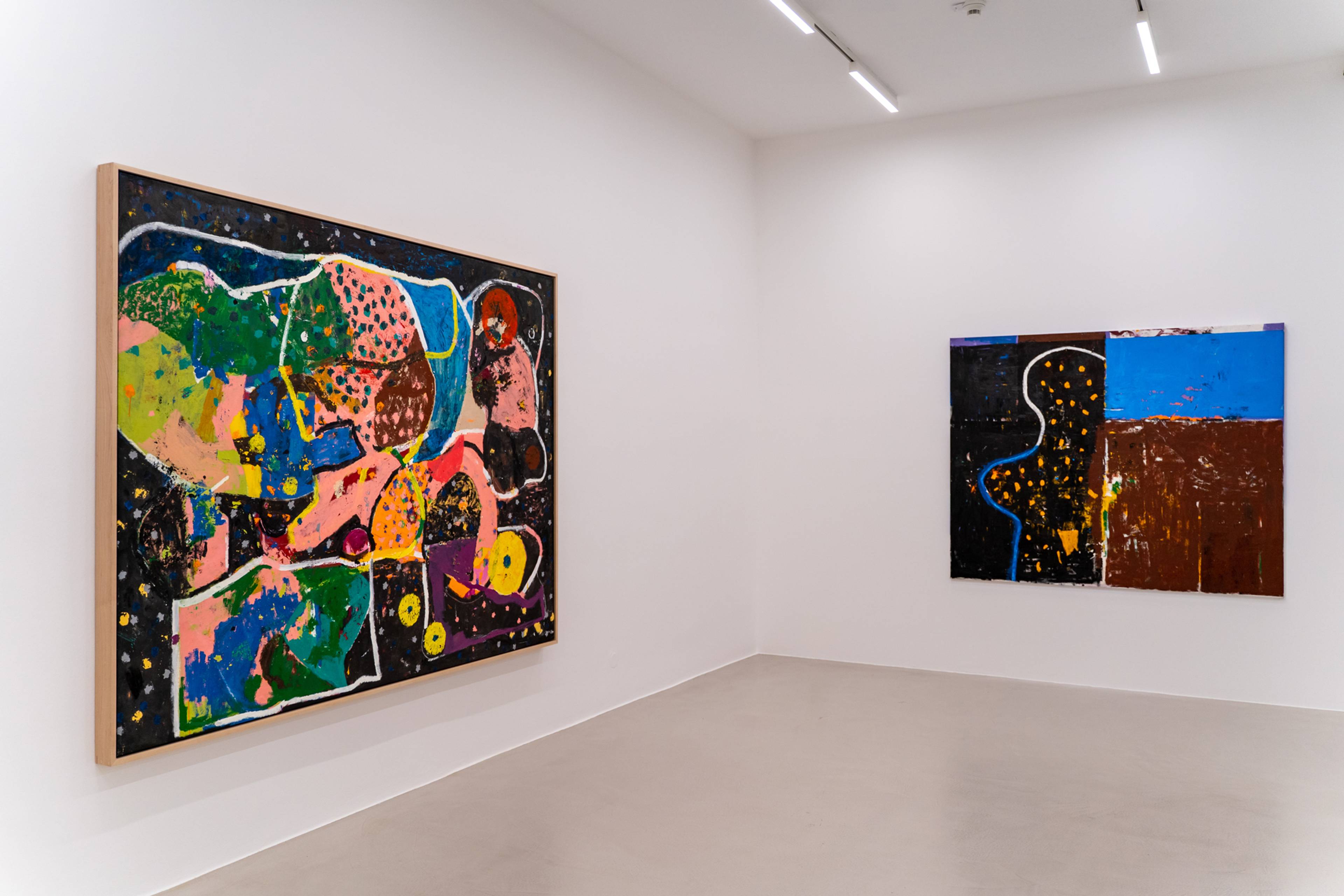
View of Joe Bradley, Kunsthalle Krems, 2025. © Kunstmeile Krems. Photo: Agnes Winkler
CE: When they’re maybe not even aware of which ground they’re entering, it’s just coming from hormones and political frustration.
JB: Totally. I would imagine these kids had no awareness of the avant garde or free jazz or anything like that. It was just this cathartic outburst. So, that stuff was there when I was searching to establish an identity, a point of view. Reading MAD magazine as a kid, I loved the way it just turned everything on its head. It was totally subversive. The cultural icons we are meant to worship are there to be ridiculed. If you’re a precocious young person just beginning to become aware of the world around you, it’s a shock to the system. It’s just so clear that it’s all one big, false advertisement for itself. Pop culture is garbage, the politicians are all con men. It’s maddening, because you look around and everything is just —
CE: Corrupt.
JB: It’s all bullshit! This is not a unique take, I know. But when you first become aware of the situation, it’s like, what do I do?
CE: Kill Mickey Mouse?
JB: Do you kill Mickey Mouse? This is the question.
CE: So, what was your starting point? How did you get a sense of production, of presentation and feedback, a first sense for admiration for what you were doing?
JB: I studied painting at the Rhode Island School of Design and then moved straight to New York. I started showing pretty quickly, which was helpful. The expectation that the work will be seen by strangers outside of your studio, it ups the ante, you know? You stop thinking of it as a private thing. So, a couple of years after I had arrived in New York, Kenny Schachter asked me to do a show at his gallery in the West Village. It was an interesting space. Vito Acconci had designed the interior, the walls were covered in this sort of steel mesh. It felt a bit like being inside a cage.
If you’re a precocious young person just beginning to become aware of the world around you, it’s a shock to the system. It’s just so clear that it’s all one big, false advertisement for itself.
CE: Kenny still has some of your works from that period, I think.
JB: I think so, yeah. I see him around New York, we’re still friendly.
CE: And one of his kids has a tattoo of a drawing of yours!
JB: That’s right! Much to his chagrin, I’m sure. Kenny closed the gallery in New York and moved to London, and a few of us who had worked with him moved over to a gallery called CANADA, which was down in Chinatown. It has moved to Tribeca since.
CE: It seems like the galleries in New York keep moving in circles.
JB: They tend to move in packs, yeah. CANADA is a great gallery, and really kind of a special scene. I felt welcome there, and they were showing friends of mine whose work I was into, Michael Williams, Brian Belott, Katherine Bernhardt. So, the context was right, and it was just a nurturing, good place to be.
CE: So, you were trying things out, questioning painting history?
JB: I was still kind of finding my footing. Playing at my identity, you know? Like, who am I? What do I have to say? At that age, there’s this feeling that you’ll find your project and that will be it. But, in a way, that process of becoming just keeps going. It’s a life’s work.
CE: In your painting practice, you seem to pose yourself different challenges, like leaving modes you were using before and letting things go. Was that part of establishing your artistic identity?
JB: That’s just the way it has played out for me. I’ve learned that, in order to move forward, I need to find myself in unfamiliar territory, so to speak. If I become comfortable with a mode of painting or a set of tools, the potential for discovery dissipates.
CE: You had to discover that there are paintings where you would say, Joe Bradley became lazy in discovering things.
JB: Well, I can look back at my own body of work and see that some paintings are more inspired than others, or I might look back and think, “God that was a stupid idea.” This just goes with the territory. The best ones feel alive. I think that is the ideal. You want the painting to feel like a living, breathing thing.
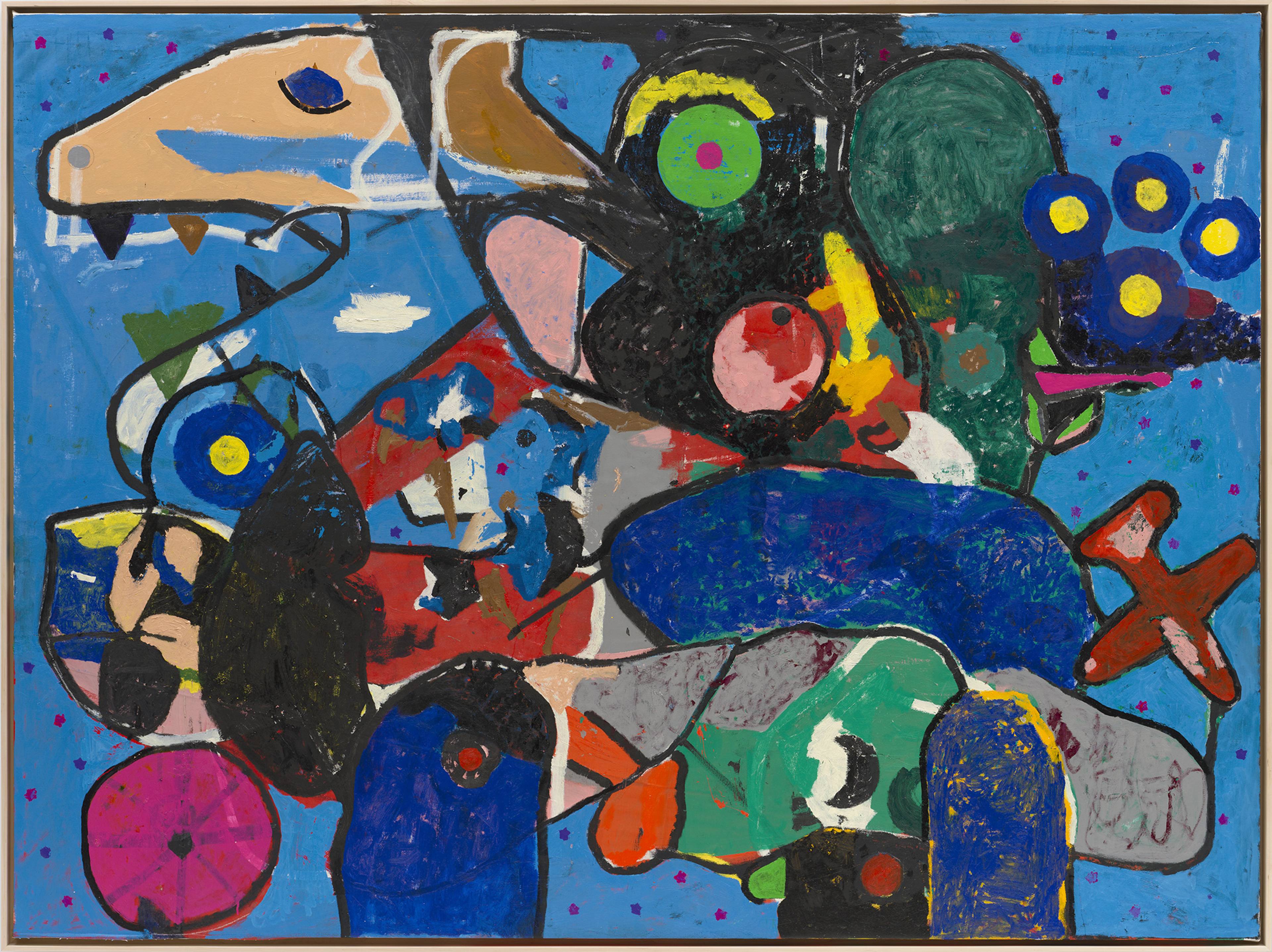
Joe Bradley, Parade, 2025, oil on canvas, 218.4 x 295 cm. Courtesy: the artist and David Zwirner
CE: You’ve been active the past twenty-five years, in a period that has been technically super sped up, and where perception has become increasingly distracted. Images and imagery circulate now at a speed no one can control. Is the studio a kind of refuge in all of this?
JB: Yeah, that’s fair to say. To look at a painting, your body needs to be in the room with it. You need to stand in front of the painting to experience it properly. This sounds trivial, but I think it’s important, particularly in the digital age. We are awash in imagery and “content,” and in this hurricane of information. I find the experience of looking at painting extremely relaxing. It is a rare opportunity to be still, and to slow down one’s thinking process.
CE: Professional writers ask you quite often how you know a painting is finished. But I would rather ask: how do you know a painting has begun to become a painting?
JB: Each painting resolves in its own way. Some arrive unexpectedly, like a gift. Some kind of grind to a halt. Some paintings are really stubborn and just resist …
CE: Resist their progress?
JB: Yeah. It’s a mystery to me. Sometimes a painting just feels cursed, like no matter what you do, it’ll never come out the other end. When a painting is finished, there’s the feeling that this thing no longer needs my assistance. At a certain point, it takes on a life of its own. It can go out into the world and fend for itself.
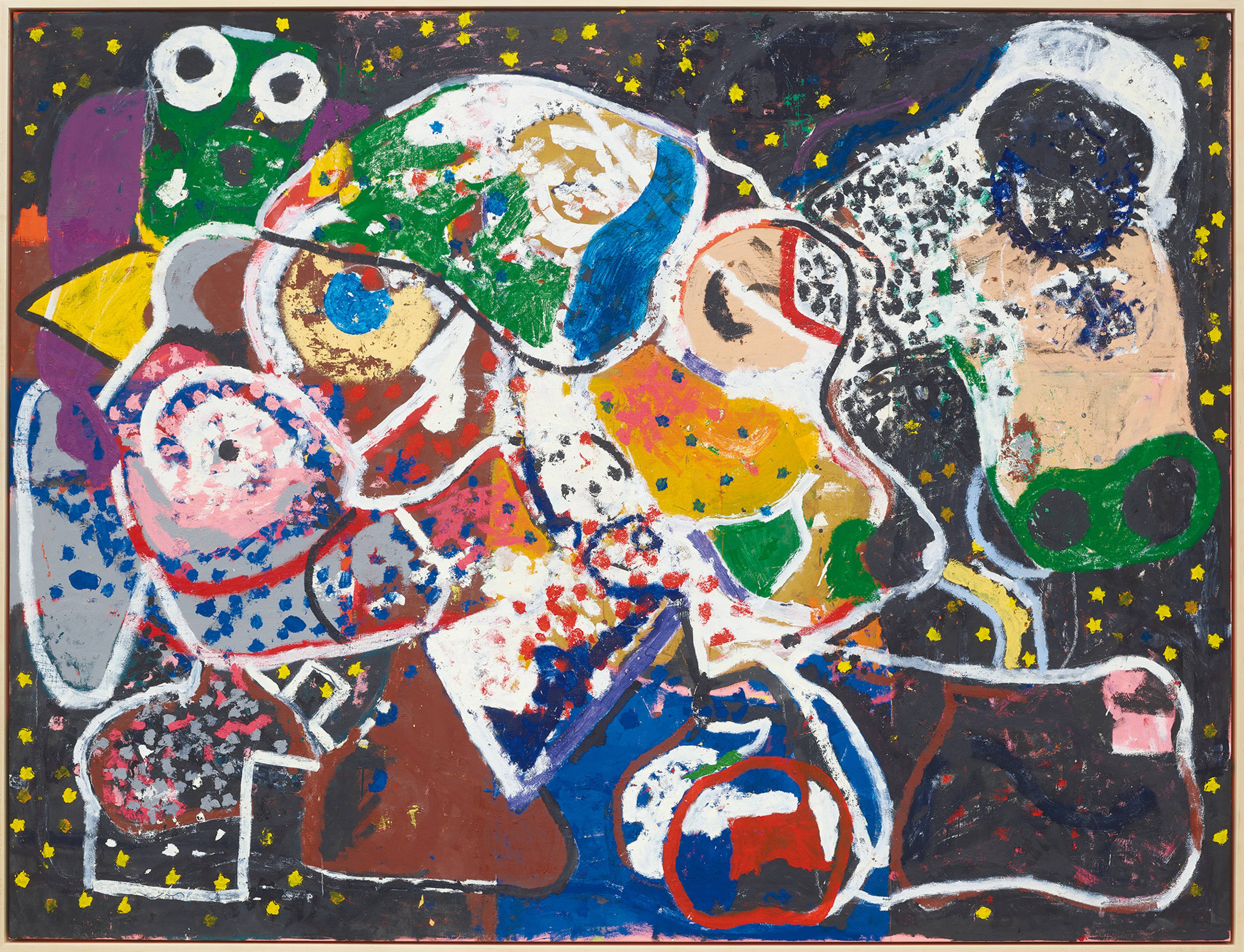
Joe Bradley, Work Horse, 2022–24, oil on canvas, 192.5 x 254.5 cm. Courtesy: the artist and Galerie Eva Presenhuber, Zurich/Vienna
CE: At your talk at die Bildende, there was an interesting question from a student who asked, once a painting has succeeded on your own terms, when do you risk making it great, despite the possibility that you might ruin it?
JB: That was a good question. It’s an occupational hazard, you know? I take snapshots of paintings in progress, and there are ones where I think, fuck, I should have stopped back in November or whatever. It’s hard to resist the urge to see what happens next.
CE: You’re connected with all of your paintings, and some might keep growing.
JB: I’m in a phase of really overcooking the paintings. I want to push them into the red, to almost overload them. There’s not a lot left to chance.
CE: Like in your earlier work?
JB: Some of my early stuff had a kind of “voila” quality that I’m not so interested in anymore. There’s a hubris that young me had that has been tempered or traded in for some other quality. I don’t think I could pull off the “Schmagoo Paintings” (2008) now.
CE: The “Schmagoo Paintings” were shown at “Forever Now,” a huge painting survey at MoMA in 2014–15 that was claiming to provide insight as to what the future of – or at least the contemporary of – painting is. How did that go over for you?
JB: The curator, Laura Hoptman, felt they really jibed with her idea of what the show was about. I was just happy to be included.
I can look back at my own body of work and see that some paintings are more inspired than others, or I might look back and think, “God that was a stupid idea.” This just goes with the territory. The best ones feel alive.
CE: You mentioned the difficulties of explaining your own paintings or of talking about painting in general. In the catalog for “Forever Now,” Laura tried to do so by explaining painting via analogy to a different medium, by referring to Simon Reynolds’s theory of “retromania” in music. Basically, in that reading, painting hasn’t left the baggage of its own history, despite painters pushing the medium further.
JB: I’m comfortable with painting as, I don’t want to say as a tradition, but as a pursuit with a long history to be reckoned with. I’m also comfortable with the idea of painting as defunct, decadent, retrograde. None of that really matters to me.
CE: When you’re in the studio or generally?
JB: Really, my orientation towards the whole thing is essentially positive. I enjoy painting for myself, and I love it as a —
CE: Profession?
JB: Well, not only that, but as a way of life, a way of engaging with history and with the world around us. It is a powerful tool for self discovery. We can think about painting and its long history and the way the conversation has moved over time, but in the end, it’s driven by the individual.
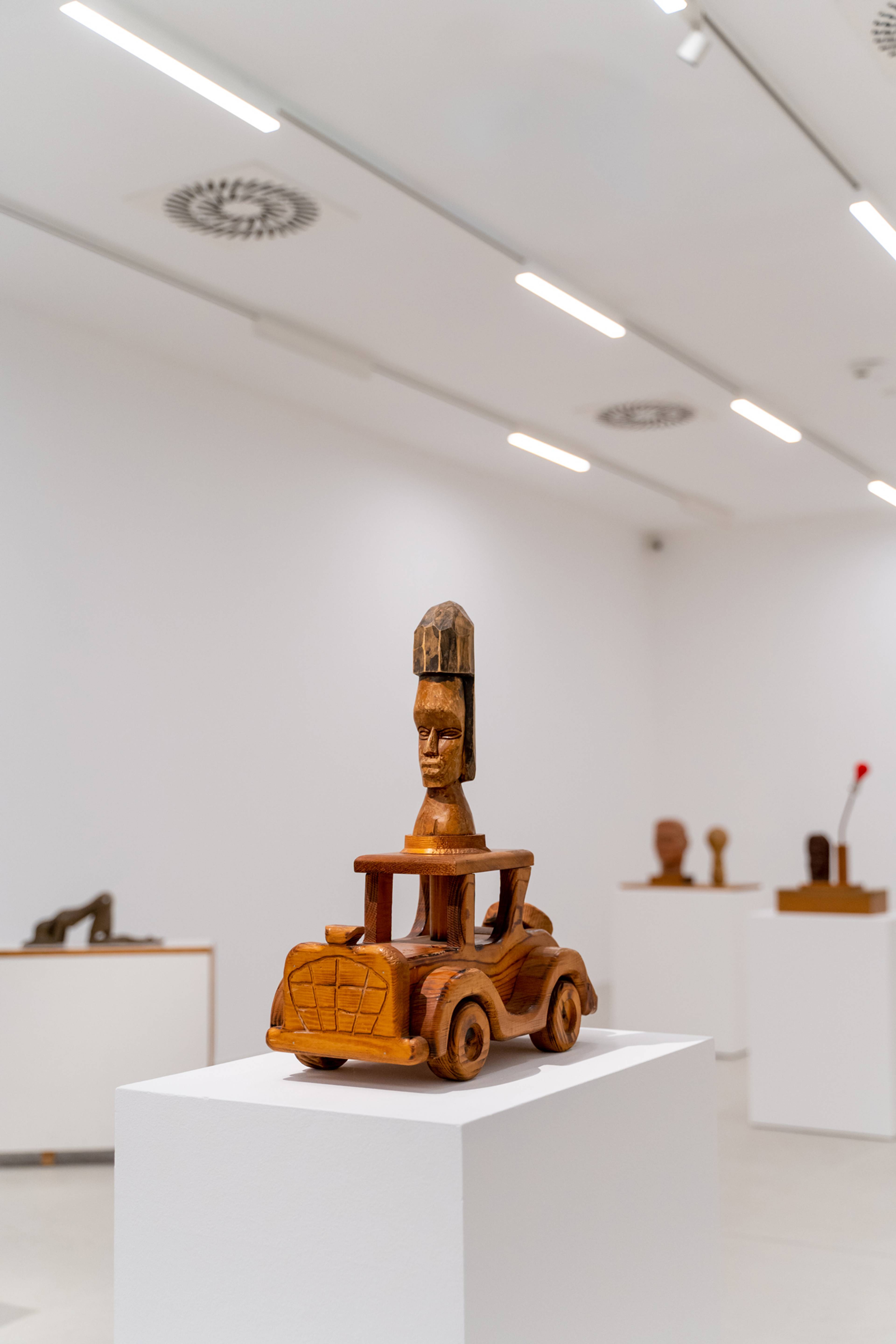
Views of Joe Bradley, Kunsthalle Krems, 2025. © Kunstmeile Krems. Photo: Agnes Winkler
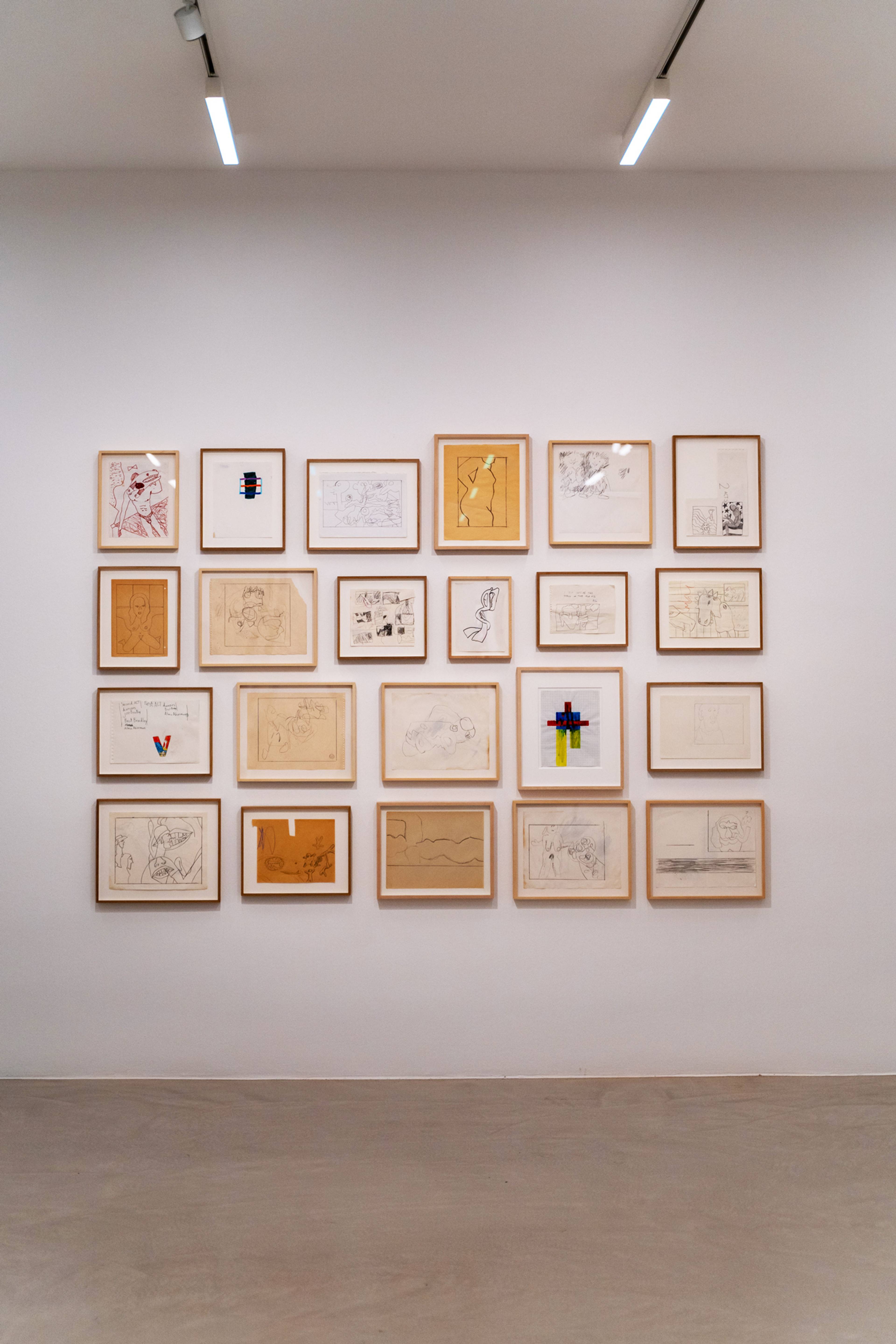
CE: Let’s talk about your drawings. When did you start doing them in your exhibitions?
JB: I’ve been showing drawings alongside paintings as far back as 2012.
CE: And they’re important for your paintings as well?
JB: Drawing is really the cornerstone of my practice. I like how uncomplicated it is compared to painting. Painting to me seems almost impossible.
CE: To make a painting?
JB: Yeah. It’s really challenging. Some painters have a natural facility and talent with the medium, but I don’t think I’m one of them.
CE: You have the proof of having finished convincing, good-looking pieces – that must give you confidence?
JB: It’s a little miracle every time I pull one off.
CE: Over the years, though, you must have become a master of your painterly doubts!
JB: No, I’m still filled with anxiety about my own shortcomings as an artist, if I can be honest. It’s a humbling pursuit. I went to the Kunsthistorisches Museum in Vienna the other day, and being in the Bruegel room … I mean, my God. That’s a good place to go for an ego check.
When a painting is finished, there’s the feeling that this thing no longer needs my assistance. At a certain point, it takes on a life of its own. It can go out into the world and fend for itself.
CE: You downsize your ego during the painting process, but then at an opening, you also have to put it onstage again.
JB: It’s funny that way. It’s a solitary gig, but it also has this social aspect. Many times I’ve spent the day in studio and then gone straight to an opening or dinner and I’m like, catatonic. Like, I can’t string two sentences together.
CE: What mental state do you have to be in to work?
JB: I think about painting when I’m not painting. Ideally, when I’m actually painting, I’m not thinking at all.
CE: Could this mean that, when you return to your studio, even right after opening a show, you’ll have a bunch of canvases waiting for your finishing touches?
JB: I just moved out of my studio and into another one, and I counted twenty-three paintings in progress. That’s not unusual for me;
CE: And will they all wind up getting finished in similar ways?
JB: I don’t know. It’s too soon to tell.
CE: When are you happy with a show? And what about when it comes to the audience, in terms of what they get out of it?
JB: I don’t really think about the audience. The audience is kind of a fantasy anyway. I try to keep myself engaged and amused.
CE: And even if you’re not painting, you’re still working on painting and talking about it.
JB: It never ends! I take painting seriously, but it’s also just painting. You know what I mean? I need to hold both positions to keep the game going.
CE: Checks and balances with color to be.
JB: Amen.
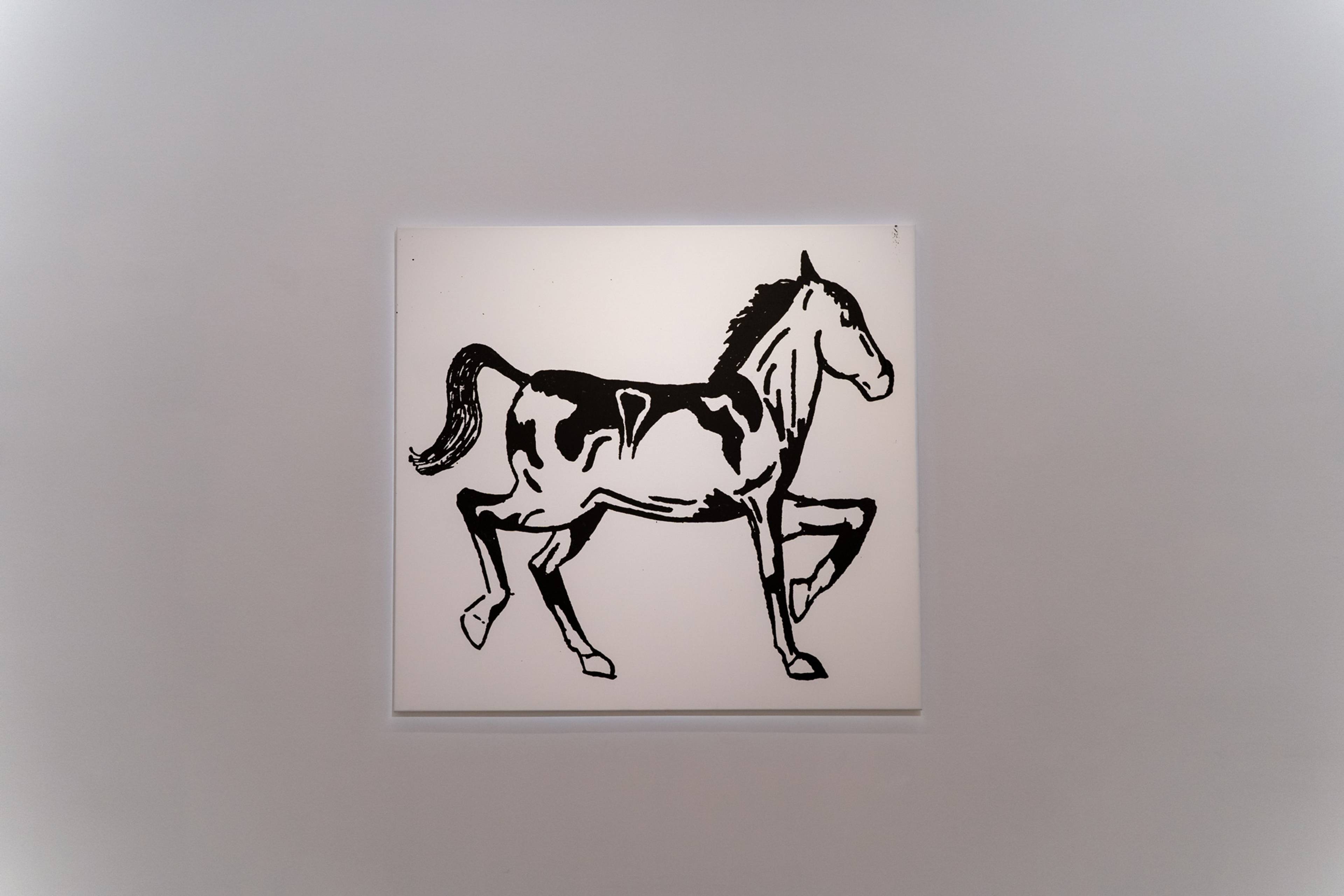
Joe Bradley, Horse, 2014, silkscreen ink on canvas, 127 x 137 x 2 cm
___
Joe Bradley
Kunsthalle Krems
22 Nov 2025 – 6 Apr 2026