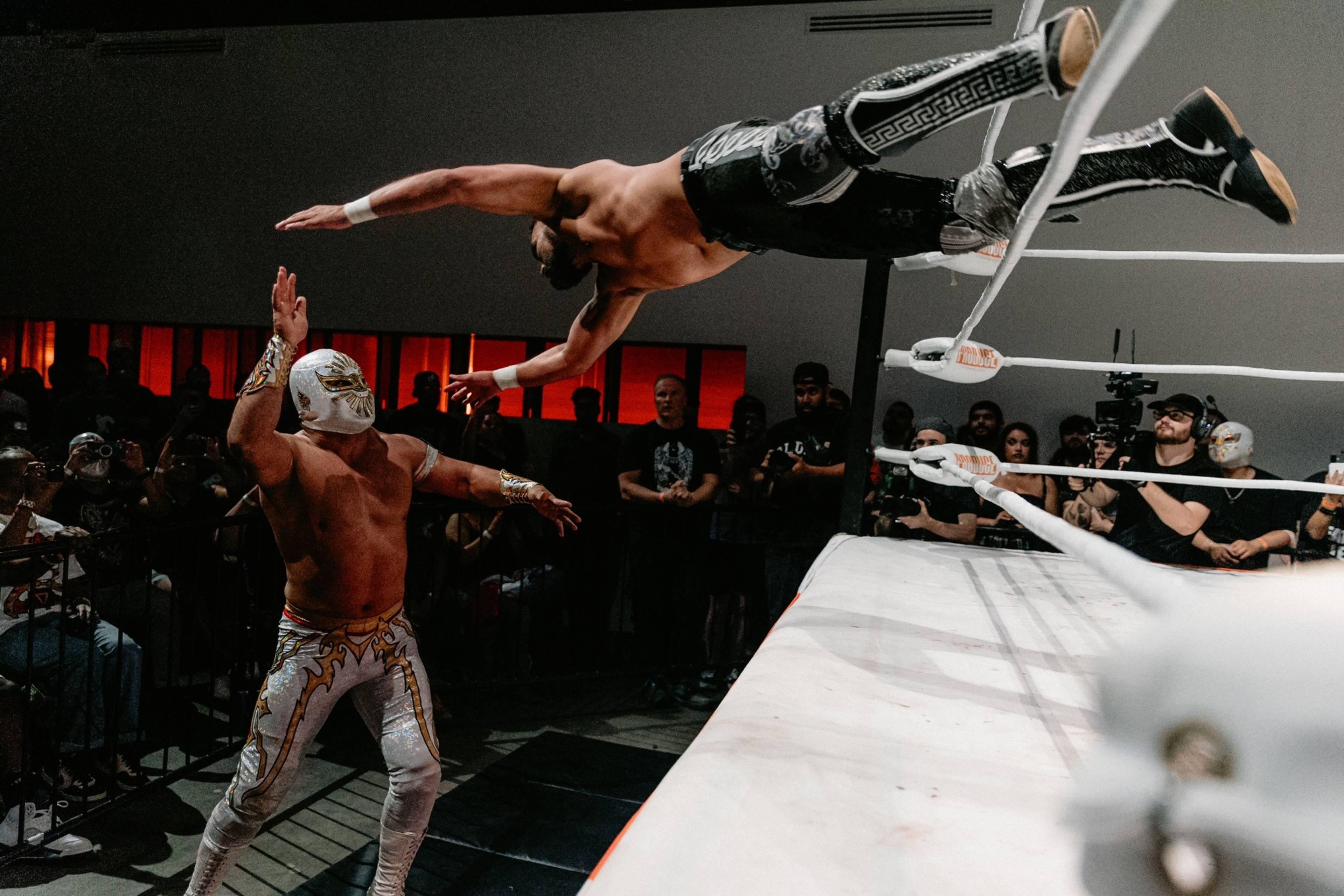

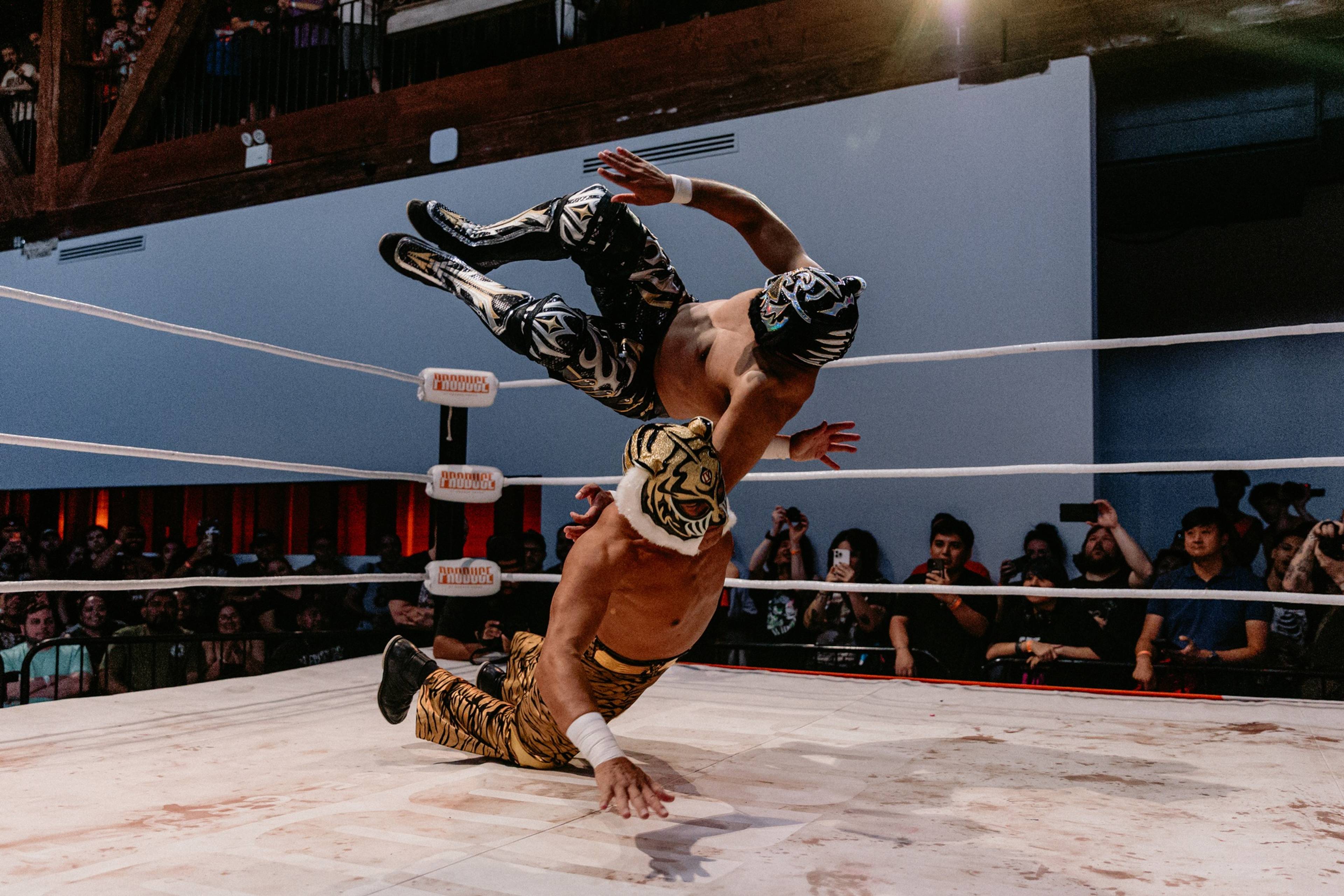
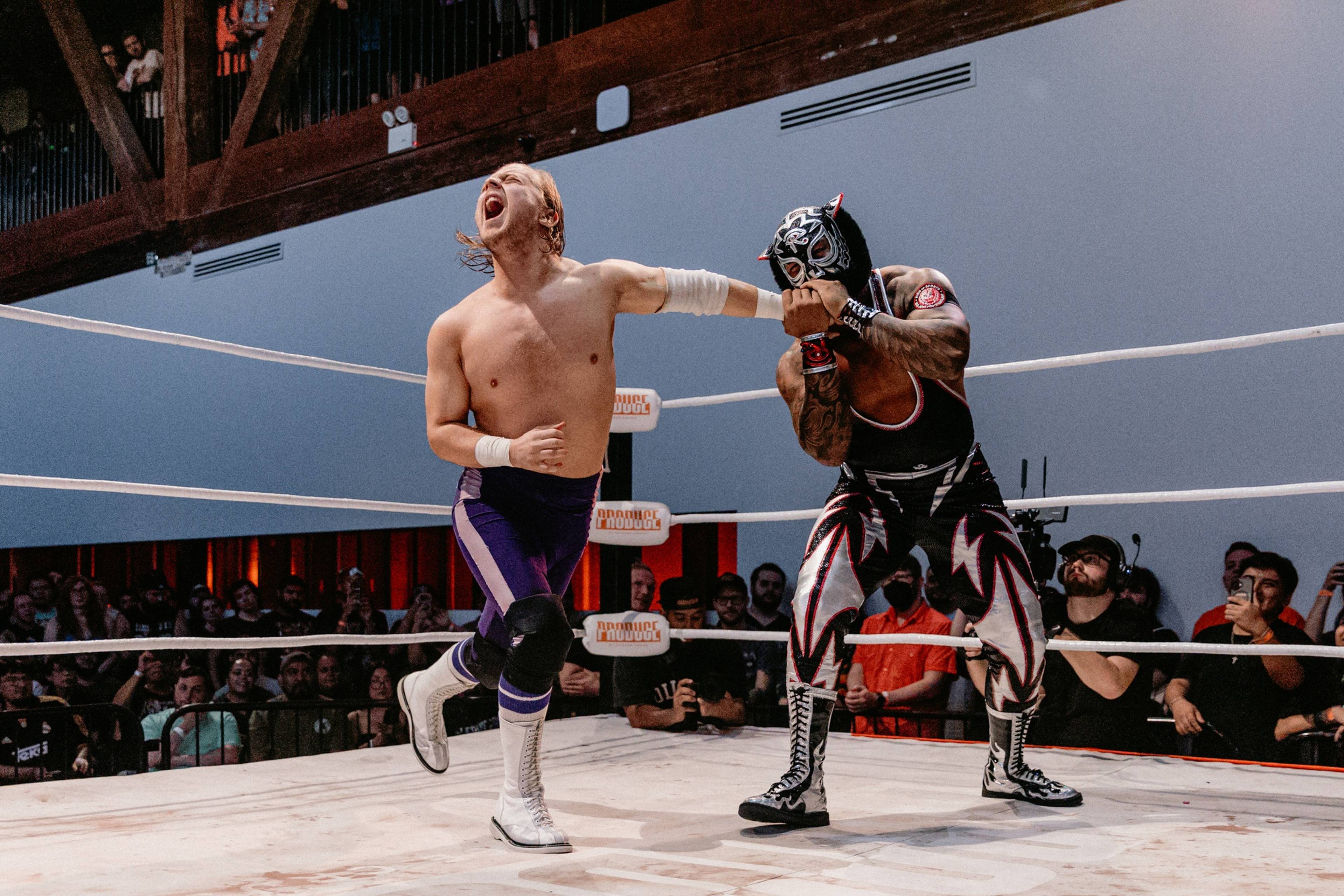
Have you ever heard a body hit the padded steel and wood planks of a wrestling ring? It’s jarring, in person – slappy, clattering, a symphony of falling meat. One mosquito-bitten night in August, I journeyed to the postindustrial art space Pioneer Works in Red Hook, Brooklyn, for an indie wrestling showcase called PRODUCE: Volume 3. Looking down on the squared circle from the mezzanine, what struck me was the blood. Splatter dried and rinsed to the color of chocolate stains decorated the PRODUCE logo on the canvas. The WWE (World Wrestling Entertainment league) can afford the dry cleaning, I guess, but at this level the dramatic gouts of suffering stay right there in the fabric.
A gallery isn’t an obvious venue for wrestling, except that the organizer of the PRODUCE series, businessman Adam Abdalla, is better known in our field as the head of Cultural Counsel, a ubiquitous force in the world of contemporary art PR. It’s hard to overstate their influence. Founded in 2015, CC represents everyone from A24 to Kickstarter to the City of Miami Beach – and Pioneer Works. CC feels like the champ of an art world where there are far more publicists than critics.
In the wrestling world, I was a bit adrift, unfamiliar with the storylines or the characters, only vaguely grasping the feud between a trio of Japanese women dressed like ravers and their American rivals in red and black pleather, or the pathos of a couple of veterans like Minoru Suzuki and Hechicero, familiar with the world’s biggest rings, spending Monday night in a gallery trading slaps to the chest. The thirty-man Royal Ranbo, though, featuring everyone from a rapper with a hype man to a rockabilly in a diaper, was highly entertaining: a sweat-glazed choreography of good guys and bad guys, or what’s called “faces” and “heels.” As the match ground to victory, I overheard one of the fallen remark to a colleague: “In the kayfabe days, this would’ve gone on all night.”
But, you’ll say: Art is real, while wrasslin is, let’s face it, fake. No, wrestling is staged, it’s theatrical, which is not the same thing. And besides, what is it about Art, as in artifice, that’s so real? The art industry has its own kayfabe.
Yes, kayfabe – a term of art in pro wrestling, defined along the lines of “always stay in character.” Writer, wrestling journalist, and former High Times editor Mike Edison calls it Talmudic: “a living, breathing body of law and scholarship…” The clearest examples are negative, when the curtain slips: people point to 1987 when the Iron Sheik (heel) and his mortal enemy “Hacksaw” Jim Duggan (face) got arrested for drug possession together on the New Jersey Turnpike. The Sheik (who, in life, had been a bodyguard to the Shah of Iran) was a flagrantly Orientalist bugaboo, while Hacksaw ran around with an American flag and a 2x4 – this was geopolitical rivalry distilled to its most stupid, and sort of beautiful that way. Their bust was like George W. Bush getting caught cutting lines with Osama bin Laden. If you didn’t know wrestling was a scripted spectacle, you knew it then. But that hasn’t stopped people from loving it.
Imagine a world where, instead of queasily, jealously dreading the huge group shows studding the calendar, people looked forward to the next Made in L.A. like it was WrestleMania. Artists are certainly competitive. Maybe stoking conflict is the way to the top. Enough’s been written post-Trump about the WWE vibes of US politics and the Faustian gains of ragebaiting. But there’s undeniable power to a biblical framework of Good battles Evil. Pro wrestling has narrative tissue, abscesses of revenge and envy, and turnovers between cliques and stars – a rich range of human endeavor held together by the common project of the league. In return for the entertainers’ pain and skill, fans give their most guileless loyalty. Don’t we want the same for Contemporary Art?
But, you’ll say: Art is real, while wrasslin is, let’s face it, fake. No, wrestling is staged, it’s theatrical, which is not the same thing. And besides, what is it about Art, as in artifice, that’s so real? The art industry has its own kayfabe. The Talmudic contract here is that every artwork is a sincere expression of another human being. This, you cannot question. Start asking if an artist really means it, and you should find another hobby. Most do, many don’t, and only they, in their hearts of hearts, know the truth. Without this shared ambivalence among artists and their public, there’s really no reason to care about the work itself, and art world debates fall back on less satisfying but more concrete objects like prices and popularity.
Indie wrestling event “PRODUCE: Volume 3,” Dynamite Kid versus Black Tiger IX. Pioneer Works, New York, 3 August, 2026
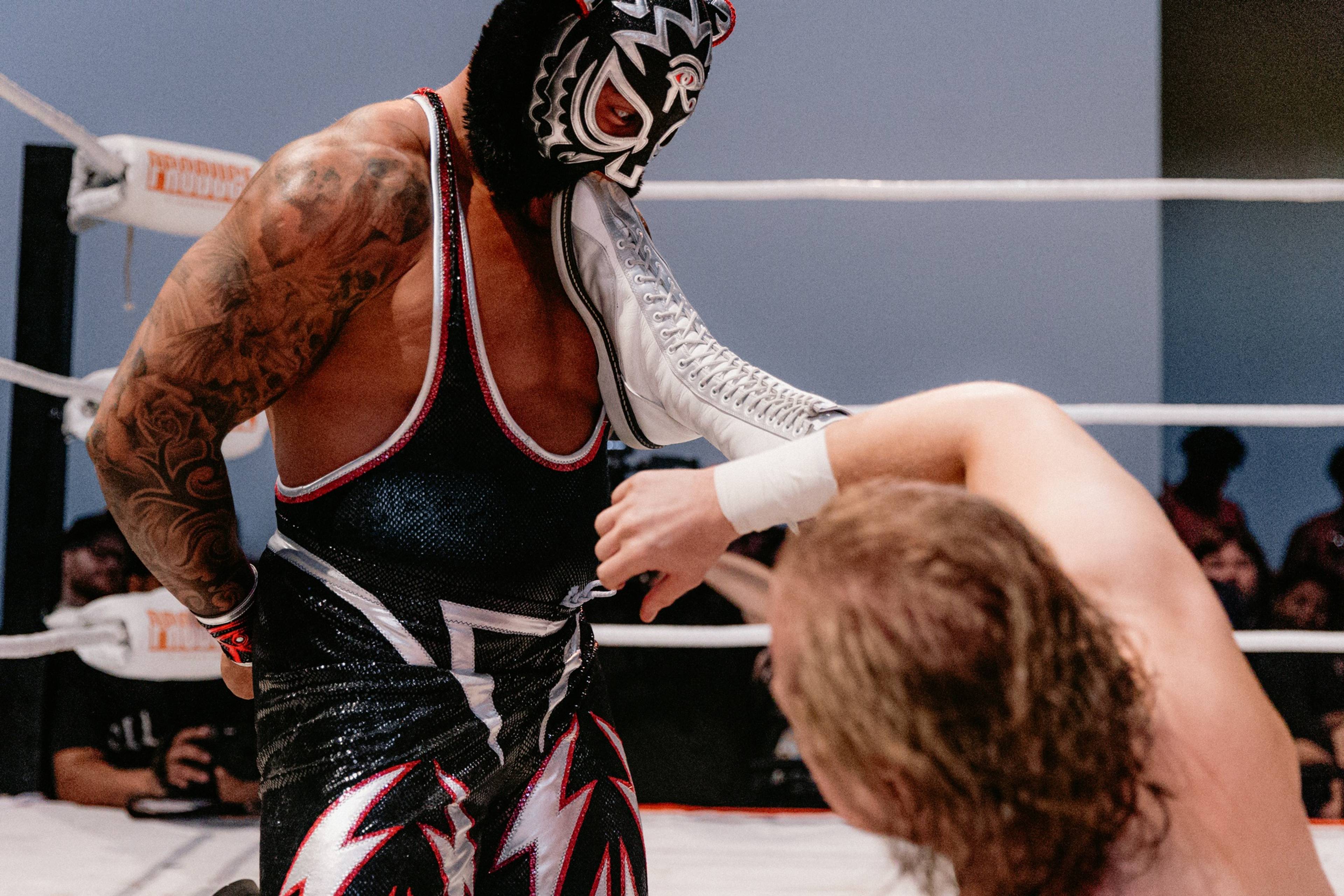
The real obstacle to prime time is that artists can’t be made to play legible moral roles. Who are art’s good guys? Maybe the painfully earnest: Ai Weiwei, Hilma af Klint, Agnes Martin, Anselm Kiefer, Cameron Rowland come to mind. You can roll your eyes, you can yawn, but their gimmick is to Really Fucking Mean It. Maybe they do. I’d argue, though, that sincerity is still a gimmick. Things get more interesting in the gray zone, with the oblique, the heartfelt, the prismatic, the daunting then taunting then haunting – I’m talkin about Pope.L, Lutz Bacher, Allan Sekula, Robert Smithson. That’s a tag team match I’d watch.
I made a list of art world “bad guys,” too. It feels a little unfair. The wrestling analogy breaks down, for the simple reason that, while wrestling heels revel in “heat,” or the crowd’s hatred, art world villains act aloof. Tom Sachs, with his borderline abusive management style; Alex Israel, whom a dealer once described to me as “the most hated artist in LA” – I don’t see these guys basking in boos and hisses. (Actually, early in my career, Alex came up to me with a pretty good retort to my gutting review of his show: “I like what you wrote about me.”) If they goad the public, it isn’t often with baroque braggadocio but platitudes and evasions, like Jordan Wolfson’s deliciously reluctant press junket for his September comeback show at Gagosian in the mode of “Larry is making me do this.” The punchably buoyant persona of Jeff Koons makes you nostalgic for his edgier 1980s self, when he claimed the title of “fucking genius” in a Madrid club. It’s not that these guys are bad artists. It’s that they take on personas too cool or too tortured to be vulnerable with their fans. “You start out as an artist,” Wolfson told Andrew Russeth at Artnet, “and the idea of getting attention is attractive to a young person. That attraction is a symptom of being an amateur.”
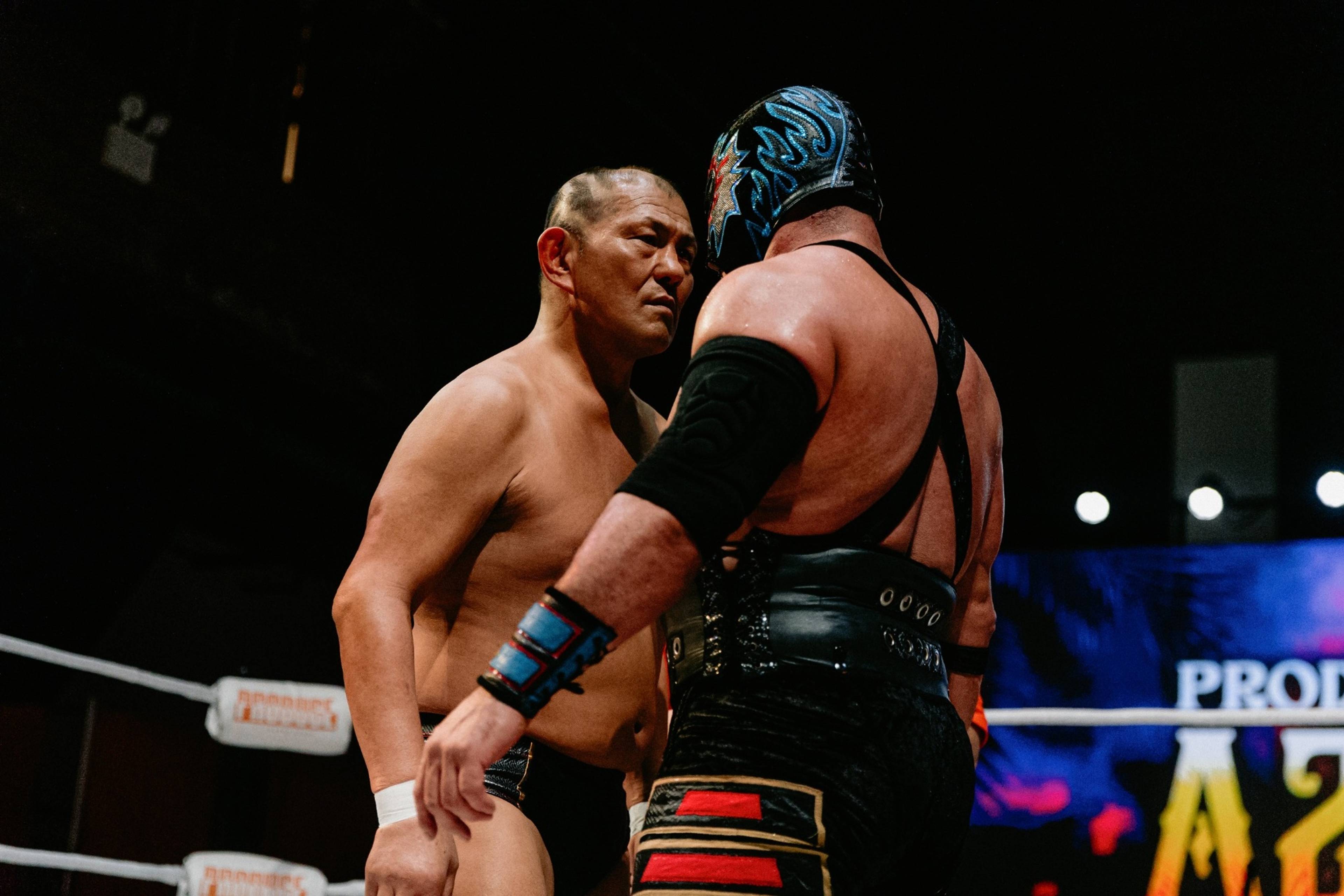
Indie wrestling event “PRODUCE: Volume 3,” Minoru Suzuki versus Hechicero. Pioneer Works, New York, 3 August, 2026
But conflict, they say, is king. Attempts to draw crowds to an art museum often involve a little artificial rivalry. Like the Turner Prize: four artists enter, one artist leaves. But art contests have always been awkward. Artists, while ambitious, don’t like being pitted against one another so directly. This is part of a general risk-averseness in the art industry, part of the feeling that everything is a fight so maybe art shouldn’t be. In 2012, the first Made in L.A. biennial announced the Mohn Award (funded by Jarl Mohn, a former MTV and E! producer). A life-changing 0.1 million dollars would be given to a biennial artist chosen by a public vote. Some of the artists balked, and tried to strategize. Would they refuse to participate? Would they promise to share the pot? Ultimately Meleko Mokgosi, a relative unknown, beat out the veteran Simone Forti and hometown heroes Slanguage, and everybody moved on. Since 2014, the big prize has been juried and a smaller one awarded by visitors. But I’m not sure the biennial ever shook the bad American Idol vibes.
The current Venice Biennale has stumbled into a similar idea. As we speak, the Biennale is polishing something they call “Visitor Lions.” Here, a little direct democracy is the organizers’ fallback plan after the Golden Lion judges declared they wouldn’t consider awarding a country with active warrants from the International Criminal Court on their leaders – meaning Israel and Russia – then resigned. Over sixty artists have withdrawn from the contest. Their names are still on the ballots, though, and given the anti-nationalistic nature of their protest, it feels especially ironic to force them to compete. You won’t want to miss the thrilling conclusion at the Award Ceremony on 22 November.
It’s not that the art world fights too much. It’s that we don’t know how or why to fight about art.
The PRODUCE Instagram grid is nothing but wrestlers vowing to violence one another. Good for them! Pre-match trash talking is as important to sports entertainment as the little razor blades performers use to cut their faces in the ring. But art world callouts rarely result in a friendly cage match. The formerly anonymous writer who blogs as the Art Daddy has spent three years baiting her favorite moneybags man-children, megadealer Larry Gagosian and collector/Instagrammer/ex-pro gambler Jeff Magid. It’s a running joke that they ignore her. I wonder if debate is the point. If Larry Gagosian suddenly challenged Art Daddy to a podcast, the Truth to Power gimmick would need to put up or shut up. That said, the Art Daddy’s schtick is on the good-natured side of the steroidal art world soliloquies flying around the open web. To stay sane, it’s better to treat art world call-outs as performative, or else as regular trolling. It’s tough to imagine how clapping back could turn antagonism into a constructive argument.
It’s not that the art world fights too much. It’s that we don’t know how or why to fight about art. Not much of what I’ve mentioned so far has anything to do with artwork. More and more, debates in the art world feel like proxies for bigger, moral contests like racial justice or wars of aggression. I think it’s safe to say art museums and magazines are inadequate venues for these issues, even though clashes of aesthetics feel frivolous in comparison. We’re living through the end of art history, well past the storyline called the avant-garde that used to organize the violence between styles and ideas. We’re left with institutions built for conflict, but without the shared project that once gave that conflict meaning. The art world doesn’t need to believe in aesthetic progress the way it used to, and it shouldn’t, but it does need to agree that art itself matters enough to fight about.
One of my favorite art history scuffles, I think, contains some seed of today’s atomized, platform-powered discourse. In 1967, critic Michael Fried wrote “Art and Objecthood” in Artforum to defend the High Modernism he loved. Fried methodically took the piss out of Minimalism and its glorified rows of boxes, calling it facile, indecisive, theatrical. He thought the new art betrayed formalism in order to give the masses more spectacles. Artist Robert Smithson, though, who was kind of a minimalist but definitely rolled with that crowd, fired off a perfectly puckish letter to the editor. “Every refutation is a mirror of the thing it refutes – ad infinitum,” he wrote. “Every war is a battle with reflections.” Reversing the critic’s moralizing undertones, Smithson’s piece ends with a vision of Fried as a bible-thumping preacher prancing across a psychedelic infinity of small, hard-edged stages.
As Fried feared, Minimalism triumphed, and the art world plunged headlong into theatricality. A thousand postmodernisms bloomed. But Smithson’s jeering vision came true too: we are all on our own little stage now, and the space in between has turned trollish and bitter. This isn’t a conversation or even a fight. It’s hell.
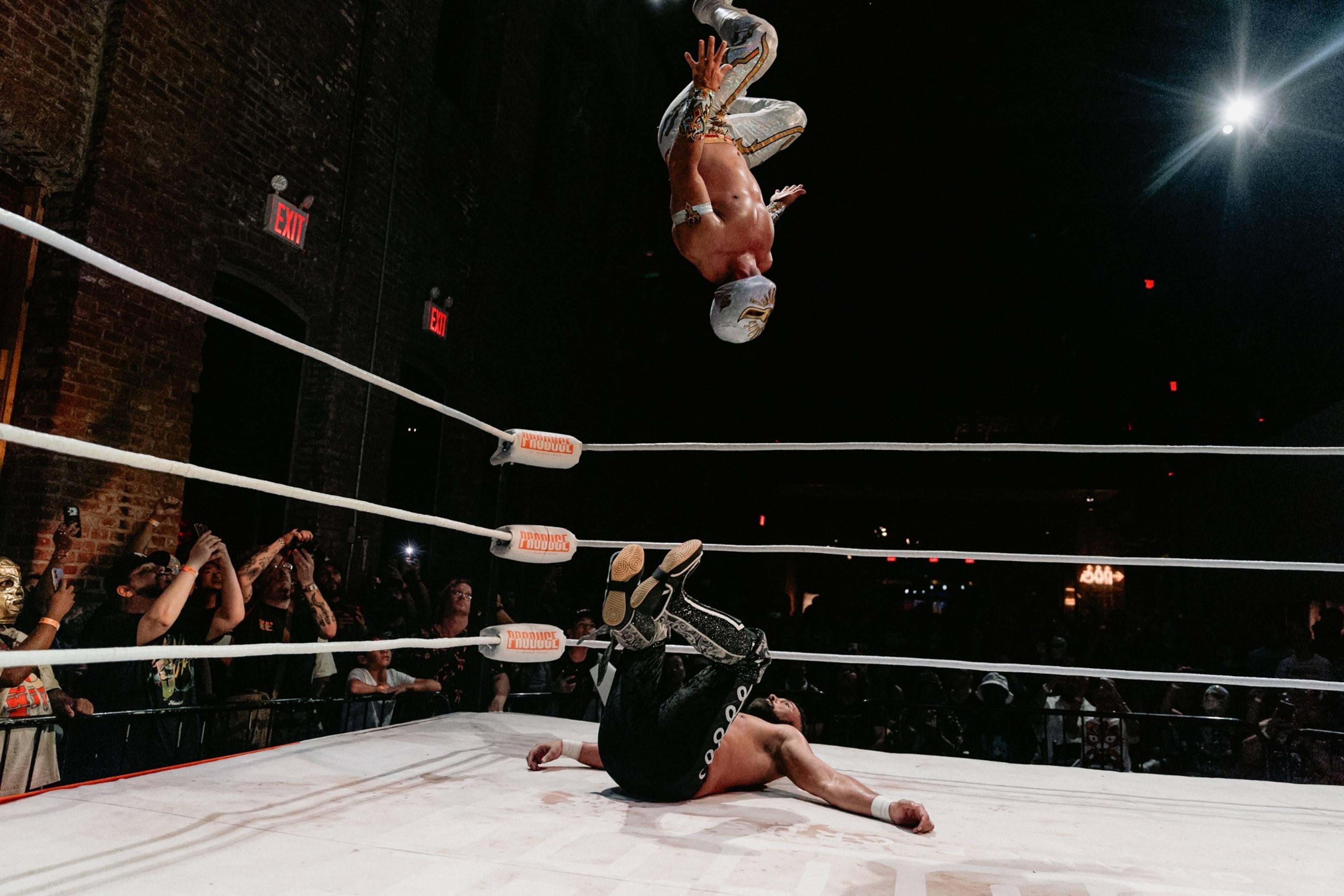
Indie wrestling event “PRODUCE: Volume 3,” Mistico (in the air) versus Rocky Romero. Pioneer Works, New York, 3 August, 2026