

I staggered out of the multiplex into the light of the Staten Island Mall, across a Lidl parking lot, to a godforsaken bus stop surrounded by shopping carts. I had just spent three hours in Christopher Nolan’s The Odyssey, like millions of others, but I was thinking about a different epic: Jackass: Best and Last.
Today in New York, it’s a trial to find a screening of either film – Jackass because not many theaters are still carrying it, The Odyssey because the vast seat maps on the movie ticket seller Fandango.com are full, marked with little crested helmet icons. Thence, my journey to the heart of New York’s fifth borough, Staten Island, by train, ferry, bus, and foot, on a quest for a seat at a distance from an IMAX screen that wouldn’t aggravate my scoliosis.
The Odyssey, you’ll remember, follows the titular ruler of Ithaca on his long, dangerous journey home from the Trojan War. Odysseus leaves Troy with three ships full of soldiers, and washes up ten years later completely alone, the sole survivor. The Jackass franchise, meanwhile, features a lovable crew of misfit stuntmen led by coiffed hero Johnny Knoxville who, in the spirit of lo-fi skate videos, find innovative and hilarious ways to get hurt or vomit. It’s worth underscoring how extreme some of their pranks get. People seem scandalized by the rumor someone pooped in the pee-only toilet feeding the swim tank in Florentina Holzinger’s Seaworld Venice installation, but this hardly approaches the majesty of a classic Jackass stunt called Poo Cocktail Supreme, in which Steve-O is strapped into a fully loaded porta-potty and launched into the sky.
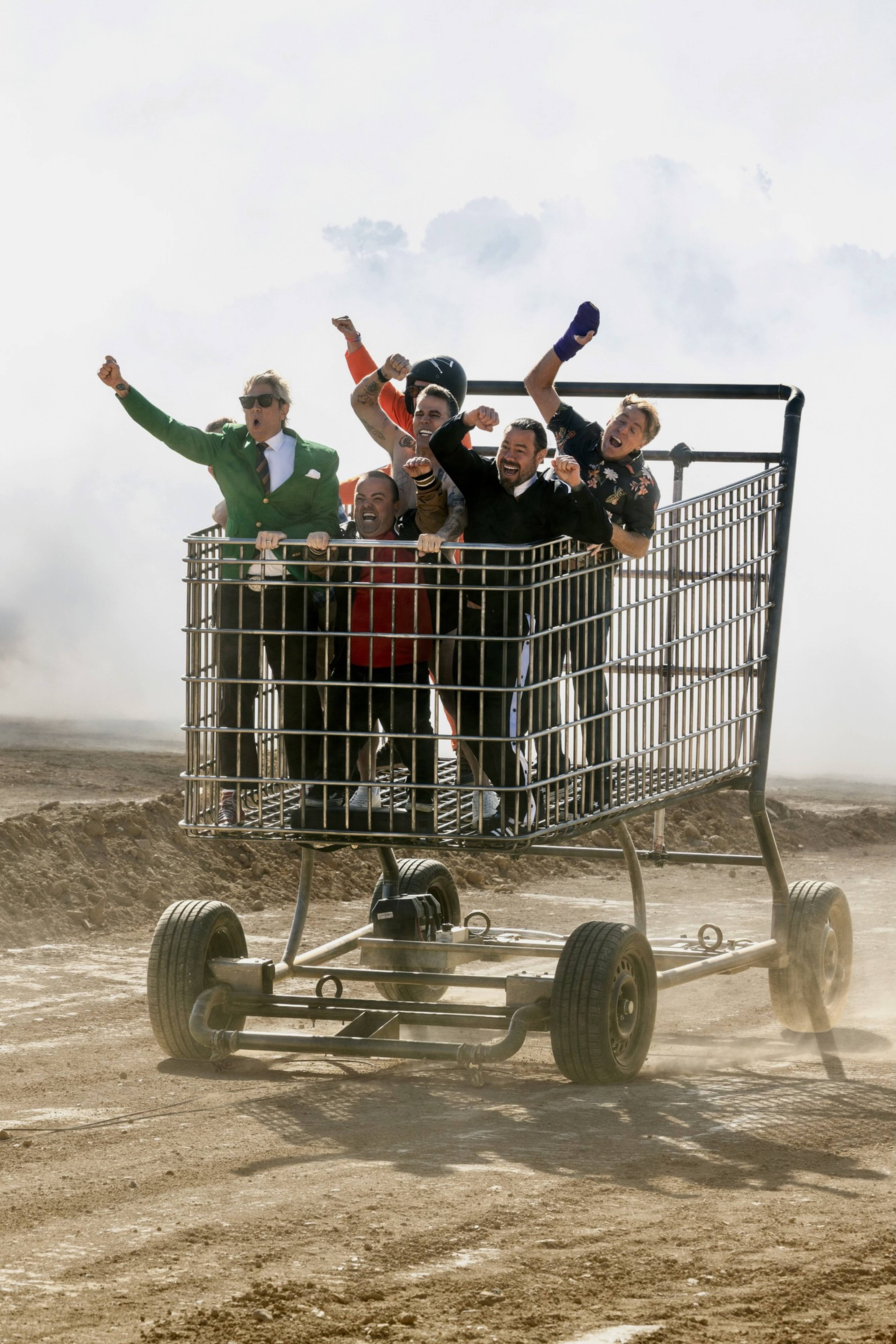
The shopping cart is the Jackass cast’s bireme. Just as Odysseus and his warrior buddies hoist bloody sail, Johnny Knoxville and his loyal crew crowd into gigantic custom shopping carts. In the final film’s last scene, several of them ride a shopping cart the size of a monster truck through blasts of dirt and rocks, candy-colored cars exploding and lawyers running for cover as they pass, until finally their silver wire vessel careens over a cliff and explodes too.
The beauty of Jackass is that these young men are veterans of a conflict not many people know is happening. That war is ongoing. It comes into view when the sad little war in Iran feels like some boomer’s last gasp gambit to beat a phantasmic Viet Cong.
Unlike in Homer’s tale, in the twenty-five-year odyssey of Jackass, almost everyone lives. Some addicted, in pain, a couple lives wrecked. But by that measure, Knoxville is a far better leader than Odysseus. In the last film’s final scene, the Jackasses enjoy the macabre spectacle of watching charred mannequins in their clothes and red Converse smoldering in the shopping cart’s wreckage. These muscly, tattooed, fearless fucking freaks who kick, tazer, scare, and abuse but most of all love the living shit out of each other. They stand over the bodies of the characters they’ve played, having become, over a quarter of a century – from their dewy twenties into their leathery fifties – a funeral for the best years of their lives.
There are more than a few parallels between these two blockbuster buddy films. Take Nolan’s touted preference for practical effects over CGI. It doesn’t get much more practical than chugging colonoscopy laxative then playing Twister with your bros. Both epics are structured with episodic vignettes; one trial leads to the next with only the faintest causality, you survive this and you survive that (or you don’t), with the occasional callback to a previous stunt or prophecy. Fitting this meandering method, Jackass: Best and Last and Nolan’s Odyssey both rely heavily on flashbacks, stories within stories, clips and songs with added commentary, a present-day framing narrative chopped and screwed into some opiated mythic rhythm. And, in both cases, enough time passes in-story that viewers can orient themselves by how grizzled and gray the characters look. Because both films, let’s face it, at their hearts, are about aging. Each battle, detour, quest, and reckless, concussing stunt defers fate and defies the gods.
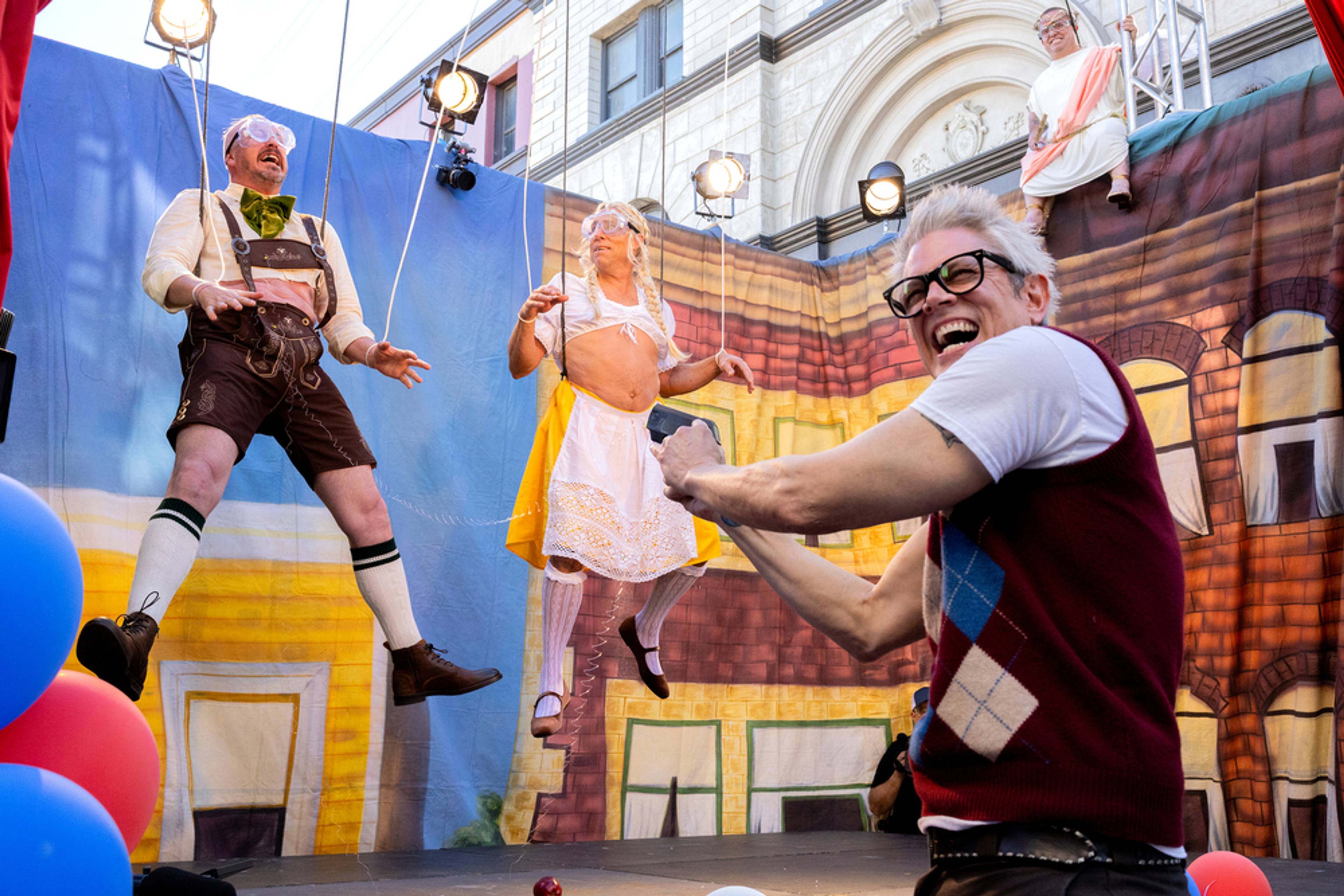
Still from Jackass: Best and Last, 2026. © 2026 Paramount Pictures
When Jackass was on the air, my parents wouldn’t let me watch MTV. It wasn’t until much later that I realized there was more to the show than a bad fratty aura. Its masculinity is farcical and campy. The violence is self-inflicted, consensual, and mutual. A lo-fi archival clip during the Best and Last credits shows one performer on his knees. “I need help,” he says, simply, directly. A hand shoots out.
I’m sure it was tough for Odysseus to watch his men all hacked and munched and drowned to Hades. But in a way, Nolan’s Odyssey (after Homer’s) isn’t an anti-war film so much as an anti-buddy film. The sack of Troy is portrayed as a war crime, the Iliad as a wasteful struggle over trade routes on the thin pretense of honor, but Nolan’s film is less in the traumatized style of Kubrick’s Full Metal Jacket than the resigned tradition of Spielberg’s Saving Private Ryan. War is fucked up beyond all recognition, that sentiment goes, but “ours is not to reason why” – for mere mortals, it’s not about the machinations of the battle lines, but about the men next to you, those men you’ll die for and who’ll die for you, your brothers in arms. Unfortunately for his comrades, Odysseus is selfish and entitled, maybe a little charmed, secure enough in the gods’ favor to, as the film’s tagline has it, “Defy the gods.” He’ll be fine! His brothers? Well, as he says, he will honor them by surviving. Every adaptation of a 3,000-year-old story is going to reflect its time, and Nolan gives his selfish age an especially self-centered hero.
Jackass is an ensemble project. There’s hearty competition among the cast to endure the most pain and humiliation. Still, Knoxville is their leader for a reason: he takes the hardest hits. The opening stunt of Best and Last was filmed in 1997 but was available only underground until now, because it’s so extreme – and people have literally died trying similar things for clicks. Knoxville, young dumb and full of cum, announces himself as “Johnny Knoxville United States of America”; he pads a cheap bulletproof vest with a few girlie mags then shoots himself in the chest with a revolver. This description doesn’t capture the dripping insanity of the moment, as the cylinder clicks one, two, three, four times before the bang.
He’s fine, of course, but the clip sets up the final Jackass film in a poignant way, since basically every stunt from there on out, for the next quarter century, will be a version of the same thing: gonzo Russian roulette, using safety gear. They want to get hurt, to get close to death without dying. They grow old doing it. Ah, it’s like the sirens’ song in Nolan: they sing about the thing you most want in the world, the thing you can never have: the thing you had but lost... Time. Odysseus strapped to the mast wails in extremis like a graying Steve-O getting a prostate exam from a humanoid robot. They share that same impossible anguish.
If Knoxville thinks of himself as an artist, it’s in the vaudeville tradition of Buster Keaton. Critic Philippa Snow writes in her 2022 book, Which As You Know Means Violence: On Self-Injury as Art and Entertainment, that Knoxville explicitly rejects the label of performance artist. He says in an interview that the term “just comes across as highbrow, elitist, pompous, and not entertaining.” For Snow, the foil to Knoxville is American performance pioneer Chris Burden. She reads Burden’s early work in the 1970s – not least Shoot, where he gets winged by a .22 bullet – in terms of the Vietnam War. Vietnam was Troy, except the Greeks lost, and we’re still mad about it.
Snow also sees Knoxville and Jackass as reactions to war trauma, although the war is less specific. 9/11 hadn’t happened yet when Jackass first aired, our boys were too old to fight the War on Terror. The beauty of Jackass is that these young men are veterans of a conflict not many people know is happening. That war is ongoing. It comes into view when you hear the US Secretary of Defense whine about diversity hires and promise to boost the troops with testosterone, when the sad little war in Iran feels like some boomer’s last gasp gambit to beat a phantasmic Viet Cong, where strength and masculinity and honor are equated with the capacity for violence, a stock stupid version of masculinity still symbolized for many by the Spartans...
It’s a war to define manhood. And Jackass, gonzo guerrillas, fought it for decades. One of the new skits has Chris Pontius, now fifty-something, do a nude high jump as a salute to the original Olympics. He slaps his not unlarge penis on his thighs, back and forth; then up and down, from tummy to taint. The sound guy trains a boom on his dick. Slap, slap, slap, slap, bang.