

I didn’t expect to like Diane Severin Nguyen’s War Songs. The lens-based artist’s commission for the 11th Performa Biennial, a musical revue of Vietnam-era protest songs fronted by a folkie-coded pop singer, promised to bring her stylish vision of globalized youth culture to the subject of US crimes against humanity. On stage, a cast of a dozen musicians in a mix of denim and streetwear offered new arrangements of Vietnam War-era anthems including a shoegaze Bob Dylan cover and a drill version of a folk song called “Napalm Sticks to Kids” (ca. 1970), plus a jangly rendition of 2009 “Party in the USA” by Miley Cyrus. A quilt of bleached American flags wobbled behind the stage and a camera swooped in front on a crane. It was an awkward evening of off-key song, corny and earnest unto cringe.
Judging from the lobby chatter after the show, people were confused and disappointed. As a performance, a “show,” the musical revue had been uneven, unpracticed, and strangely bitter. What had been the point? But I liked it. I related to the feeling that protest art has been the set dressing of so much cynicism and dashed hope that the only way to access or even approach the idealism embodied by our rose-colored picture of the 60s counterculture is through irony. It’s going to be awkward. It has to be. Which makes performance an appropriately awkward medium. Performa asks visual artists to work outside their comfort zones and in front of live audiences. Many learn what anyone who has endured an alt-lit poetry reading can tell you: it’s hard to hold a stage. However caustic or blasé your material, at a basic level, you need to believe in what you’re doing – a prelude to embarrassment.
Luckily, performance doesn’t need to be technically good to move you. When the band struck up Dylan’s 1967 “I Pity the Poor Immigrant,” I felt it. Yes, I thought of masked Immigration and Customs Enforcement agents throwing brown people into unmarked vans. But it’s a backhanded song, and Diane was backhanded to include it. Dylan portrays the immigrant as base, greedy, misguided, viciously committed to the American dream. Probably Irish or Italian. But this doesn’t wipe away the song’s relevance, it multiplies it. This war is all wars, this hate all hates, and the pityer is pitiable too.
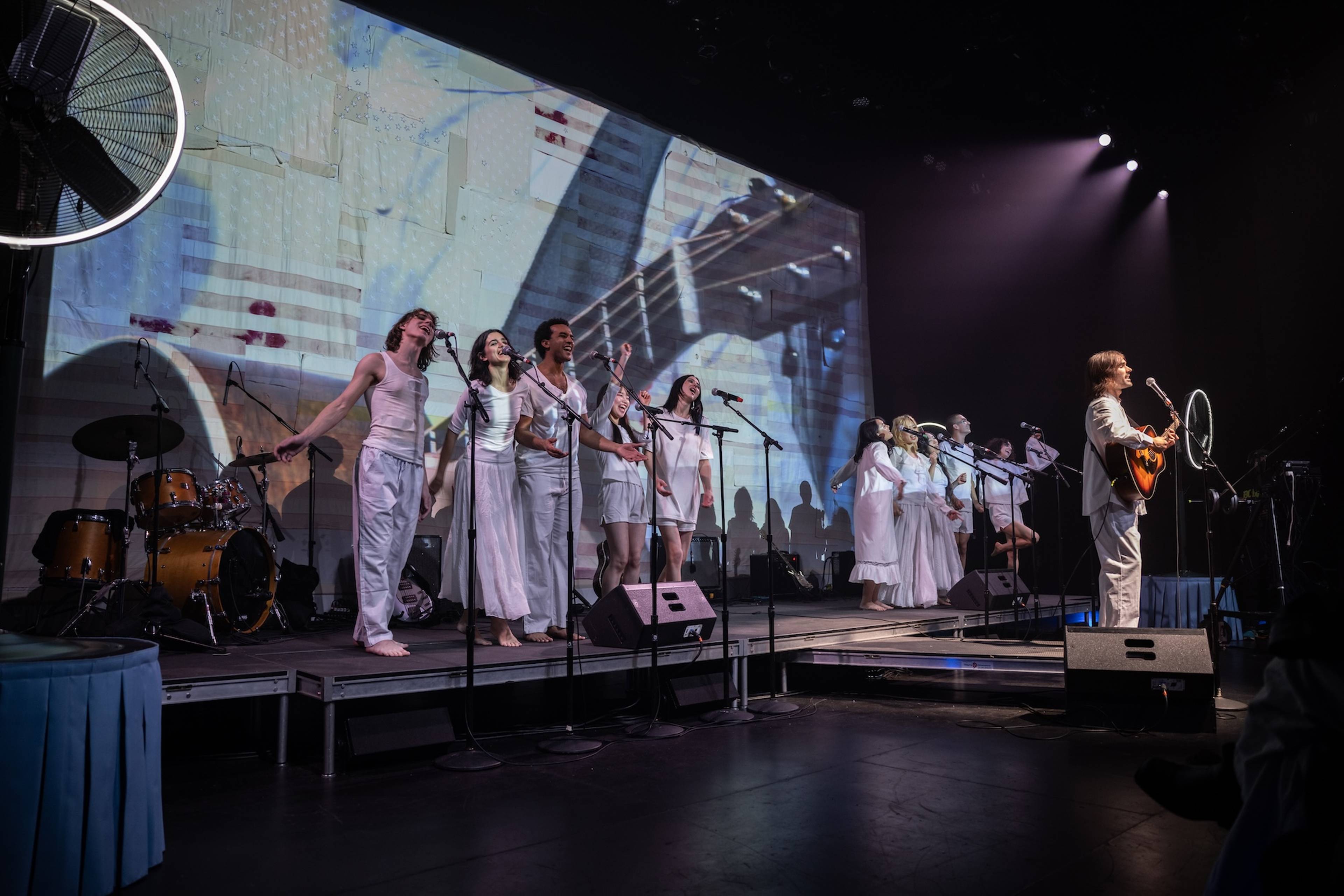
Diane Severin Nguyen, War Songs, 2025

Performance views, Performa Biennial 2025, New York. Photos: Julia D'Ambola
Yeah, War Songs was cringe, and War Songs knew it. “Some people might call this cringe,” said the lantern-jawed singer, Laszlo Horvath, in his closing monologue. “Fine, fine. Cringe is what happens when you care about something in public. Cringe is the sound of the walls breaking.” I couldn’t find these lines online, so maybe Diane wrote them. Much of the speech is from Martin Luther King’s anti-war address at the Pentagon in 1967. But I’m not sure caring about something in public is what’s embarrassing. More like caring about something that fails. Like believing that protest art can make a difference, stop this war, when it’s never stopped one before. It was cringe when the cast came out for a final number, a group singalong of “This Land Is Your Land” by Woodie Guthrie, recorded 1944, because manifestly this land is more some people’s land than others. Little blooms of red and blue dye seeped through their white cultist outfits as they sang, bleeding color for those bleached-out flags behind them.
According to the description of War Songs on Performa’s website, “This uncanny clash between the eras shows the trouble with protest music: these calls for freedom stick to a formula that makes them both timeless yet useless, just as one war becomes indistinguishable from all the other conflicts we see unfolding across our screens.” Fine, fine. I love Paul Virilio, too, when he says that technology renders all wars uniformly remote. But this framing is reductive. I think Nguyen was trying to have it both ways. Sadly, seeking truth is cringe, so the cringe-averse artist tries a roundabout way there: making art about how art doesn’t change anything. “In this dust / there was a city,” sang one performer a cappella, repeating a phrase from “99 Luftballons” by West German 80s band Nena that I didn’t realize was an anti-war song. Among a night of peacenik ballads in November 2025, the line slipped around time and space, now Hanoi, now Mosul, now Gaza City. Whatever you want. It’s a paranoid kind of camp, piling questions upon questions.
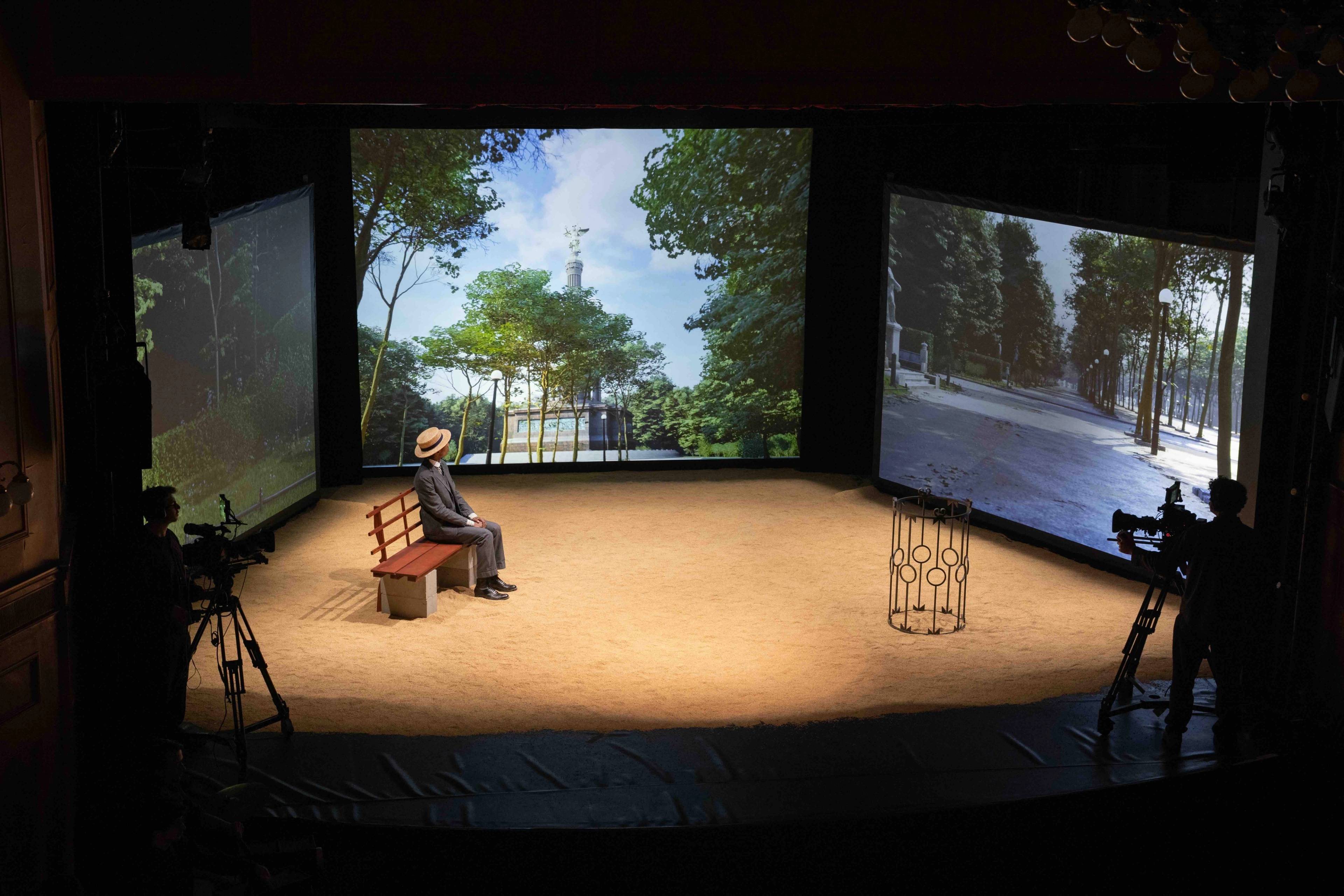
The scenario of artist and writer Aria Dean’s work, co-commissioned by Performa and the Hartwig Art Foundation, Amsterdam, took a more theoretical approach. Her one-act play, The Color Scheme, phrased the tension between idealism and realism as a dialogue between two Black men in Weimar Berlin, letters of introduction in their pockets. One a professorial type in a three-piece suit and boater hat, and one a worldly writer with Communist sympathies, they debate aesthetics as they stroll through Tiergarten. At first, the Philosopher seems out of touch, obsessed with the truth and beauty of the figurative monuments they pass, while the Poet insists on capturing the plain reality of the common man at the expense of artistry. They share a belief that art can improve the world.
How can artists speak to their time but also transcend it?
Dean’s mise-en-scene has a 3D-animated simulacrum of Tiergarten on three rear-projection screens behind the minimal set. Two cameras on stage frame the men walking in place against these backdrops and send the feed to the center screen, so they look like they’re ambling through the woods. This artifice, rather than breaking us out of the scene, broadens it, making the whole uncomfortable theater (the cameras, the three-member orchestra, the audience) part of the production, the performance, the mesh of artifice and sincerity that the Philosopher would call poetics and truth.
Naturally, their arguments feel pointed today. The Philosopher waxes lyrical about their shared African roots, alluding to the Harlem Renaissance and Cubism, but obliquely describing an approach to form and content that evokes today’s so-called identity art; the Poet, meanwhile, disdains the imperialist past in a way that figures today’s iconoclasm directed against looming figurative sculptures of violent white men. In other words, they’re wrestling art and politics. How can artists speak to their time but also transcend it? Especially when transcendence is a euphemism for negligence, and confessing this or any belief is cringe itself?
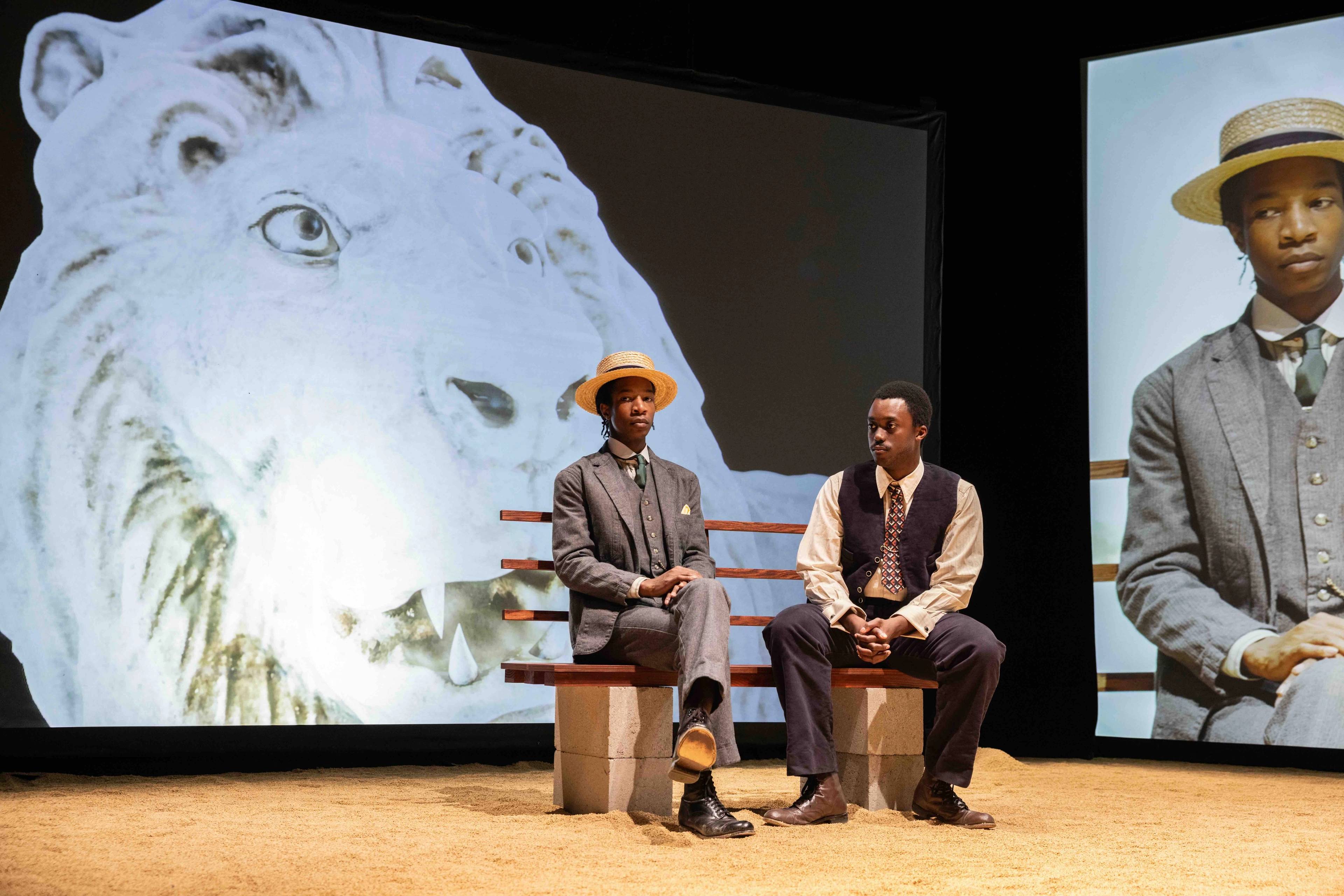
Aria Dean, The Color Scheme, 2025. Performance view, Abrons Arts Center, New York. A Performa and Hartwig Art Foundation Commission for the Performa 2025 Biennial. Photo: Walter Wlodarczyk
The Color Scheme is also a war song. The characters are searching for their place in a traumatized world; their conversation is abstract, but has a ponderous dramatic irony, because the audience knows what comes of both of their flavors of idealism: the camps and the gulags. Or at least we know that, a century later, their arguments still resonate, meaning not much has changed. This is both comforting and depressing. Both Dean and Nguyen appear morbid about our chances as a species, yet sanguine about the need to keep trying. You can’t look at hope directly. That’d be cringe. So Nguyen tries to avoid saying she believes in anything, and treats belief itself as the subject to depict, kept at lens length. Dean is doing something equally meta, but more Brechtian; call it the sound of the fourth wall breaking.
Each of the two men has a monologue where they’re silhouetted in front of the screens, and the images play the role of the mind’s eye. The professor’s is particularly striking. He describes the world as a kind of web of mutual reflections and perceptions, where truth is a sculpture to bump into in the dark, and images are light bouncing off it. “In reality, beauty is not what’s important,” he says. “Beauty is… a tool…” Cue a pulse of dissonant strings and cymbal crashes, as a 3D model of a statuary lion group flashes with joker paint and blackface. I think what he (or Dean) means is that the beauty/truth/etc. of these stodgy sculptures isn’t in the forms themselves, or in the murderous rulers who commissioned them, just as the truth isn’t in the tenements or a poem about the tenements but in some greater interplay between appearances, reality, and interpretation. Live performance and the performance of life.
I’ve wondered why theater is still trendy. Performa’s production value is higher than that of ad-hoc companies like the Brooklyn Center for Theater Research (of Dimes Square the play fame), but there’s a similar appeal to how approachable their artifice is. The flaws of the production, meta or otherwise, connect you to the common experience of a flawed world. Nguyen’s was the only Performa event I attended with remotely comfortable seating. The cramped auditorium hosting Dean’s show was worse than a cheap airline. I was writhing. But I forgot about that during the first monologue, and didn’t remember until the curtain call, when the prominent cameras swept across the audience like a kiss cam, confronting us with our gawking hope.