

Years ago, on a cross-country drive, I was taking a shower at a campsite. Water beaded on the chrome fixtures, crane flies flapped in the corners. Just one droplet spread the cold overhead light in such complex ways – what would it take for a video game to render photorealistic water in real time? You’d have to simulate every molecule, if not atom; calculate how every particle and ray of light weaves through the matrix of H2O and strikes our retinas and sets in motion the whole hallucinatory chain of vision. Anything less than that would be an abstraction.
I remembered this reverie in early June, at the 2026 Computer Vision and Pattern Recognition Conference (CVPR), as I surveyed a sea of people clinging to their round lunch tables in the Denver Convention Center. Who were they? Why were they there? Students presented their research and angled for PhD sponsors, or chatted up recruiters from Meta or Waymo. At least three startups had a self-driving big rig parked inside their booth. As one medical imaging specialist told me, the small guys were there to get bought by the big guys. What would it take to get to know each one of the 12,000 registered attendees, at least enough to make any statement about what they want, about our future, in aggregate? It struck me how much data each individual contained, and I could see the appeal of applying deep learning to the problem of all that human yearning. If you could somehow just download their brains…
But I can guess. Many of the people at this relatively small academic AI conference are hard at work dismantling the world of images. They’re remaking it as an intricate simulation, not by calculating the behavior of every molecule but by abstracting reality from a fairly random scan of previous states of matter – what we call pictures. It sounds scary, but don’t forget how unreliable and abstract the Sontagian image world already is. The idea was never really that a photograph captures or reveals reality. Susan Sontag said that the camera turns the world into a reservoir of potential images. The tool changes the world by changing how we see (On Photography, 1977). It’s happening again. The winning paper at CVPR 2026 (“Efficiently Reconstructing Dynamic Scenes One D4RT at a Time”) describes a new method to extrapolate 4D models from 2D video: “Traditional 3D reconstruction asks: ‘What is the geometry of everything, everywhere, all at once?’ We argue this exhaustive, rigid approach is fundamentally ill-equipped for a dynamic world.”
A low, nervous voice coming over the loudspeakers pulled me back to the present. It was someone explaining their artwork: the artist walkthrough had begun, and for some reason the audio was being piped all over the hall. This was why I was there: just past the Google booth was a juried AI art show. The entries had been selected by Luba Elliott, an English curator who specializes in electronic and AI-based art, putting on exhibitions at conferences like CVPR. She told me she was interested in the kind of art made by people with backgrounds in programming and robotics. For one thing, it’s a less snobbish scene than traditional fine art. Some of the artier projects on view included a quizzical, daisy-headed robotic arm with cameras and sensors positioned like a face (Yamin Xu) and an oil painting of the 1994 Stanford Bunny, a ceramic figurine that became a famous 3D-scanning test case (Zhanpei Fang). Another artist lay on a futon on the floor while an AI chatbot told her to rest (Avital Meshi & Dorte Bjerre Jensen). Most of the work seemed like whimsical product demos or proofs of concept, only with no obvious utility or marketability, which made it art. I’m interested in what most people, ie, non-art professionals, think is art. It’s a good gut check in a milieu where a working definition is: Anything discussed as art.
The question of whether AI can make art, or be useful for artists, seems less interesting than ever. The better question is what motivates an artist to pick up their tool.
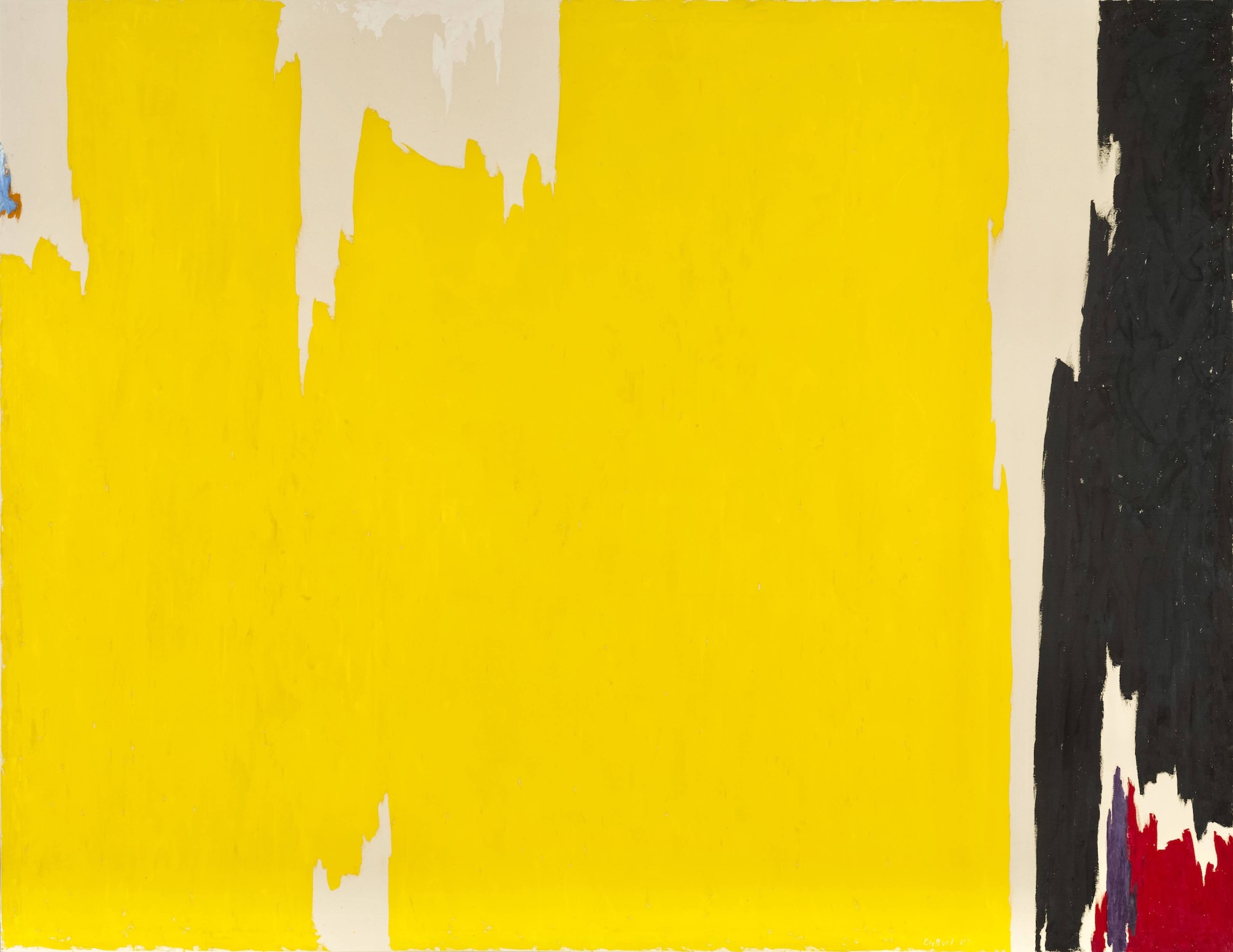
Painted on the side of a mall a block from my hotel was an ad for the Clyfford Still Museum, the monographic monument to the belligerent founding father of Ab-Ex (1904, Grandin, North Dakota–1980 Baltimore, Maryland). “The canvas was his ally,” it read. “The paint and trowel were his weapons. And the art world was his enemy.” The Still is a concrete box with galleries on the upper floor and open storage and conservation at ground level. Most of its 3,000 artworks have never been displayed. I spent an hour with Still’s canvases. I concentrated on PH-977, a nearly three-by-four meter, mostly yellow field, jaggedly defined by the artist’s rebellious palette knife, with a couple tongues of black and red and raw canvas near the edges. I wasn’t sure which emotions I was supposed to feel. Doesn’t yellow make you hungry, like at McDonald’s? Two speakers flanking the painting played a breathy electronic soundscape by artist and jazz musician Matana Roberts (b. 1975) inspired by Still’s piece, one of five ekphrastic compositions made for the show, “Still in Sound.” Eventually, I found a new appreciation for how much Still’s style owes to his favorite tool. The sharp little trowel gave his bold passages of color a scaly, manic texture. He had to paint. He had to paint like this, jabbing and smearing. Like a product demo, the tool came first.
While I was in Denver, glowing reviews of the datamonger Refik Anadol’s new immersive AI “museum” in LA called Dataland started appearing. I’m not surprised that roomfuls of shapes and colors appeal to selfie-seekers and children. I’m even willing to entertain that Dataland, or something like it, is the vanguard of popular art. I did raise an eyebrow, though, at claims to the effect that data-intensive AI art on this scale is inevitable, and that to understand it is to love it and vice versa. As Michael Govan, director of LACMA (Los Angeles County Museum of Art), delicately explained to the New York Times, “There’s not going to be a future in which this kind of work is not happening. It’s like Marcel Duchamp – if you know what’s behind it, you’re open to understanding it.” I guess I’m open to understanding it. Here’s a slightly different story: What’s behind Anadol’s work is lots of money from companies with an interest in mystifying and spectacularizing AI. There’s the sphere of art in action: Anadol’s work is art because it’s in MoMA’s collection, and it’s in MoMA’s collection because collectors with a stake in his success put it there.
Outside the Still was a stage and a few vendors selling folksy paintings, crystal wind chimes, and trippy stickers. It was the annual Denver Chalk Art Festival. Lone artists, or small teams, crouched over squares marked on the hot street, filling in jungle scenes or shroomy pet portraits. A couple artists were rendering their work in isometric perspective – from a bird’s eye view, it looked stretched out, but from the street, the figures appeared to pop straight up. At least one of these, featuring a cat in sunglasses riding a saddled velociraptor, seemed AI-generated. In 2022, when an AI-generated fantasy genre “painting” won first prize at the Colorado State Fair, artists were irate. But the question of whether AI can make art, or be useful for artists, seems less interesting than ever. The better question is what motivates an artist to pick up their tool.
Abstraction is a tool, too. It’s not as if our brains can track the positions of trillions of molecules – as much pain as the symbolic order causes, it’s necessary for us to function. But it’s possible to go too far. I’m skeptical of abstract art because it risks abandoning the lived world and ignoring history. AI, despite its hoards of data, does the same. Maybe a self-driving truck has horrible accidents in its dataset, maybe it has the romance of passing Colorado’s mesas and plains somewhere in there too, but those moments can’t be recalled or expressed in any meaningful or libidinal way. Machines don’t fall asleep, and they don’t dream.