

In “Pleas of Resistance,” on view at OK – Center for Contemporary Art, Linz and originally organized by Barcelona’s Museum of Contemporary Art, a significant gap between artist Carlos Motta’s (*1978) intended effects and his underlying concepts becomes apparent already in the very first work. In We the Enemy, artist Despina Zacharopoulou delivers a deadpan reading of a 2019 manifesto coauthored by Motta, fellow artist Atabey (f.k.a. Carlos Maria Romero), and critic John Arthur Peetz under the collective byline SPIT! (Sodomites, Perverts, Inverts Together!). She lists dozens of English-language epithets, invectives, and slurs for all manner of queer people, from the quaint to the dehumanizing: “the nancies and the fannies”; “the popper-sniffing fist-fuckers”; “the diseased and the destructive.” But, in light of the fact that many of these terms have been playfully reclaimed by just those communities they were meant to slur, the video posits a notion of the “enemy” that is brittly out of time with our present’s very unstable sense of meaning.
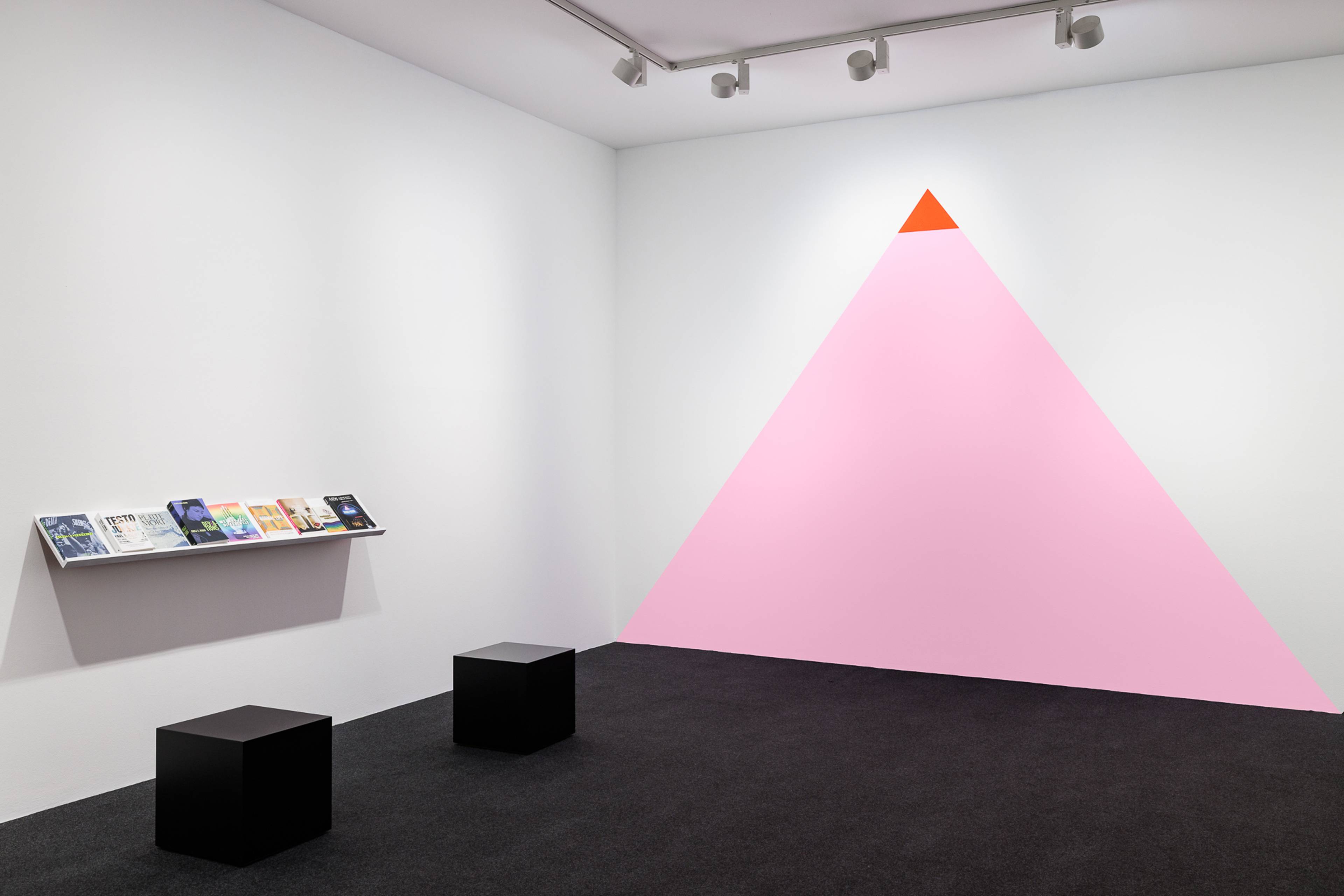
This serves as a foretaste to an exhibition that, despite all its rhetoric of decoloniality and queerness, tends less towards breaking taboos, opening up new aesthetic vistas, or troubling art’s heteronormativity than towards reinforcing narrative conventions. The following gallery left me cold, with its installation’s archival arithmetics: two triangles painted on a wall, accompanied by their exegesis within the gay rights movement, both textually and as audio by radio journalist Ari Shapiro; stacks of posters; a selection of touchstone reference materials like Douglas Crimp’s AIDS: Cultural Analysis/Cultural Activism (1988) and Paul B. Preciado’s Testo Junkie (2013); and a sketch of an AIDS counter-monument that, co-conceived with architect Koray Duman and writer/organizer Theodore Kerr, proposed two semipyramidal sculptures for New York’s High Line, one black (“encompassing all the colors of the universe”), the other pink (“the symbolic color of queer liberation”). (It was rejected in 2020.)
Carlos Motta , “Pleas of Resistance,” OK – Center for Contemporary Art, Linz, 2026. Photo: kunst-dokumentation.com / Manuel Carreon Lopez
There is relief from easy semiotics, and a sensual one at that, in Towards a Homoerotic Historiography (2014), a series of twenty “pre-Columbian” miniatures engaged in homoerotic acts; in a darkened room, the scale of the replicas and a luminous, museum-style display actually succeed in eroticizing history. Another gallery presents My dearly beloved R. (Monument to Alexander von Humboldt) (2013), an accomplished photo work that manages to dissolve a bronze statue of the German naturalist, first by trifurcating its image, then by insetting the text of a letter he wrote to a fellow army officer and secret lover: “I know that I live only through you, my good precious Reinhard, and that I can only be happy in your presence.”
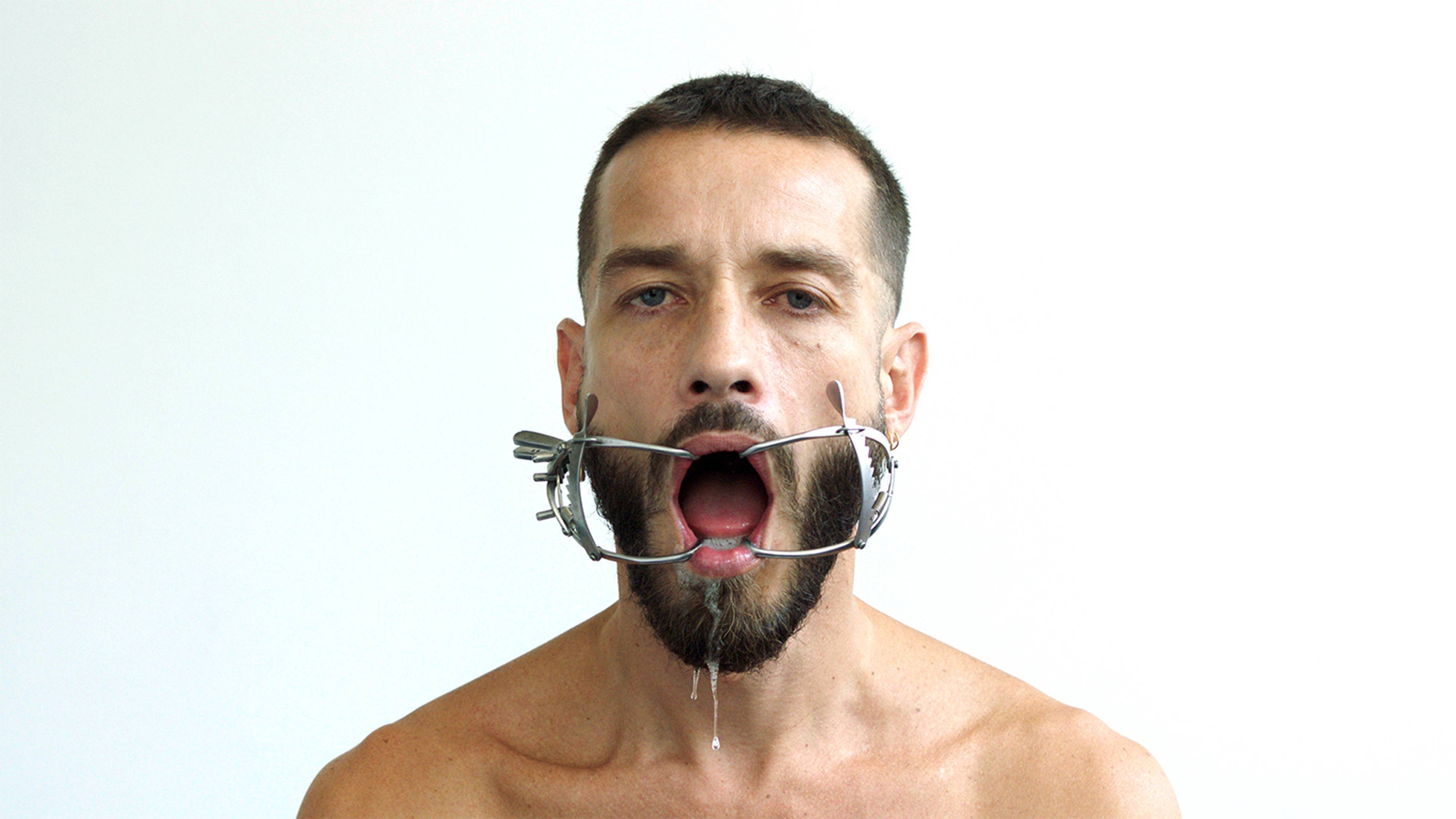
The exhibition’s key, most dramatic, and truly stirring moment is undoubtedly the video performance Legacy (2019), wherein Motta, wearing a mouth spreader (also known as a dental gag) and looking directly into the camera, attempts to articulate a 110-year history of HIV/AIDS while his face becomes increasingly contorted by pain. As Shapiro narrates matter-of-factly what Motta can only drool out through his bondage restraint, the work vividly illustrates – and all the more so in light of massive cuts in 2025 to the world’s leading initiative against the epidemic, the US government program PEPFAR – the limits of language, as well as of surrogate vantage points, faced with the enduring horror of the disease and the global failures to properly treat it.
Carlos Motta, We the Enemy, 2019. Installation view, “Pleas of Resistance,” OK – Center for Contemporary Art, Linz, 2026. Photo: kunst-dokumentation.com / Manuel Carreon Lopez
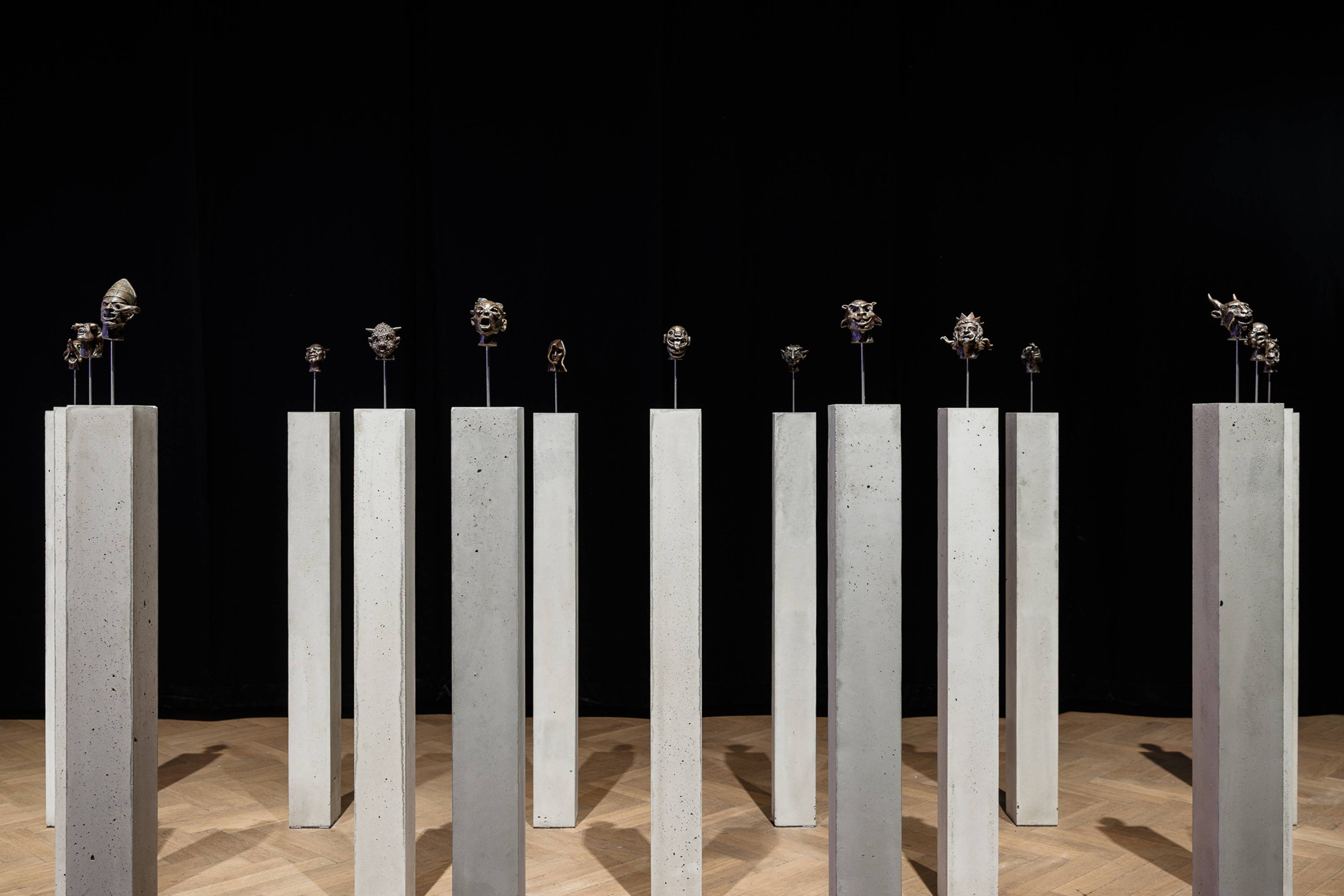
But such bracing clarity doesn’t last. For instance, it is not entirely clear why a group of bronze works on concrete plinths, forty-one in total, were arranged in rows that obstruct the view of Mourning Stage (2022), Motta’s video collaboration with Simon(e) Jaikiriuma Paetau. The presentation tempts one to view the sculptures either as individual works or as an ensemble that has “grown out” of the video – yet neither approach does justice to the respective media, and without a dramaturgical connection or other interaction to speak of, they mainly get in the way. Nor is there any meaningful spatial or thematic link between these sculptures, based on historical depictions of the devil in hell, and the exhibition-opening video with which they share a title, We the Enemy (2019). Not dissimilarly, the video When I Leave This World (2022) makes a somewhat muddy composite of its two channels. One sequence is a testimony of Tiamat Legion Medusa’s transformation from successful banker and family man into genderless “human dragon,” amounting to a portrait of singular self-directness, possibly of human delimitation. The other finds Medusa in an aerial suspension, hanging supine and virtually motionless by its reptile skin, that seems to drain it of vim and vigor, nearly of life; Motta, to whom Medusa is simultaneously speaking off-camera, dangles nearby, in a nude pose between Japanese bondage art and classical crucifixion.
It seems a little bit ironic, reproducing these religious motifs in an exhibition that foregrounds the oppression of sexual minorities by organized faiths. But perhaps just that quality of slippage, of often not quite knowing, in Motta, what’s the right amount of overdone, nicely encapsulates the tension between his noble social goals and his aethestic literalism. Even if, on the whole, “Pleas of Resistance” would have benefited from a little more curatorial stringency.
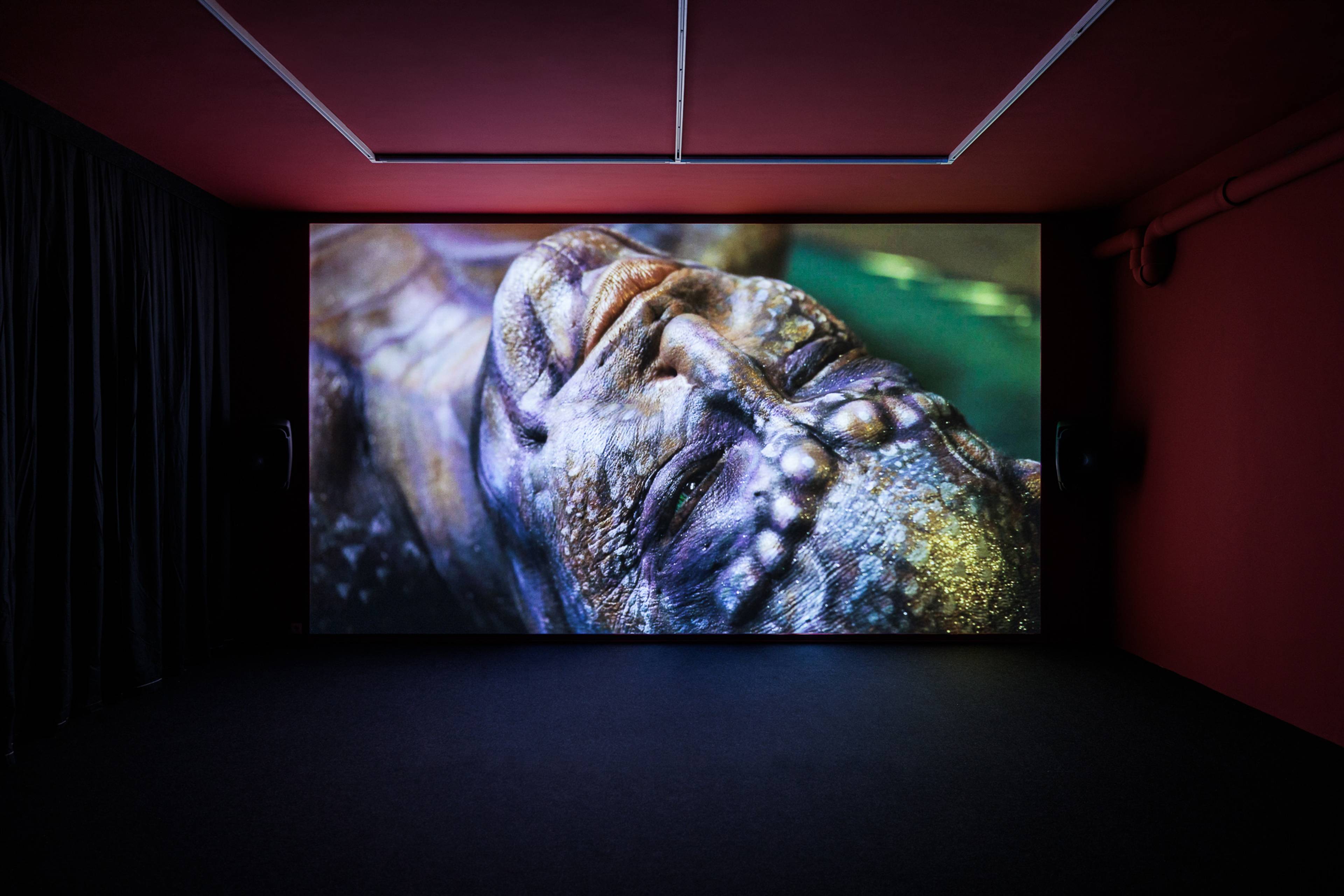
Carlos Motta, When I Leave This World, 2022. Installation view, “Pleas of Resistance,” OK – Center for Contemporary Art, Linz, 2026. Courtesy: mor charpentier, Paris; PPOW Gallery, New York; Galeria Vermelho, São Paulo. Photo: kunst-dokumentation.com / Manuel Carreon Lopez
Carlos Motta
“Pleas of Resistance”
OK – Center for Contemporary Art, Linz
28 Mar – 13 Sep 2026