
Success and failure, their possibilities and materialities, the ways we as a society privilege and pillory these concepts and those who embody them, are central to Cassidy Toner’s work. For her first major institutional show, she delivers a canny installation that openly admits to insecurities and delusions. Its title, “Besides the Point,” directs ideas of the mistaken in diffracted ways. As a malapropism of the English idiom, “beside the point,” meaning unrelated or not important, she maintains all the dismissive connotations of the original saying, while introducing the possibility of a typo. Slight errors in language are often telltale signs of a lack of belonging; illustrated by the number of classist memes mocking people exclaiming “bone apple tea” instead of bon appétit. If the title is read literally, as meaning next to the point, it could be a situation-specific reference. Toner’s exhibition is housed in three rooms off the side of the Kunstmuseum Basel’s ground floor, within the same building as Hans Holbein, Pieter Bruegel, and Lucas Cranach, but – as her titling might suggest – detached and literally beneath the institution’s famed masterpieces.
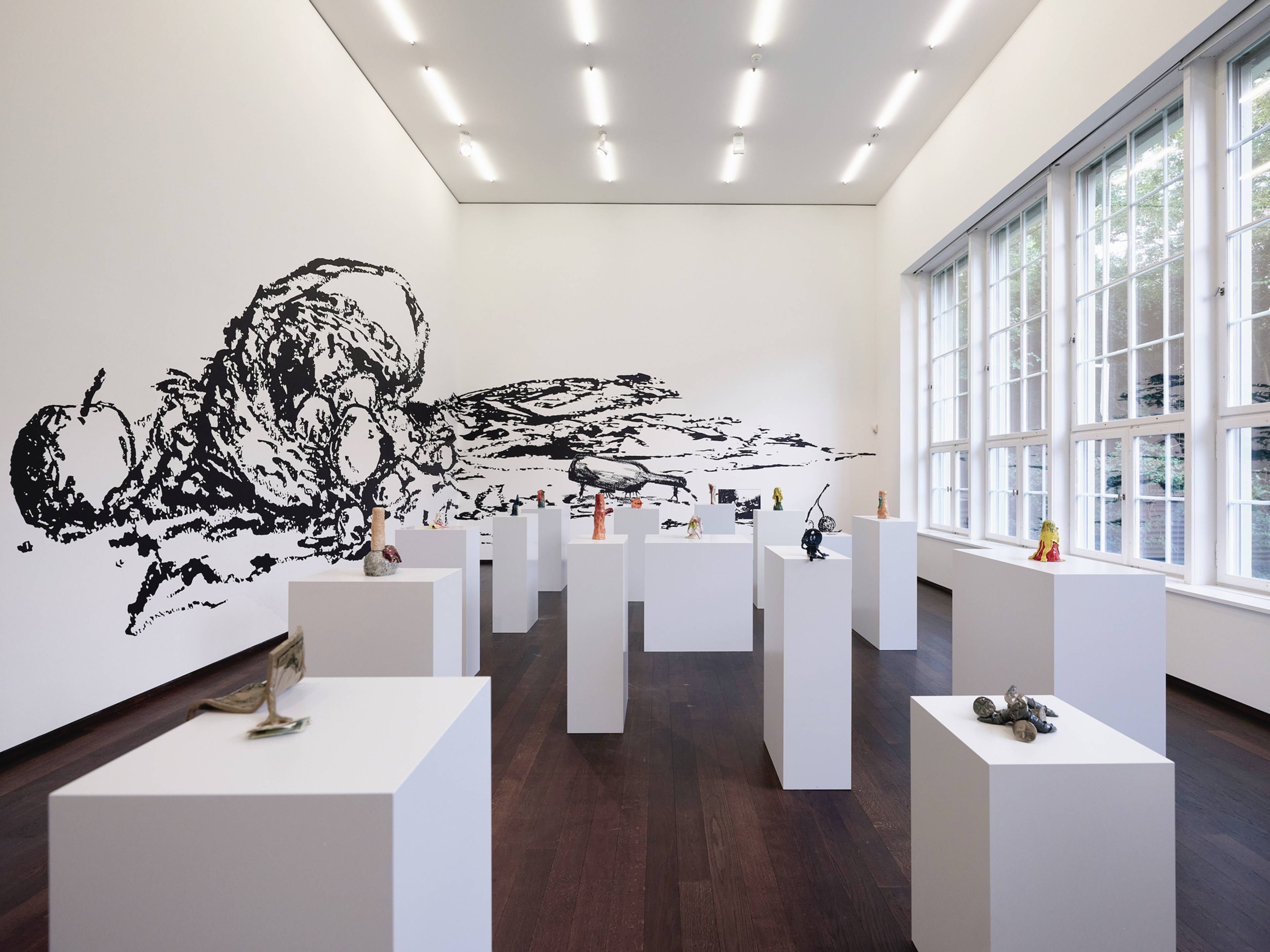
View of Cassidy Toner, “Besides the Point,” Kunstmuseum Basel, 2025
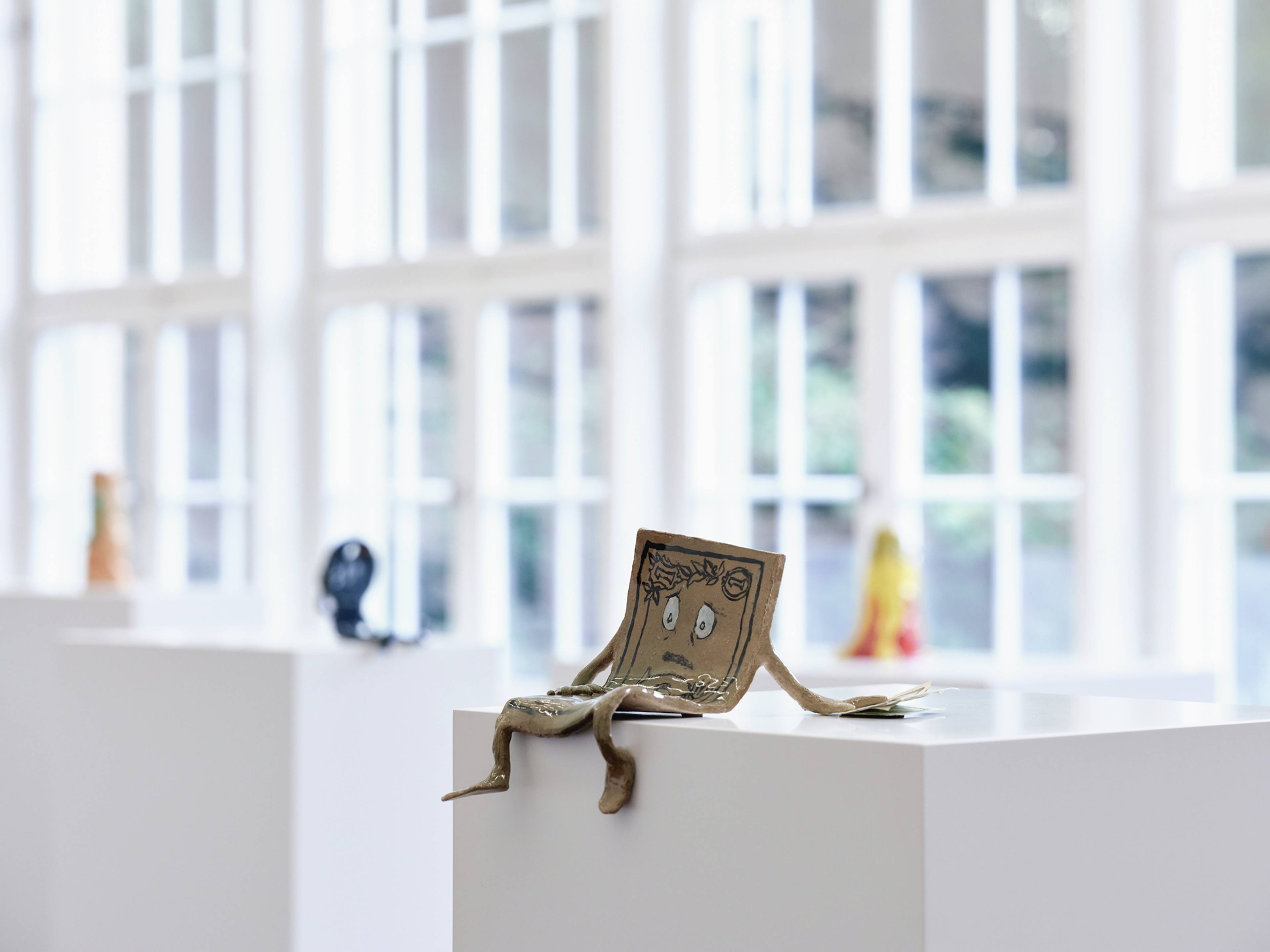
This kind of humble honesty continues throughout, as she reminds us that not only is she a young artist (born in 1992 in the US, now living in Basel) moonlighting in such a space, but – more pointedly – why she happens to be there. Toner was the recipient of the Basel edition of the Manor Art Prize for 2025, an award given by the eponymous Swiss grocery and department store to artists across the country, accompanied by an exhibition at a museum. Most artists who receive this prize quietly remove any reference to this rather awkward situation from their CVs, but Toner, in a bold act of prepaid product placement, drops visual references to the brand throughout her exhibition. A ceramic sculpture in the entry room, Lean on me 7 (all works 2025) – standing among a forest of pedestals supporting a series of sixteen similar works – is covered by a Manor-branded shopping bag. In line with their titular idea of support, the other works, all toying beautifully with the visuals of thriftstore kitsch, depict wooden leaning posts, work tools, and anthropomorphized depictions of money, a golden fleece, or even an MFA diploma.
Towering over these figures is a giant stretch of wallpaper, It looks nice outside (2025), depicting a sketch of the picnic basket from Édouard Manet’s Le Déjeuner sur l’herbe (Picnic on the Grass, 1863) and its contents quietly being carried away by ants. The connection between the bounty of food and the grocery store paying for everything is clear, but one wonders if, behind all of Toner’s performative appreciation, she actually identifies with these thieving insects too, or, even, as an artist on display – the female figure stripped bare surrounded by fully-dressed men as in the referenced painting. Such ambiguity to her corporate patron is further amplified in a later room where a Philip Morris cigarette vending machine is on view, apparently a corporate gift to the artist, cigarettes and all. Toner’s act questions what is appropriate and expected: how is the support that got her in the door different from such overt product placement? Why is one acceptable and not the other?
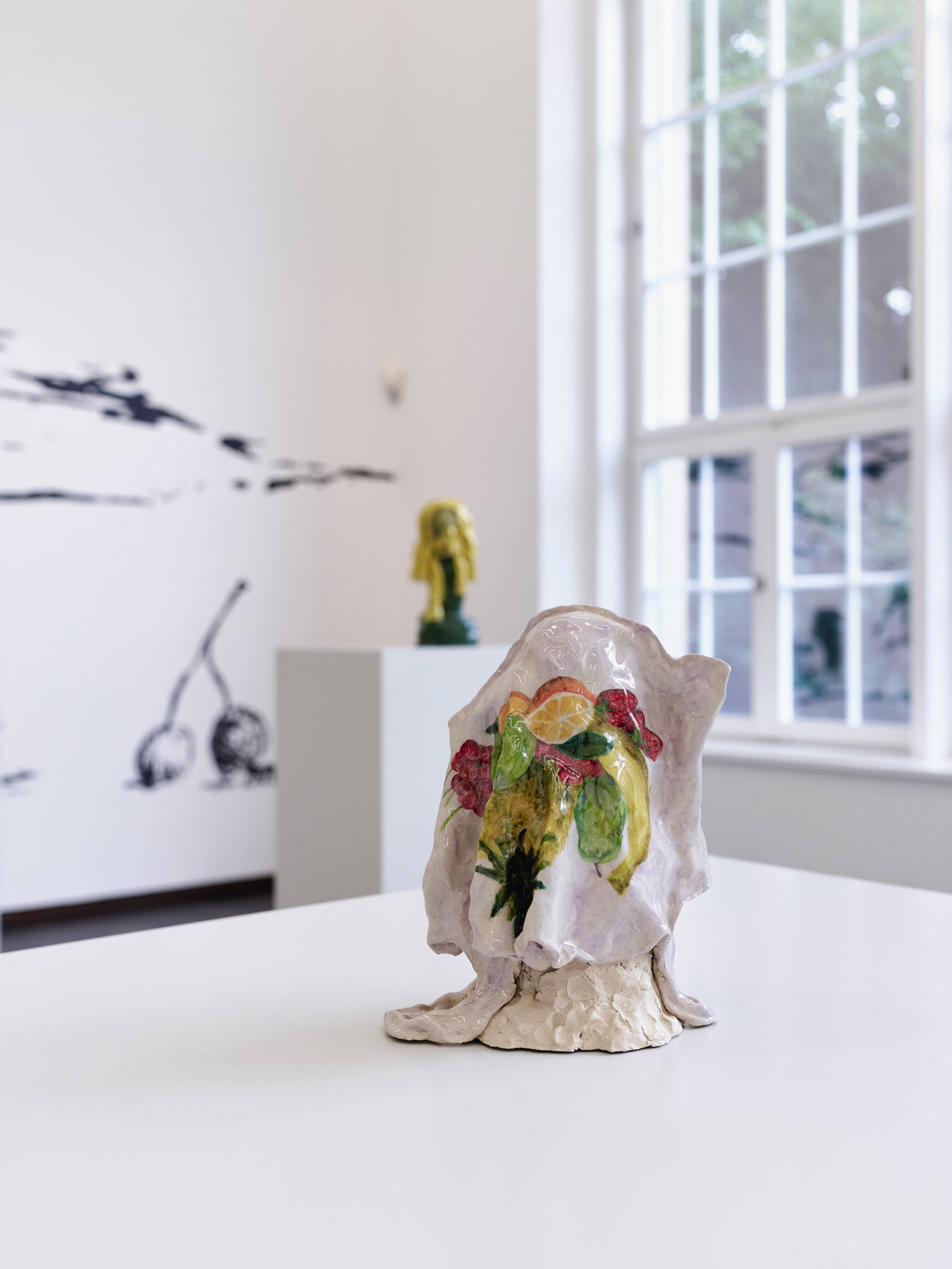
Cassidy Toner, Leaning on me #7, 2025, glazed ceramic, 24 x 17 x 19 cm
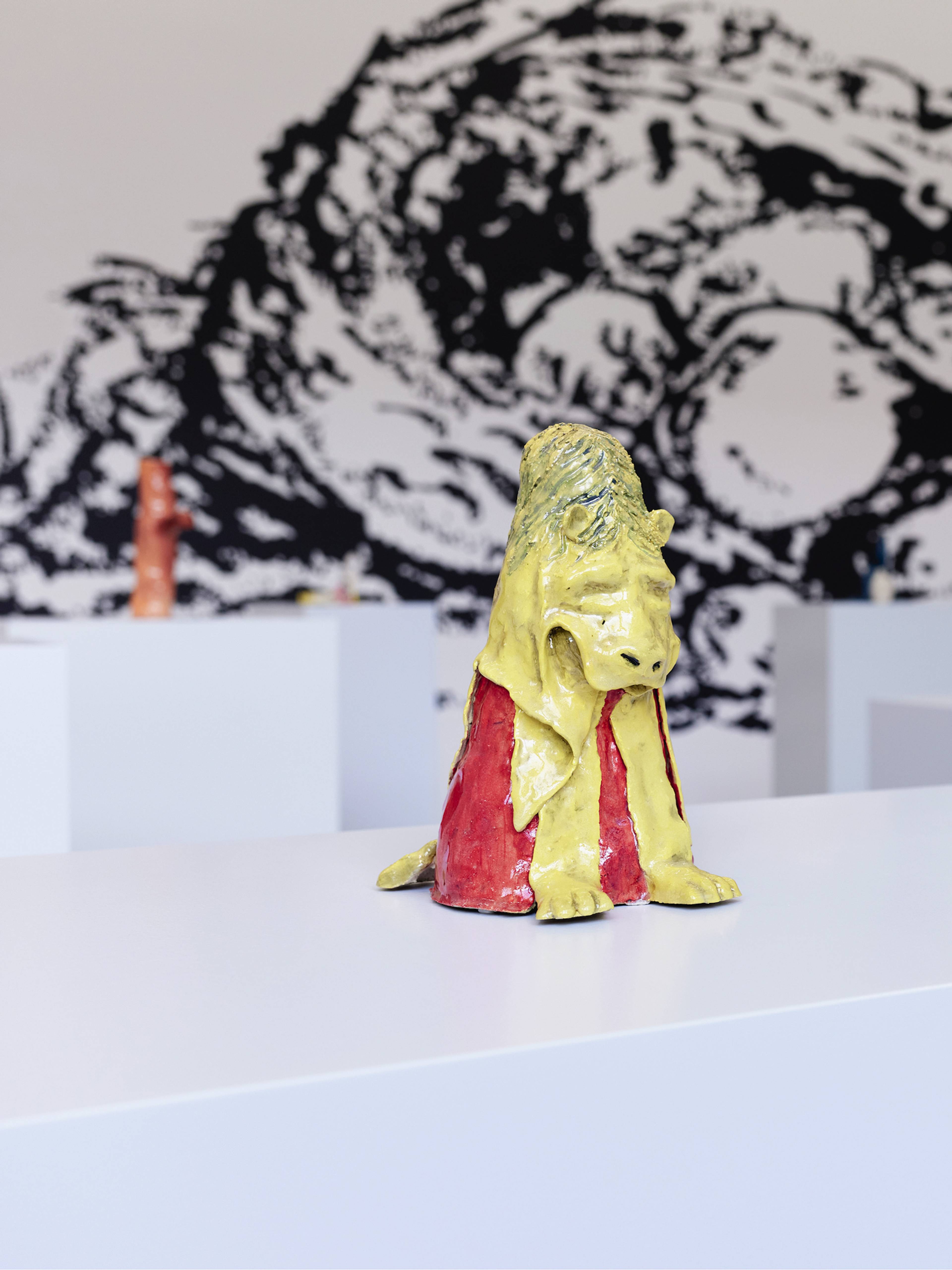
Cassidy Toner, Leaning on me #16, 2025, glazed ceramic, 26 x 15 x 19 cm
That vending machine is part of a full-room installation, one that feels empty at first. Scattered tools and bubble wrap – as if Toner hadn’t had time to finish the install – all reveal themselves to be cast in metal or resin, a physical trompe-l’oeil straddling the realism of Robert Gober and the crudity of fellow Swiss humorists Peter Fischli & David Weiss. These fragile, inconspicuous objects cause the museum guard on duty to constantly warn people not to step on them, something the artist has amplified with a video of a former museum guard practicing his joyful warnings in the empty spaces of the Kunstmuseum, so that the sounds of real execution and the recorded rehearsal constantly overlap.
Toner’s work is often discussed in terms of satire and critique; of the art world, its institutions, and the ways in which artists are expected to emerge, progress, and somehow also live. Her pieces at Kunstmuseum toy with ideas of belonging and succeeding within the sacred halls of, what really is, the world’s oldest public art collection. There’s a tension between institutional critique and plain institutional honesty as Toner draws viewers’ attention to the processes that plan, fund, produce, and invigilate exhibitions of art. Radically, she does so while departing from traditional forms of institutional critique and their post-minimal optics. Her use of tchotchke kitsch, jokey cartoons, slapstick video, and elementary visual tricks smuggles the aesthetics of the lowbrow and the childish into spaces long reserved for the treasures of royalty and the merely rich. That she carves out room for biting, mundane amusement in the process, is an equal success.
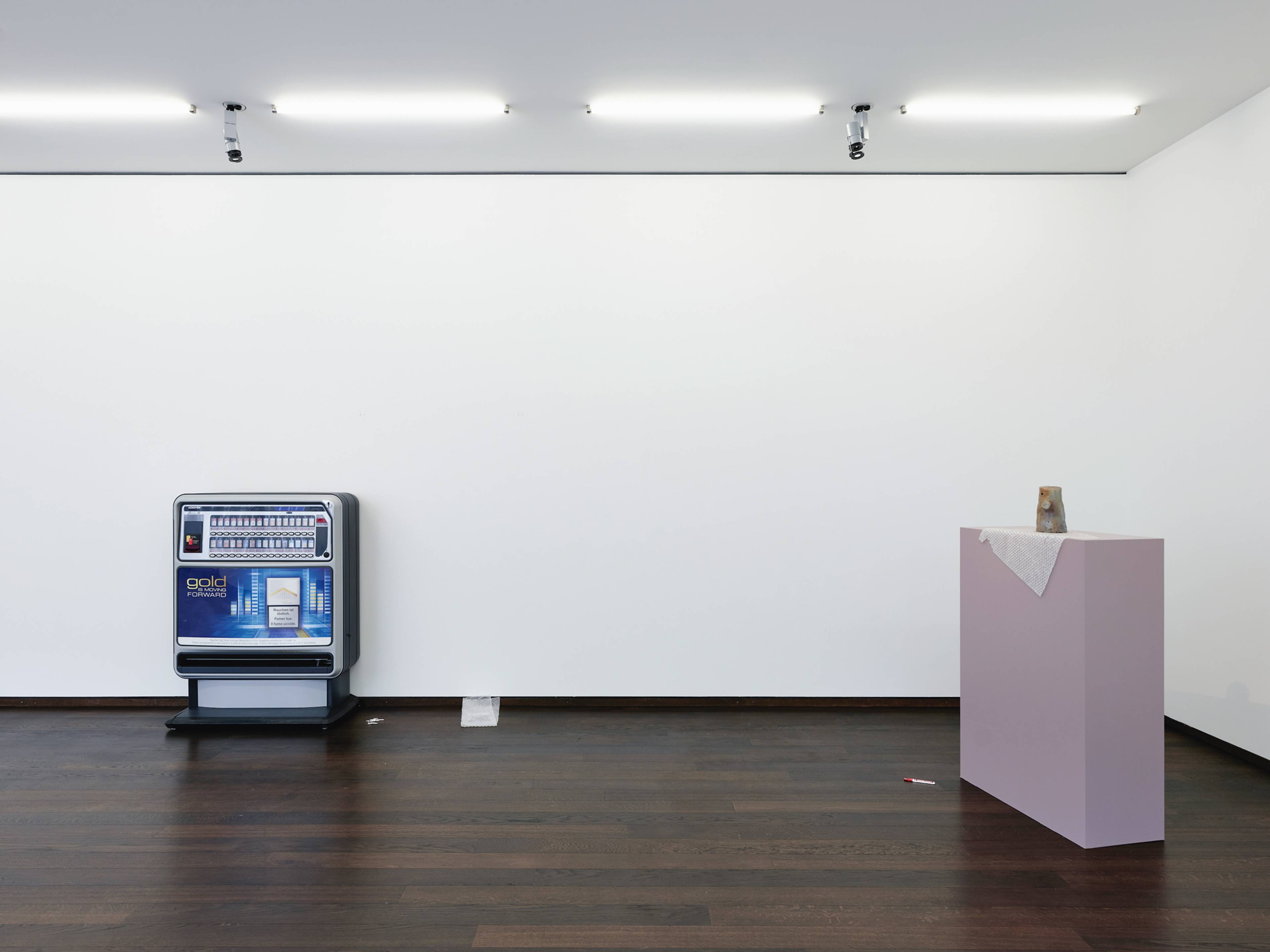
View of Cassidy Toner, “Besides the Point,” Kunstmuseum Basel, 2025
Cassidy Toner
“Besides the Point”
Kunstmuseum Bsel
22 Aug 2025 – 11 Jan 2026