
Douglas Gordon was not in attendance at the premiere, in February at the Berlinale, of Finlay Pretsell’s documentary Douglas Gordon by Douglas Gordon (2026). Perhaps this was for the best. Art, after all – forever insecure about its position vis-à-vis popular media – has a particularly skittish relationship to its depiction on the silver screen. Yves Klein died following a heart attack he suffered, aged thirty-four, after attending the 1962 Cannes premiere of the shockumentary Mondo Cane, presumably appalled by how the filmmakers transfigured him and his work into a punchline. Jackson Pollock, meanwhile, hit the bottle again after two years sober (the start of a steep decline that resulted in his own premature death), immediately following the shooting of Hans Namuth’s short Jackson Pollock 51 (1951), tormented by the phony ritual of having to “perform” his drip paintings. More obviously solitary artists have also resisted the intrusion of the camera into the sanctuary of their studio. In Agnes Martin: With My Back to the World (2003), the reclusive abstractionist becomes exasperated by the filmmaker’s probing while she is at work (director: “Could you talk a little bit more about tranquillity”; Martin, brush in hand: “MmmHhh. But I think … I better paint.”) More recently, Corinna Belz’s Gerhard Richter Painting (2011) includes an agonizing sequence in which the German artist stops playing ball: dropping his squeegee, he steps away from the canvas and informs the director that he simply can’t paint under her camera’s expectant observation of the genius at work. Perhaps the very form of the artist biopic is somehow compromised: as Nolan Kelly argued in Spike 76 (“An Artist’s Life,” 2023), “The biopic itself falls into a very specific genre defined by its lack of tragedy; every film about a famous artist, before we even watch it, has had its happy ending spoiled for us in the museum.”
The stumbling block in each of the above is the question of control, and the artist’s willingness to surrender it. Douglas Gordon by Douglas Gordon, as its title suggests, tries to take this bull by its horns. Its subject is, of course, the Turner Prize-winning Glaswegian video artist (*1966), who has now lived and worked in Berlin for many years. Though perhaps best known for his dilation and warping of the cinematic gaze in canonical works such as 24-Hour Psycho (1993) and Zidane, A 21st Century Portrait (2006), a substantial part of Gordon’s work has also been oriented toward what the American poet Bernadette Mayer called the “emotional science project” of memory and self-examination. His Something Between My Mouth and Your Ear installation from 1994, for instance, featured all the number-one singles from when he was in utero, while the ongoing List of Names (Random) (1990–) inventorizes into columns everyone he can remember ever having met.
The stakes of this film’s push-and-pull between subject and director are established at the outset, when we hear Gordon, over voicemail, ironically cajoling Pretsell about how long the work is taking him: “Your film started a fucking year ago, pal!” This apprentice-master (or older-brother-younger-brother) bantering persists throughout. The artist also seems, initially, to perceive the film as an opportunity for collaboration, with his voiceover co-directing the edit, as when he instructs Pretsell “… and then the next part starts,” or “do not show the fact that I sometimes run out of toilet paper.” He also strikes upon the perfect title for “their” film on-camera, “A Portrait of a Perilous Character.” Halfway through, however, Gordon seems to sour on or lose interest in the project and starts blanking Pretsell’s calls, before being won back around to a subsequent session.
It is interesting to contrast the artist’s somewhat insular and sedentary (though it would be a stretch to say “settled”) portrayal in this new film, where he is rarely seen outside of his tinfoil-lined Schöneberg studio, with the hyperactivity of the younger Gordon caught in the maelstrom of rapid success in Ewan Morrison’s 1996 documentary for BBC Scotland. There, the thirty-year-old tyro, on the cusp of his Turner Prize win, is shown interminably in motion, forever wriggling free of the documentarian’s clutches to a different opening of his, a different city – an emblematic figure of the jet-setting, end-of-history 1990s art scene. In this earlier film, Gordon seems wholly at home with the post-conceptualist reconfiguration of the artist’s role, from a Bohemian attic-dweller to a sharp-suited manager; a rapid-fire ideas-guy working under pressure to meet multiple deadlines.
By focalizing on the (admittedly magnetic) figure of Douglas Gordon alone, it works to shore up precisely the outdated canards of solitary genius that his best work has chipped away at.
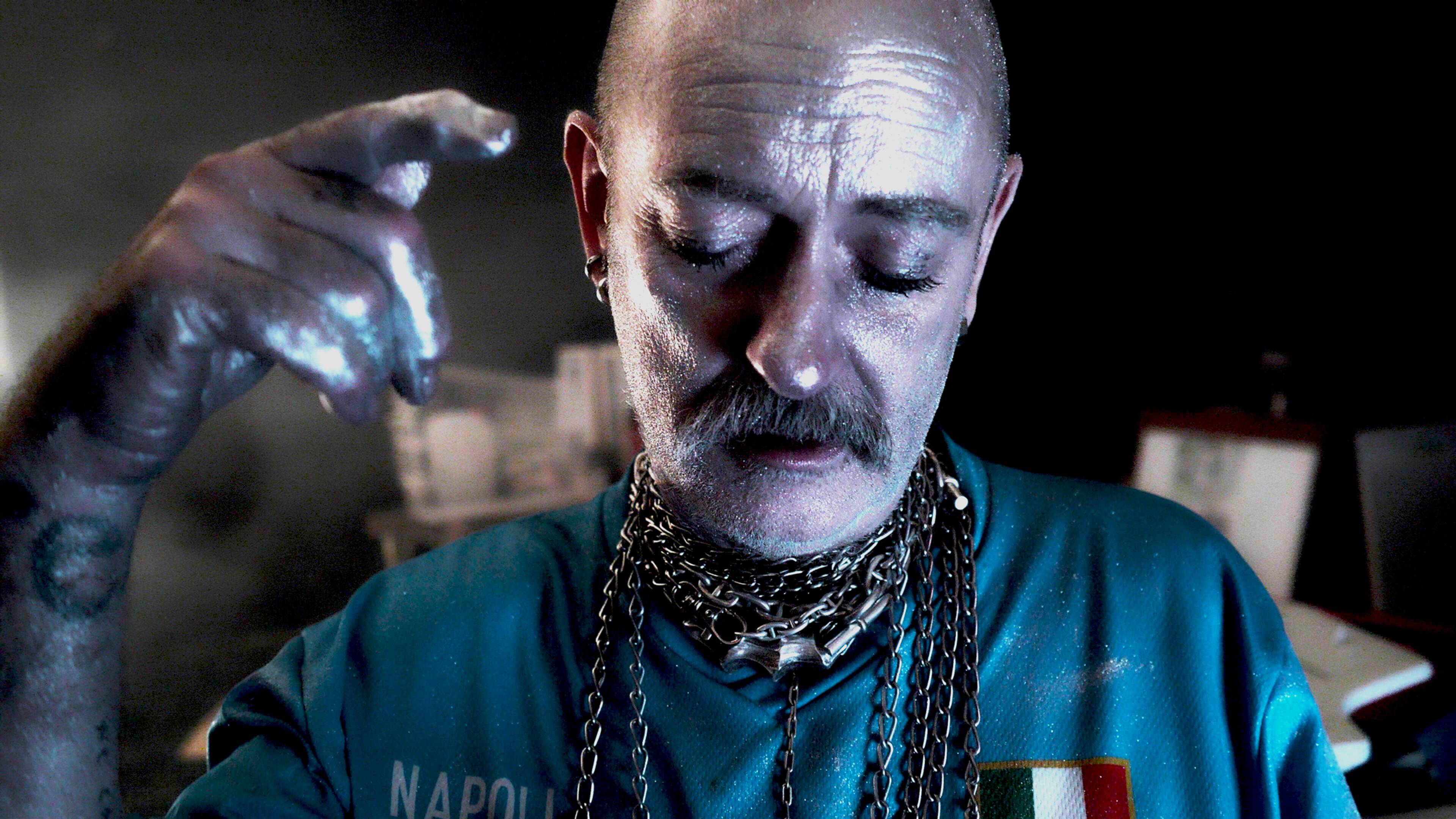
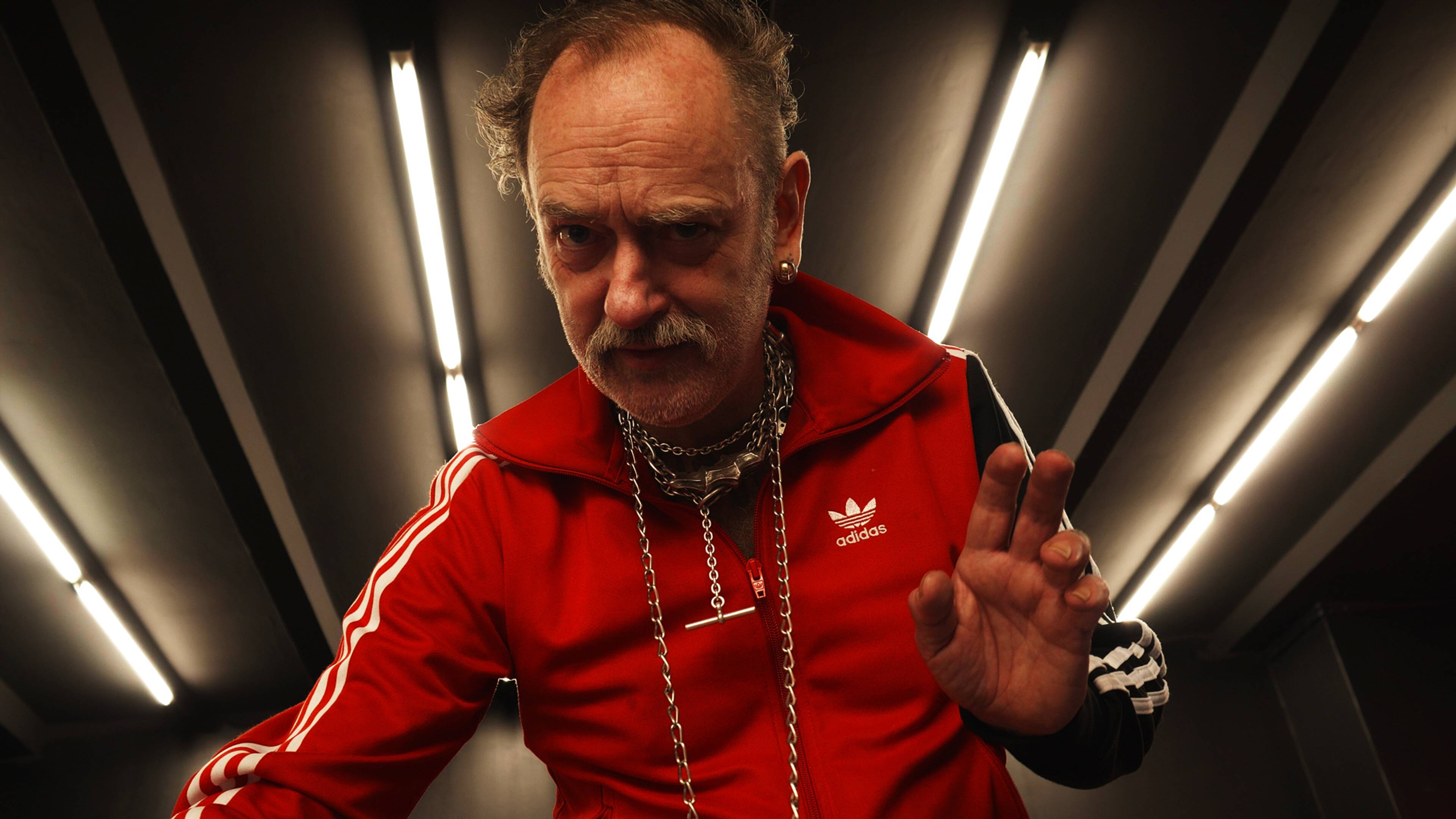
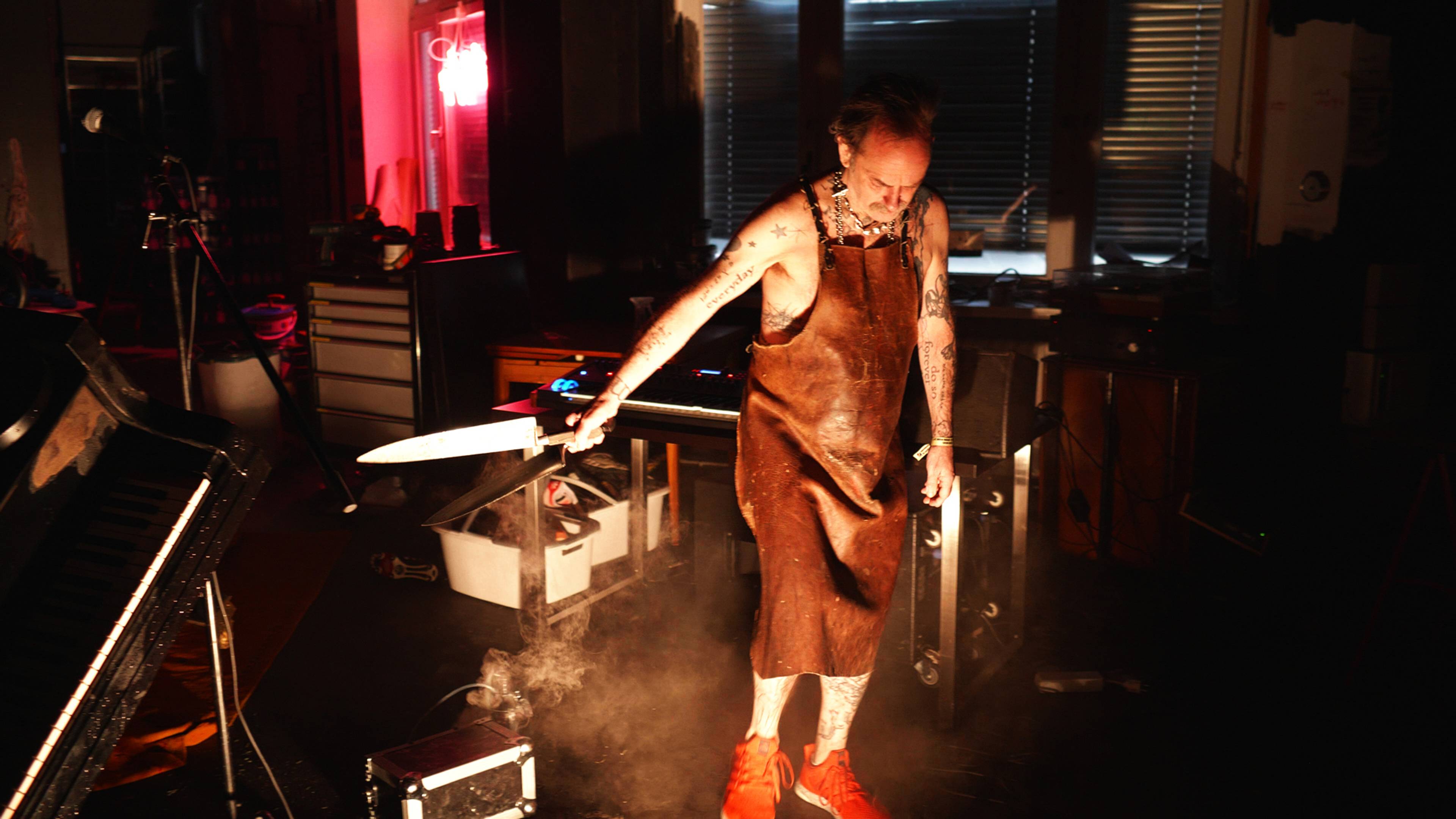
In the present-day, meanwhile, his studio appears as a kind of artificially lit netherworld, where it’s always 4am at the afters and the daylight hasn’t yet crept in through the blinds. This King Ludwig II in his Schloss Neuschwanstein seems alternately manic, performing on autopilot a sort of pastiche of the transgressive Berlin artist, and sluggish, a ruminative figure prone to often less-than-comprehensible journeys down memory lane. Early on we encounter the artist in the process of creating a Marc Camille Chaimowicz-style scatter installation (disco ball, strobe lights, dripping wax) to a techno soundtrack, horsewhipping his studio floor and cackling, setting various items on fire, while later we see him filming a friend cavorting on a bed and covering himself in glitter. We also watch him comically grimacing through a meeting with his accountant, whimsically blowing bubbles, and, fresh out of the shower, opining on the responsibilities of the artist, while the Velvet Underground blares from his stereo. The seeming whimsy of these sequences is underwritten when he confides to Pretsell that: “I get to behave like more of a child now, than I did when I was a child.”
Perhaps due to its attempted exultation of the artist’s freedom, this “portrait of a perilous character” can’t really hide from from the damage incurred by the lifelong, self-stylized performance of eccentricity (and, to an extent, the consequences of such early success). Across several sequences of Gordon preening himself in mirrors, hunched and wisecracking, I couldn’t help but think of the increasingly weary dramaturg, played by Roy Scheider, in Bob Fosse’s film All That Jazz (1979), looking in his bathroom mirror, bleary-eyed, swallowing his pills and throwing up his hands to exclaim, on routine: “IIIT’S SHOWTIME, FOLKS!”
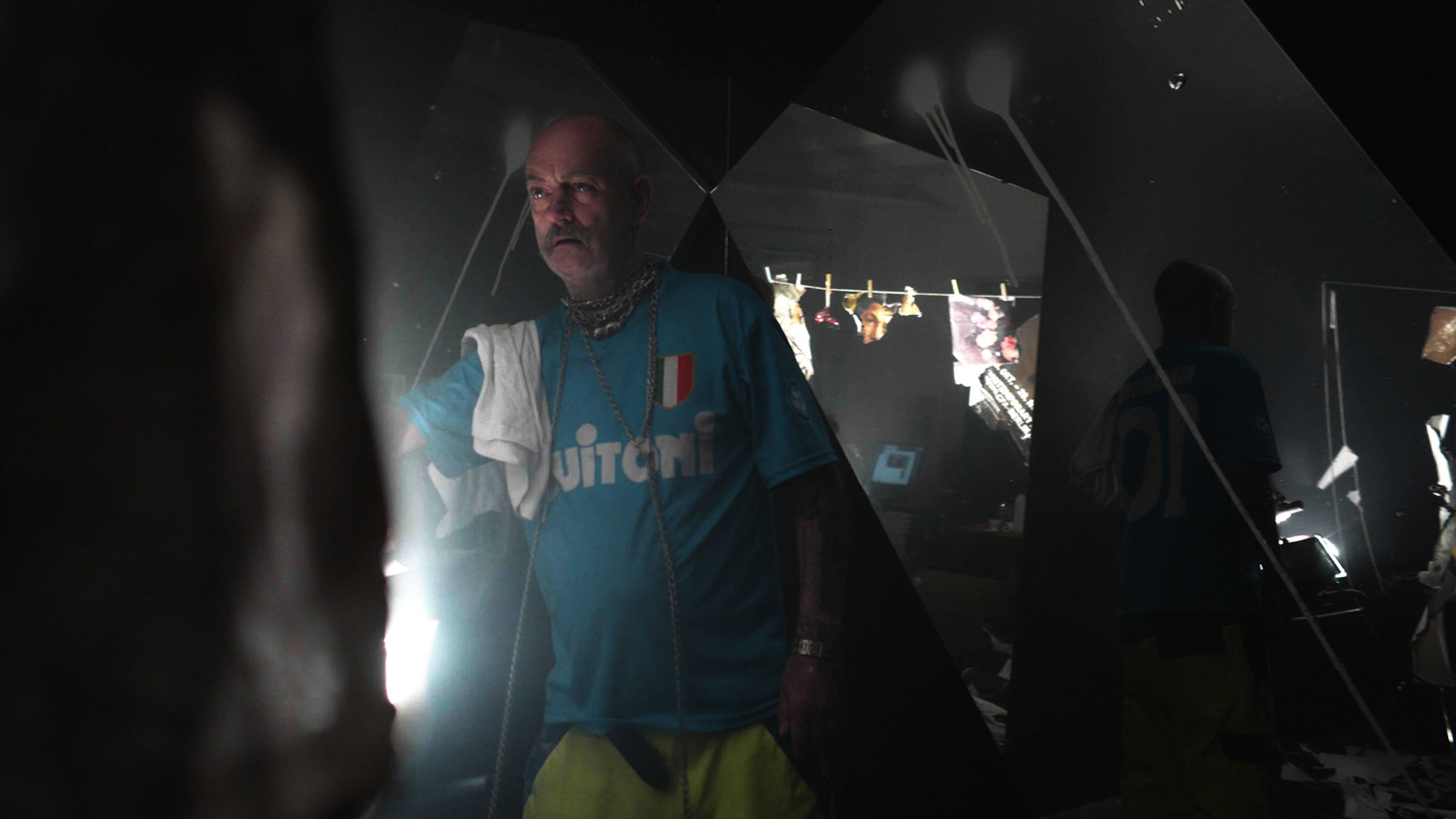
On one visit, Pretsell arrives to learn Gordon has pulled out his own tooth, while on another, we discover him fresh out of the hospital, his stomach swaddled in bandages after a hernia operation. In the film’s most affecting passage, he is shown, dewey-eyed, speaking on the phone with his mother about his Glaswegian upbringing, the promissory hope of blown bubbles, and telling her he misses her. Yet, as we can see from his phone’s illuminated lock screen, the line is dead – he is only talking to himself. At other moments, he interrupts and overrides the director’s tentative questioning. As anyone who has worked in a bar knows well, the emotional turbulence and sentimentality of the intoxicated is as often wearying as it is insightful.
Throughout all this, we never quite feel that Pretsell has managed to catch the artist unawares. There is not much examination of his artistic process, nor indeed of the art scene that produced Gordon, though we do hear him briefly discussing his admiration for Lawrence Weiner, and the film does include cutaways to installs of his own works (by far the most visually exciting parts). And here’s the rub. Much like Wim Wenders’s 2023 biopic of Anselm Kiefer, Pretsell’s film arguably founders on its director’s uncritical wonderment at the artist in his playground. By focalizing on the (admittedly magnetic) figure of Douglas Gordon alone (though we learn that his studio is always filled with people, we notably never see anyone else), it works to shore up precisely the outdated canards of solitary genius that his best work has chipped away at, whether through the appropriation and distortion of existing footage, his tendency towards collaboration, or his socialized understanding of the artwork as “an opportunity for a conversation.” Artists instead, it suggests, spring into being of their own willpower. It thereby misses a chance to enrich its glimpse onto a significant figure in contemporary art, by failing to examine the wider social infrastructure that both materially and intellectually nourishes him. Appropriately, perhaps, for an artist whose work has long been drawn to the psychological trapdoors of Victorian gothic literature, all those Dr Jekylls harboring Mr Hydes (as in his double-portrait Monster, 1996–97), the 19th-century inflation of individual charisma and character are instead placed center-stage.
In this conventionality, Douglas Gordon by Douglas Gordon made me wistful for the enlarged social canvas of the recently deceased prolific documentarian Frederick Wiseman. Particularly his National Gallery (2014), which turned a sedate, prismatic, gaze on every stratum of an art institution, from the top brass down to the museum invigilators and Sunday visitors. Yet here, too, Gordon seizes an attempt at the last laugh, to wrest back some final interpretative control over his portrayal, when he declares before the credits roll, while plastering his body in Vicks VapoRub, that: “This is the parody of what an artist is, but the honesty of what a human being is.”