

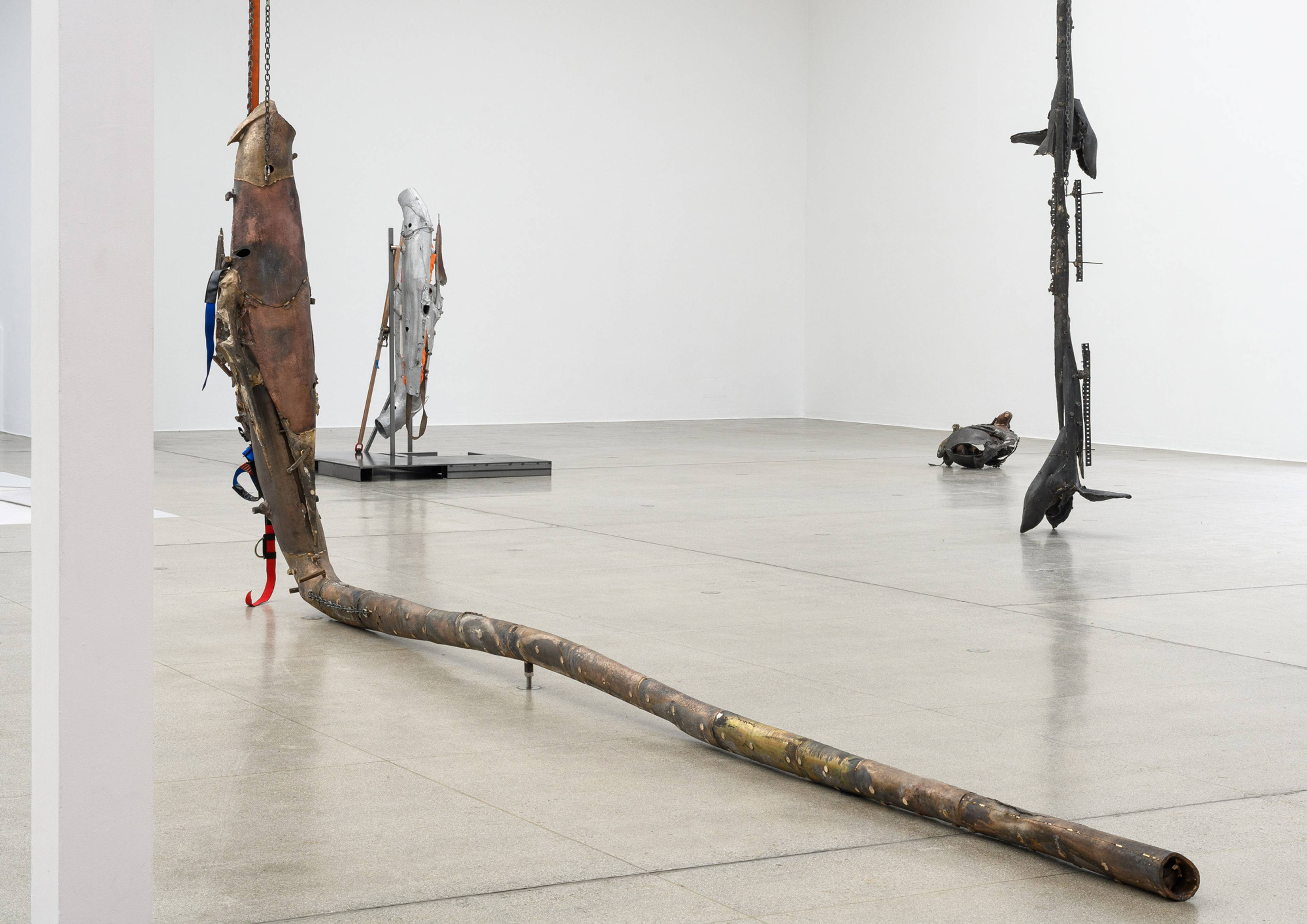
June Crespo (*1982) exposes the internal architecture of a thing, turning it inside out through traditional casting techniques and new scanning technologies. In “Danzante” (Dancing), at the Secession, Vienna, the material forms of heating systems, a corporeal cavity, the stem of a flower are dissected in the process, and then reconstructed into a whole, as if to say: as for buildings, so for bodies.
In the vast central gallery, Crespo’s amorphic sculptures – cast in bronze, steel, aluminum, or concrete – appear suspended from chains, which drop down through the ceiling tiles, or moored on the floor, in a choreography at once estranged and related. What Crespo describes as “communicating vessels” are closer to communicating systems – the kind that might circulate water or shit around, or through, us. One bronze, Vascular XI (2025), descends, then extends along the floor like a blood vessel, but also the interior of an iris or a bird of paradise. The dancing Column II (2025), a soft-looking, cardiacal form cast from concrete, rests on a feather-light pillow, as if defying gravity, and relates, as a columnar form, to two works from the series “The dancing column (Iris)” (2025), comprised of leaner, darker sheaths of stainless steel – also upright. In both its aesthetic and conceptual conceits, Crespo’s work resonates with that of Ursula K. Le Guin, a writer who imagined science fiction not as a projection of the future, but as “a way of trying to describe what is in fact going on, what people actually do and feel, how people relate to everything else in this vast sack, this belly of the universe” (Dancing at the Edge of the World, 1989).
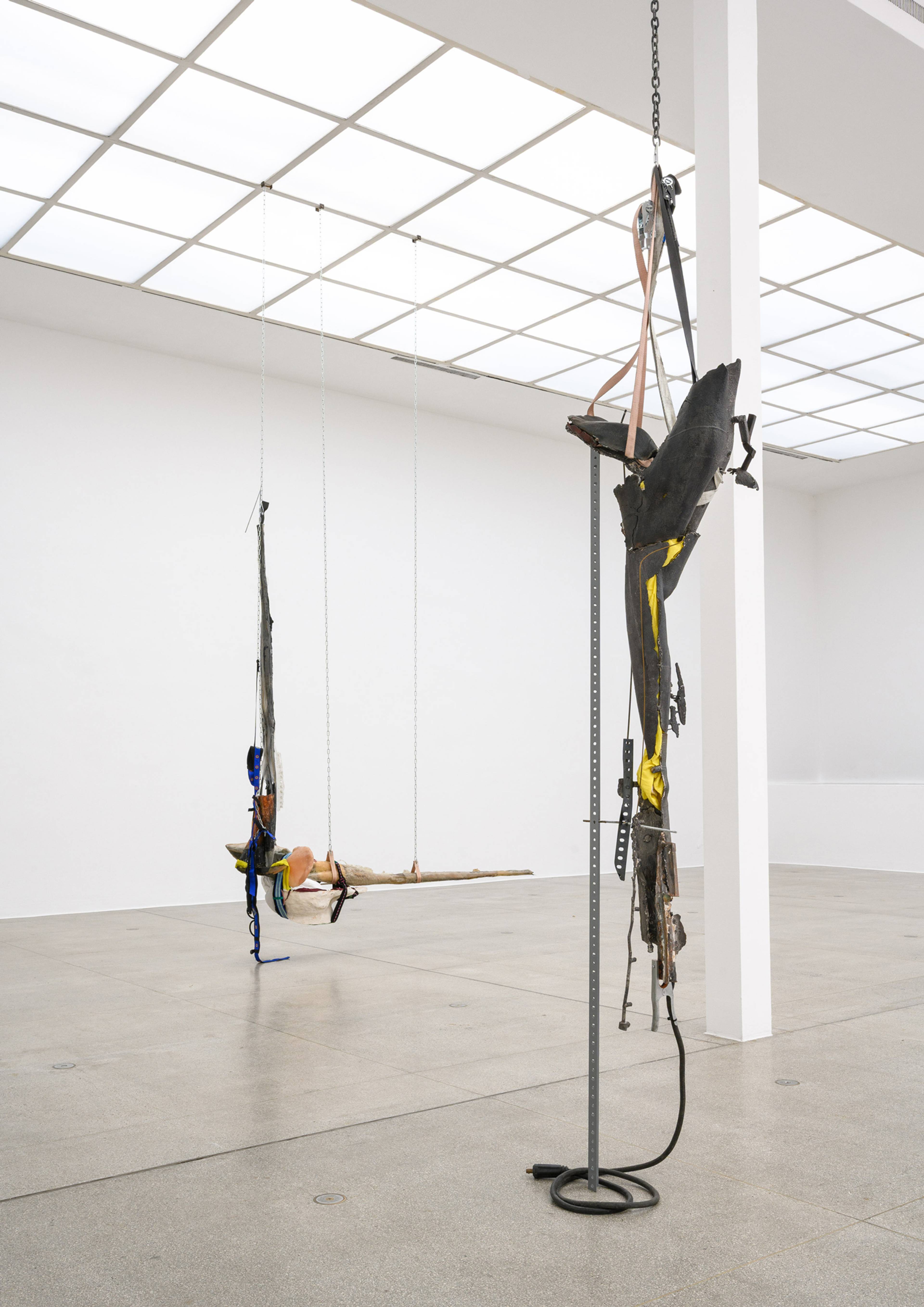
Crespo’s work also rejects the monumentalism often associated with her materials – that of Richard Serra, say, or Josef Beuys – remaining close to the body in both scale and form. She works, by hand, with the residual patina and sutures left over from the foundry’s casting process, allowing her own, and our, fleshliness to enter the work. In the gentle, shouldered curve of The dancing Column II, itself a nod to classical statuary, and in the downy hiking gear incorporated into Molar (2024) – a compact, loosely spherical cavity – she pushes through the hard veneer of her materials. Fabrics, whether Crespo’s own possessions or industrial straps and hardnesses, operate as addenda, the final touches she makes to the work before it enters the world. But they also have another important function, introducing swatches of color into the foundry’s muted palette and even drawing out unexpected, processual hues. An old rucksack in lilac and faded green is incorporated into Molar, which, in turn, sits atop the large print (NIKI, 2025) – more than a meter long – depicting soft, crumpled sweaters in similar shades of sugary white and pink. Elsewhere, the colossal TW, TG (2025), fabricated from the punchy red canvas shell of a lorry, stretched on a metal frame, and punctured with cylindrical cavities, spans one gallery wall like a chromatic throughline.
Although Crespo’s work is close to the body, it cannot be reduced to affect. Rather than get inside the work, and wear it as one might wear a body, we remain resolutely on the outside, paying witness to its casting, suturing, and welding, and to those same processes going awry, leaving behind the chemi-cal welts and imperfections that animate them. What is affective is the way we interact with the works in “Danzante”: circling them, getting close, moving off, as Crespo does during their fabrication. “I don’t want to cement an image, but propose an encounter,” she says, reconfiguring surface as interface: between the space within and what surrounds the hollow cast forms, as much as between the so-called built and natural environments, revealing them as part of the very same ecosystem. See: Óptico (2025), where cast steel and bronze are countered by a bunch of cut flowers, protruding in magenta and cerise from some internal cavity.
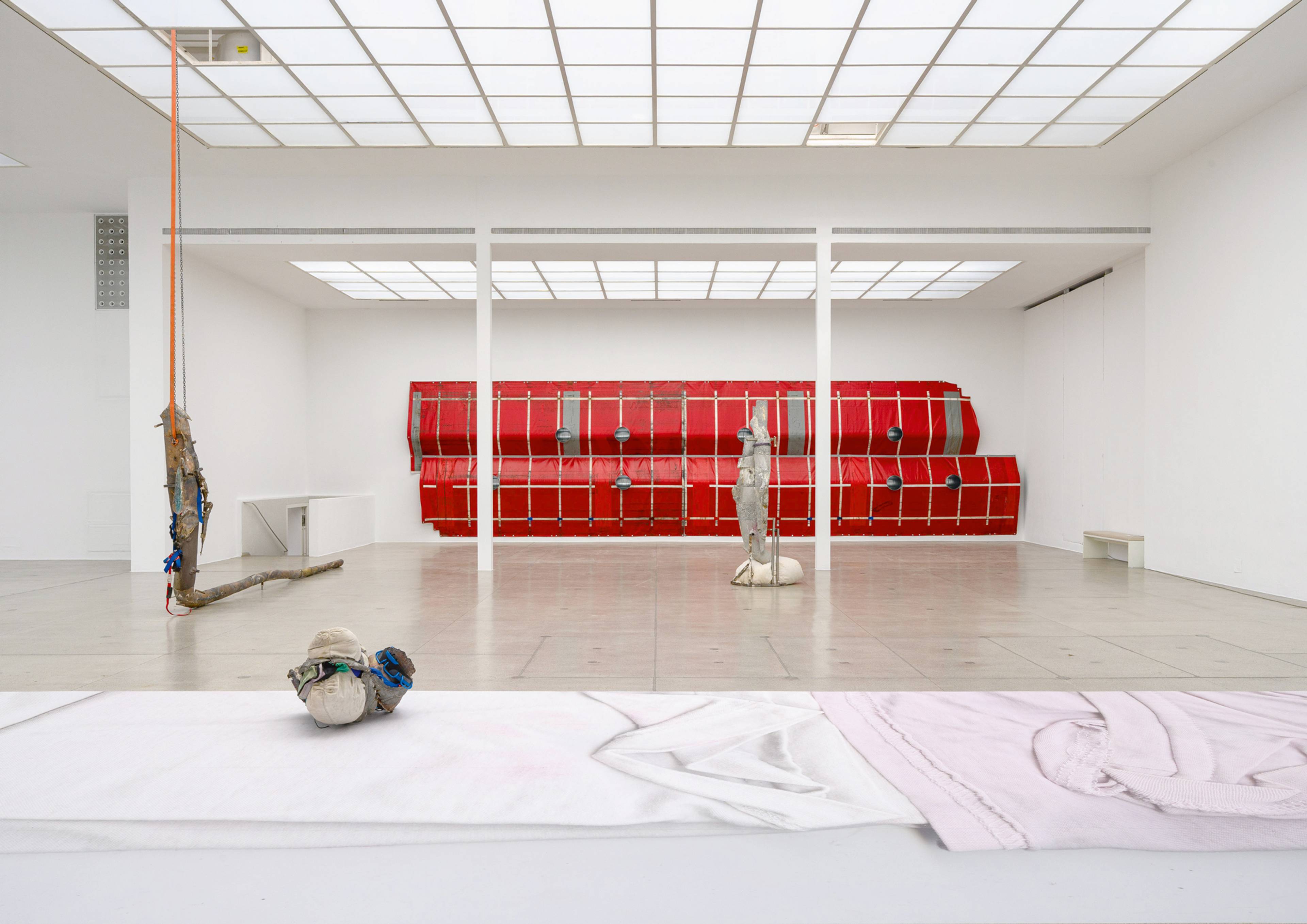
Casting is predicated on repetition, but Crespo defiles any notion of uniformity, approaching each unfinished surface as a site for material, processual, and industrial traces. The bronze Vascular XI retains fragments of its ceramic casing, perhaps in a bid to flatten the hierarchical structure between author and materials, form and process; or, more precisely, to make her materials their own agents, and turn process into form. Crespo succeeds inasmuch as the works lack a discernible, or human, logic; works that, owing to their variable material components, appear both heavy and light, hard and soft, hostile and welcoming, fractured and mended. Each of the works in “Danzante” is its own system, but also operates as part of one – like a dancing troupe poised, in position, inseparable from the dance.
June Crespo
“Danzante”
Secession, Vienna
12 Sep – 16 Nov 2025