

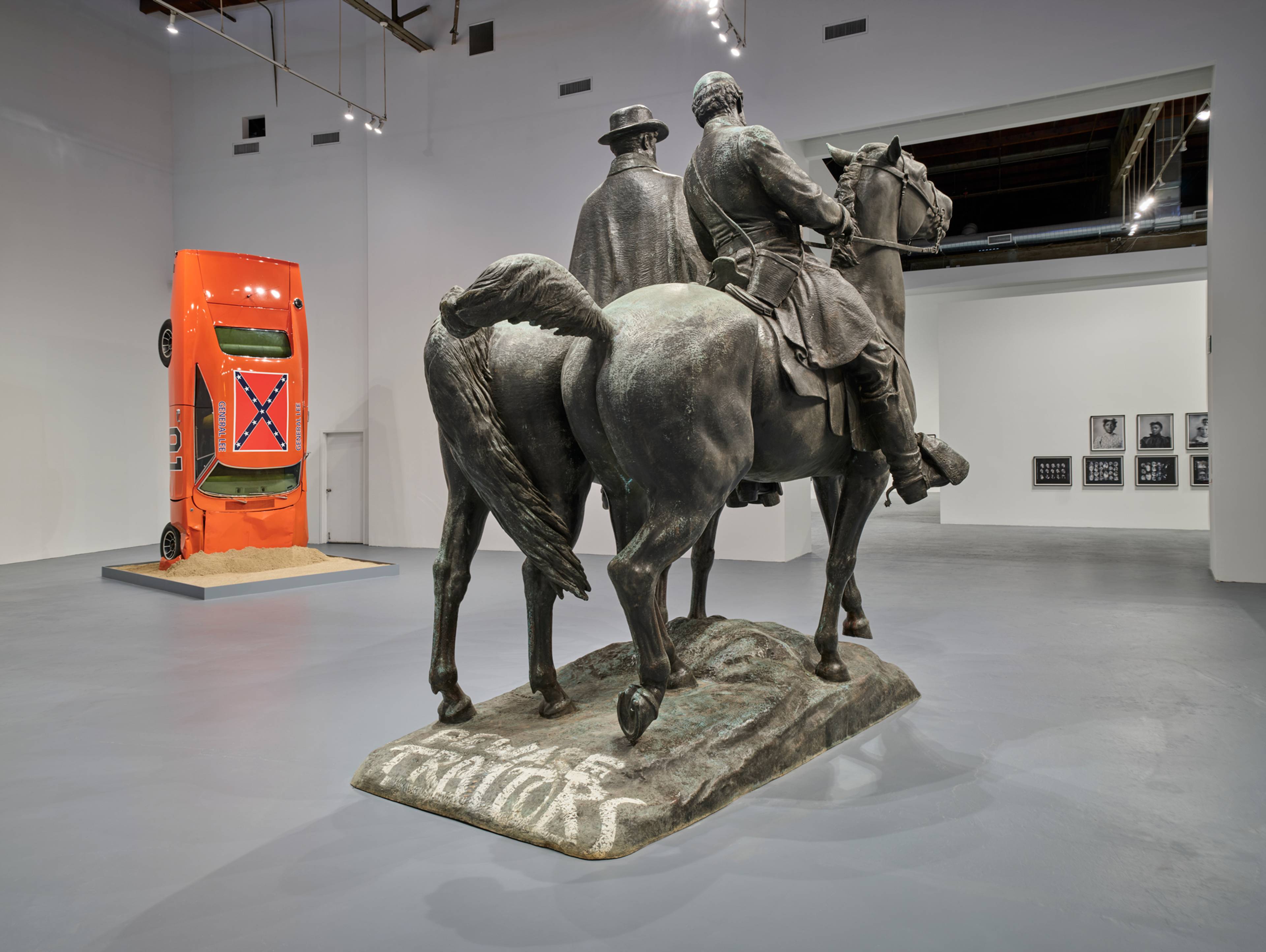
When, maybe three years ago, I heard that we’d be getting a show of taken-down Confederate monuments, my first thought was how? Logistics. Bureaucracy. My mind was on fire. The tedium of loan forms, condition reports, and insurance became suddenly fascinating when it was matter of the afterlives of these solemn grotesques. Some hundred and sixty of them had been removed from public view since 2015, in a wave of decommissioning in response to protests, advocacy, and a shifting consensus that the liberal media liked to call America’s “racial reckoning.” Of course, there were those who defended the monuments as a matter of heritage and history, and states like Alabama and Tennessee passed laws to prevent the removal of these tributes to the Confederacy. With a backlash to the Black Lives Matter uprising of 2020 in full swing, it seemed implausible that you’d be able to pry these fallen statues out of storage and put them on display in a contemporary art museum in Los Angeles, of all places.
So, it must be said, “Monuments” truly is a masterpiece of logistics. Even if the statues come from sources like the city of Baltimore and the Black History Museum of Richmond – not, as I’d somehow imagined, smuggled out from the more benighted corners of Dixie – the exhibition’s organizers managed to get eight of them into MOCA’s Geffen Contemporary, plus a few stray granite bases and a statue of Confederate general Robert E. Lee that’s been melted down and made into bronze ingots. Seeing so many of them in one place – in this place – is fascinating and genuinely strange. They are incongruous, even in themselves. Menacing and pathetic. Ponderous and brittle. Imperious and clownish (a few of them, paint-bombed during the protests, now wear garish running makeup). Although they memorialize the Confederacy, the monuments date from the advent of post-emancipation racial segregation at the turn of the 20th century: it is easy to see how the myth-making statuary would have served as instruments for enforcing a regime of white supremacy. But the monsters have been defanged, and not just those that bear signs of having been vandalized and toppled. They don’t loom over us from atop pedestals; they sit on the floor, not of a park or a boulevard, but of an art museum, a clinical environment where we may scrutinize the ex-monuments in their finely wrought detail and all their dumb materiality. It is a lot of bronze.
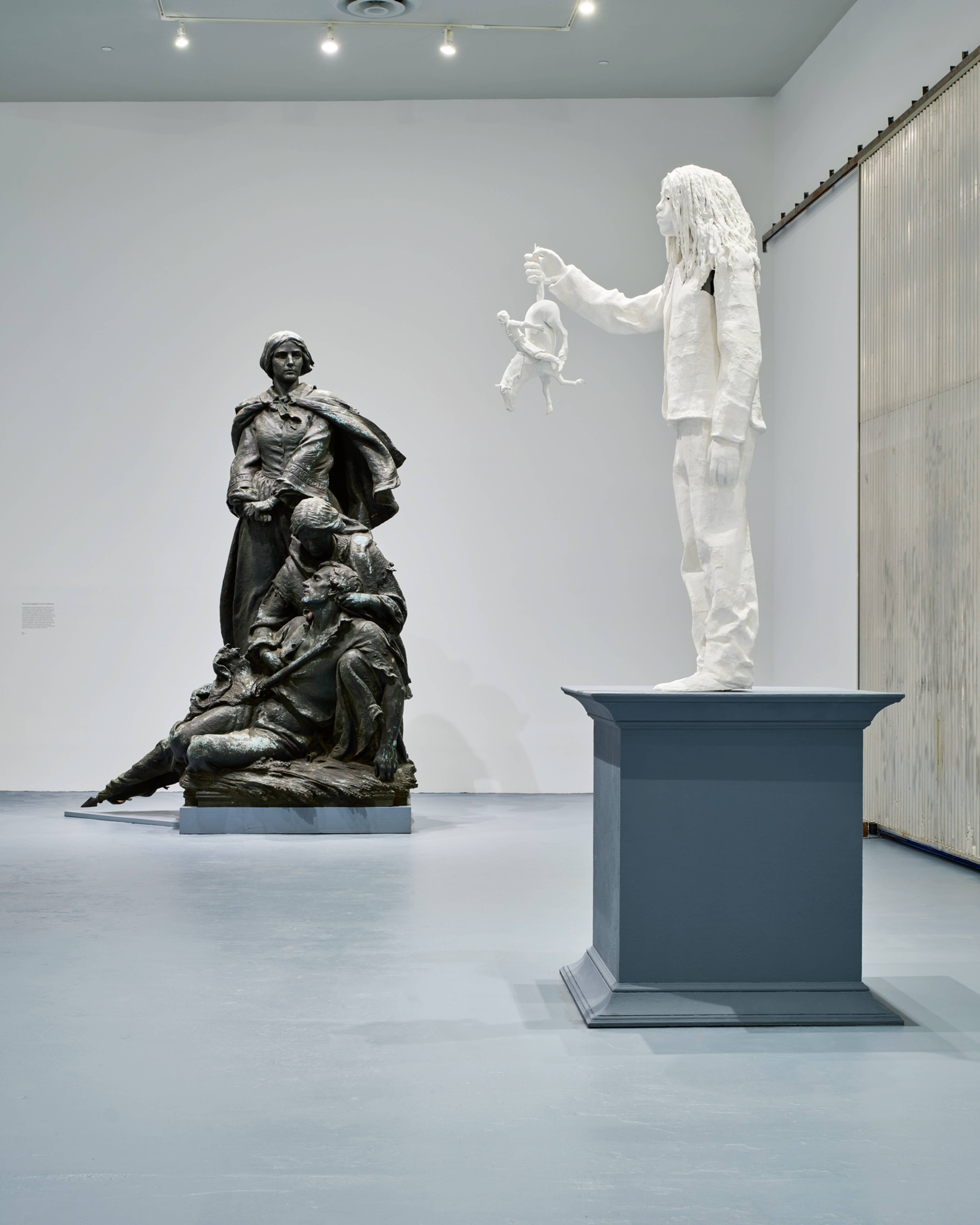
Right: Karon Davis, Descendant, 2025; behind: J. Maxwell Miller, Confederate Women of Maryland, 1917. Installation view, “Monuments,” the Geffen Contemporary at MOCA, Los Angeles, 2025
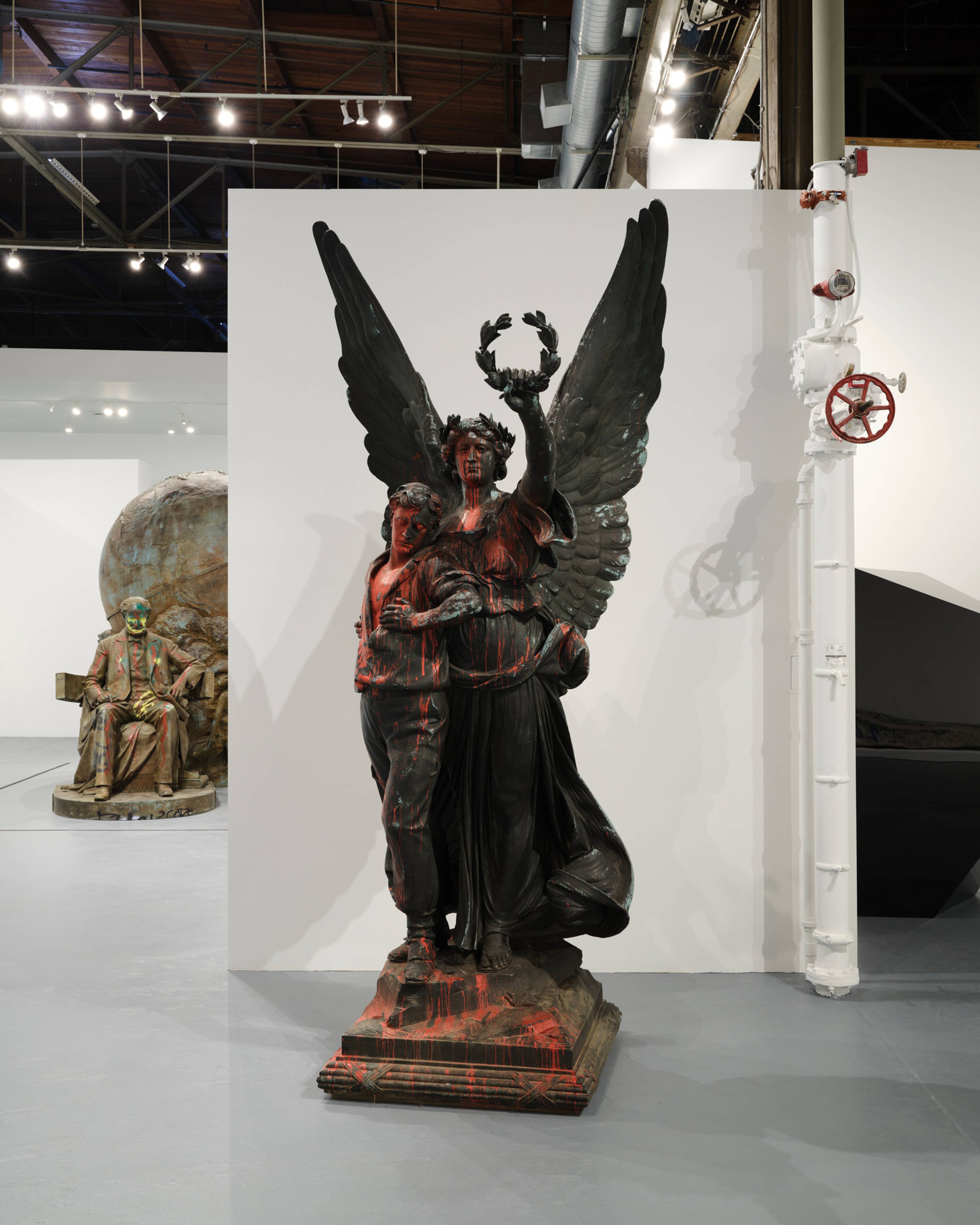
Foreground: Frederick Wellington Ruckstuhl, Confederate Soldiers and Sailors Monument, 1903. Installation view, “Monuments,” the Geffen Contemporary at MOCA, Los Angeles, 2025
The question that the exhibition seems to me to ask, though perhaps unintentionally, is what happens to these things that were controversial and contested in public life when they are displayed in a place of ideological uniformity. There, they were despised and they were defended; here, they are met with only subtle varieties of disapproval. Although there is wall text to explain the strange career of each of these artifacts of Jim Crow – the person or idea represented, the context of its making and of its ouster – this isn’t a presentation you’d get at a history museum. The monuments are aestheticized, displayed as artworks, and the real commentary on them, likewise, comes not from the words on the walls, but from works of contemporary art installed among the bronzes. Some, such as Karon Davis’s (*1977) sculpture of her son holding a Confederate equestrian statue, toylike, by the horse’s tail (Descendent, 2025), were commissioned for the show. Others feel like they could have been, like Nona Faustine’s (1977–2025) photographic series “White Shoes” (2012–24), featuring the late artist posing naked, except for a pair of white heels, “at sites across New York associated with slavery.” Maybe they had to have contemporary art to raise the money for “Monuments,” but its inclusion feels like curatorial blunder, a missed opportunity. The new and recent works are full of moral rectitude, and are much less compelling than the objects they would condemn. Where the statues are messy and contradictory and no one could possibly see them as they were originally meant to be seen, the works that judge the statues are the opposite. They are tidy and correct and tell us what we want to hear. Not that all the new stuff is mawkish or banal, but all of it (even by as formidable an artist as Martin Puryear) seems to sing in one simple voice: a Greek chorus intoning an explanation that the audience expects.
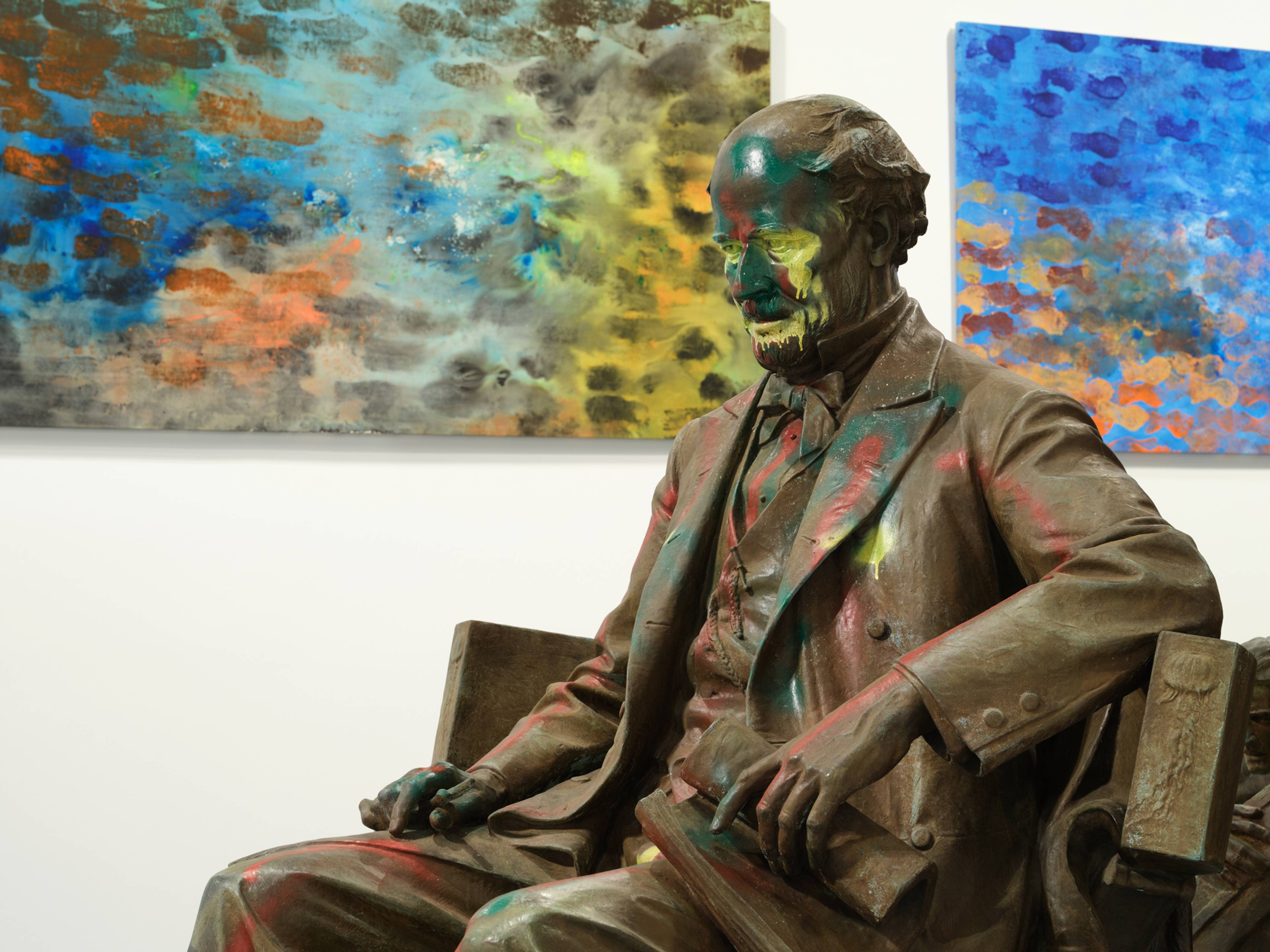
Foreground: Frederick William Sievers, Matthew Fontaine Maury, 1929; behind: Walter Price, Pond de Rivaaahh, 2023 and Evidence of progression, 2023. Installation view, “Monuments,” the Geffen Contemporary at MOCA, Los Angeles, 2025
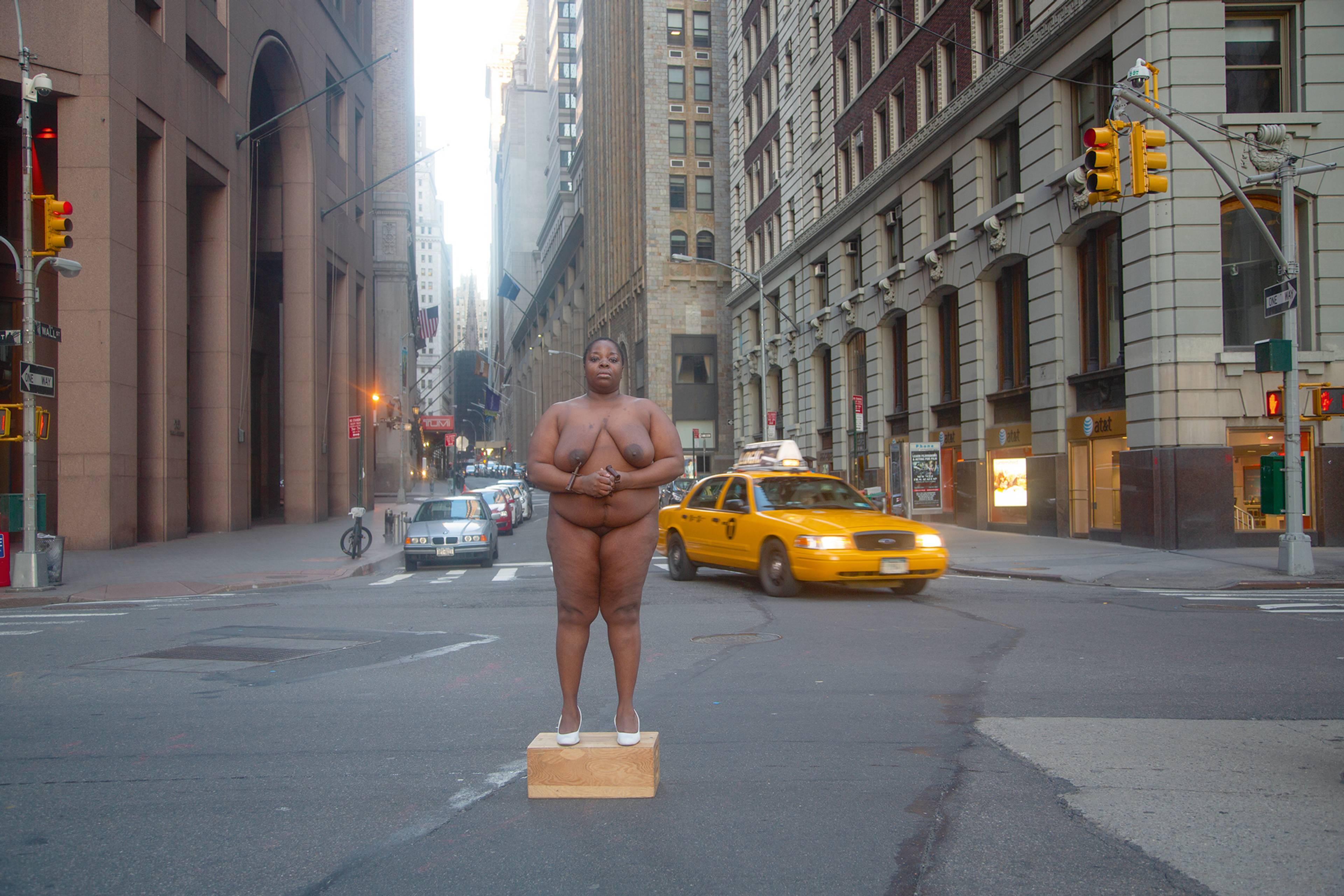
Nona Faustine, From Her Body Sprang Their Greatest Wealth, Wall St., NYC, 2013, pigment print, 85 x 127 cm. Courtesy: the Estate of Nona Faustine and Higher Pictures
The great exception is Kara Walker’s (*1969) Unmanned Drone (2023). (David Hammons declined to participate in the show.) In part because it sits alone in a building across town, at a venue called The Brick, and maybe because she is one of the very few artists today who works confidently in the mode and scale of monumentality, the piece avoids didacticism. It also benefits from its material: a decommissioned equestrian statue of Confederate general Stonewall Jackson from Charlottesville, which she dissected and rearranged into a charging, stumbling mutant. It is protean and perverse, a half-legible equine-human hybrid that brings to mind all those monstrous combinations of beings in the myths. Echidna, Crocotta, Minotaur, Centaur. Walker has made a monster out of a monster by bringing out how they are equally hideous and ridiculous. Which is probably why monsters are interesting and choruses tedious.
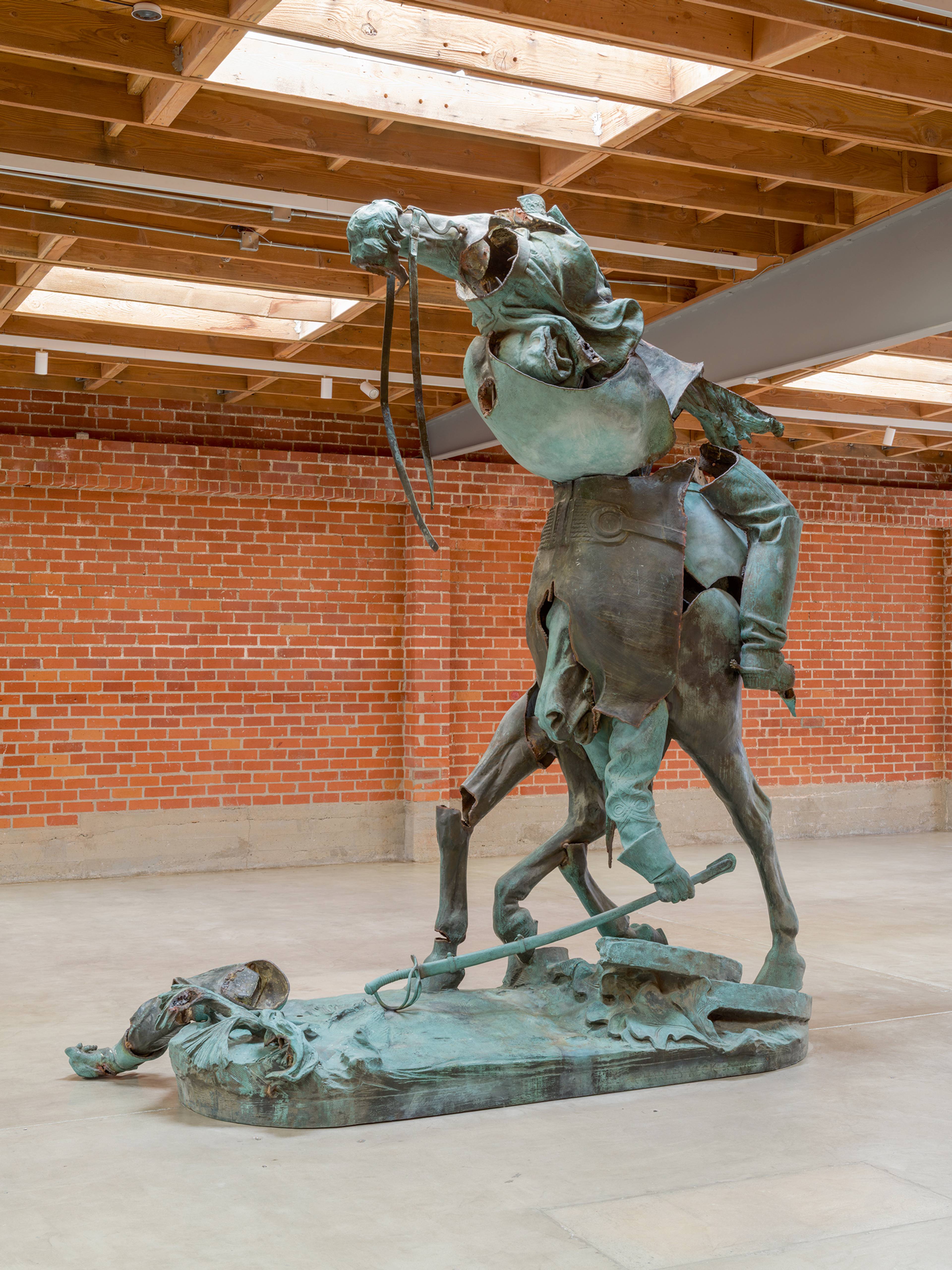
Kara Walker, Unmanned Drone, 2023, bronze statue made from Charles Keck’s 1921 statue of Stonewall Jackson, which stood in Charlottesville, Virginia and was decommissioned in 2021, 396 x 335 x 142 cm. Courtesy: the artist and Sikkema Malloy Jenkins
“Monuments”
MOCA & The Brick, Los Angeles
23 Oct 2025 – 3 May 2026