
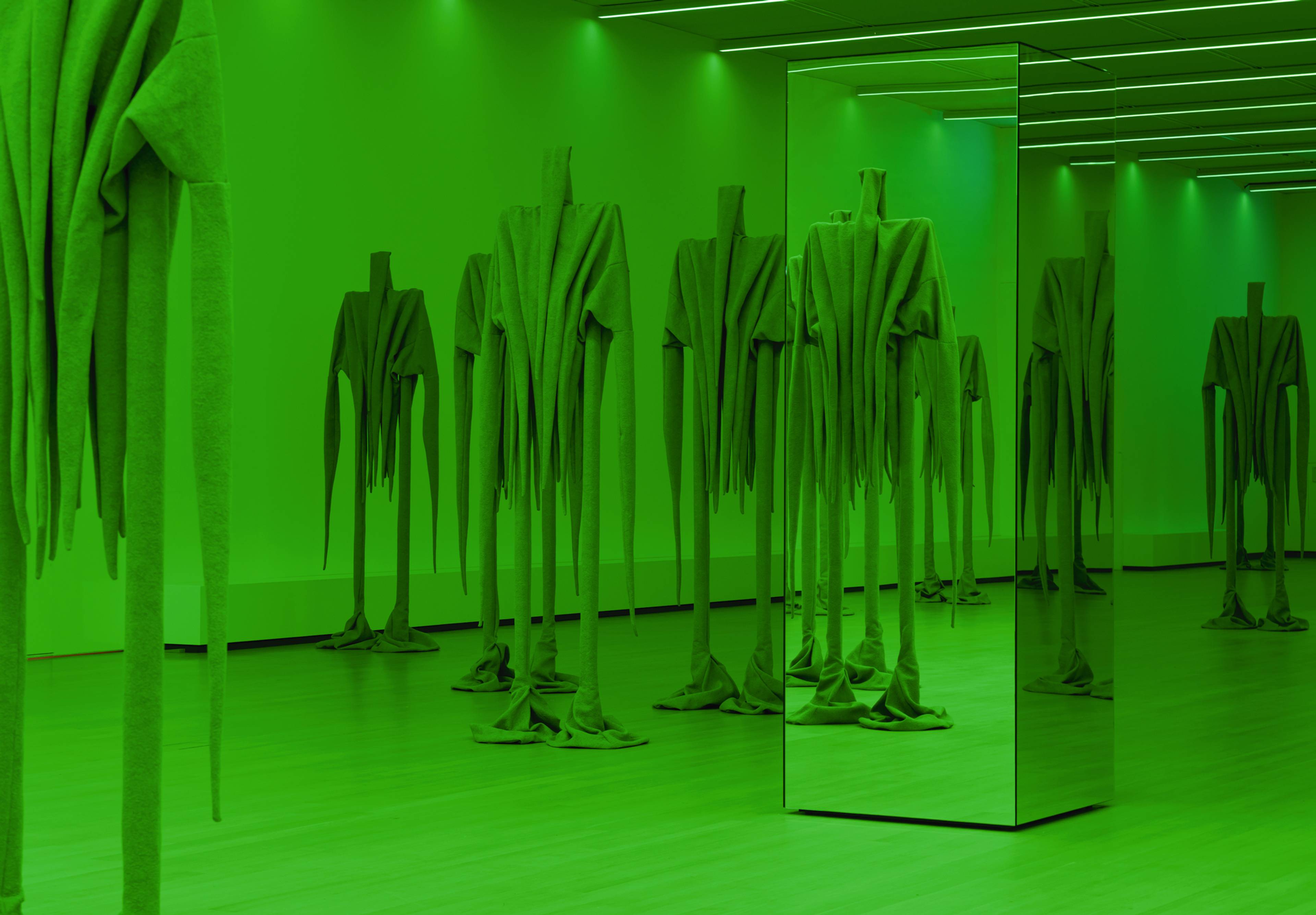
Sci-fi world-building is buttressed by precision – complex and detailed other-worlds, clear authorial intent. Sandra Mujinga’s (*1989) dystopian installation of fifty-five identical figures at the Stedelijk Museum in Amsterdam leaves you searching for both, and a bit cold. Inside a green-glowing subterranean gallery, an army of lifeless, woolen figures face a blank wall. Octopus-like tentacles drape limply at their sides, while a brooding soundscape composed by the artist washes over the space at intervals.
The malaise you feel among Mujinga’s wraith-like creatures is also by design. The museum’s promotional text embraces that spectral effect, advertising on their website how “deep beneath the Stedelijk, a universe of shadows awaits.” At the press conference, the artist herself described the installation as a “void.” She explained the ghostly formation to me this way: “I wanted them to look like they were waiting for something, that they were seeing something, or they knew something that we didn't know.” She relates the idea to a herd of animals – on the savannah, amid the tundra, or across the open sky – moving together in one direction. You – the human, the art-goer – are de-centered: These spooky creatures don’t give a shit about you. While mirrored boxes inte-spersed among and underneath some of the figures animate the stillness through the gallery, adding fractal motion, the overall chthonic aesthetics obscure her original reference point in the natural world.
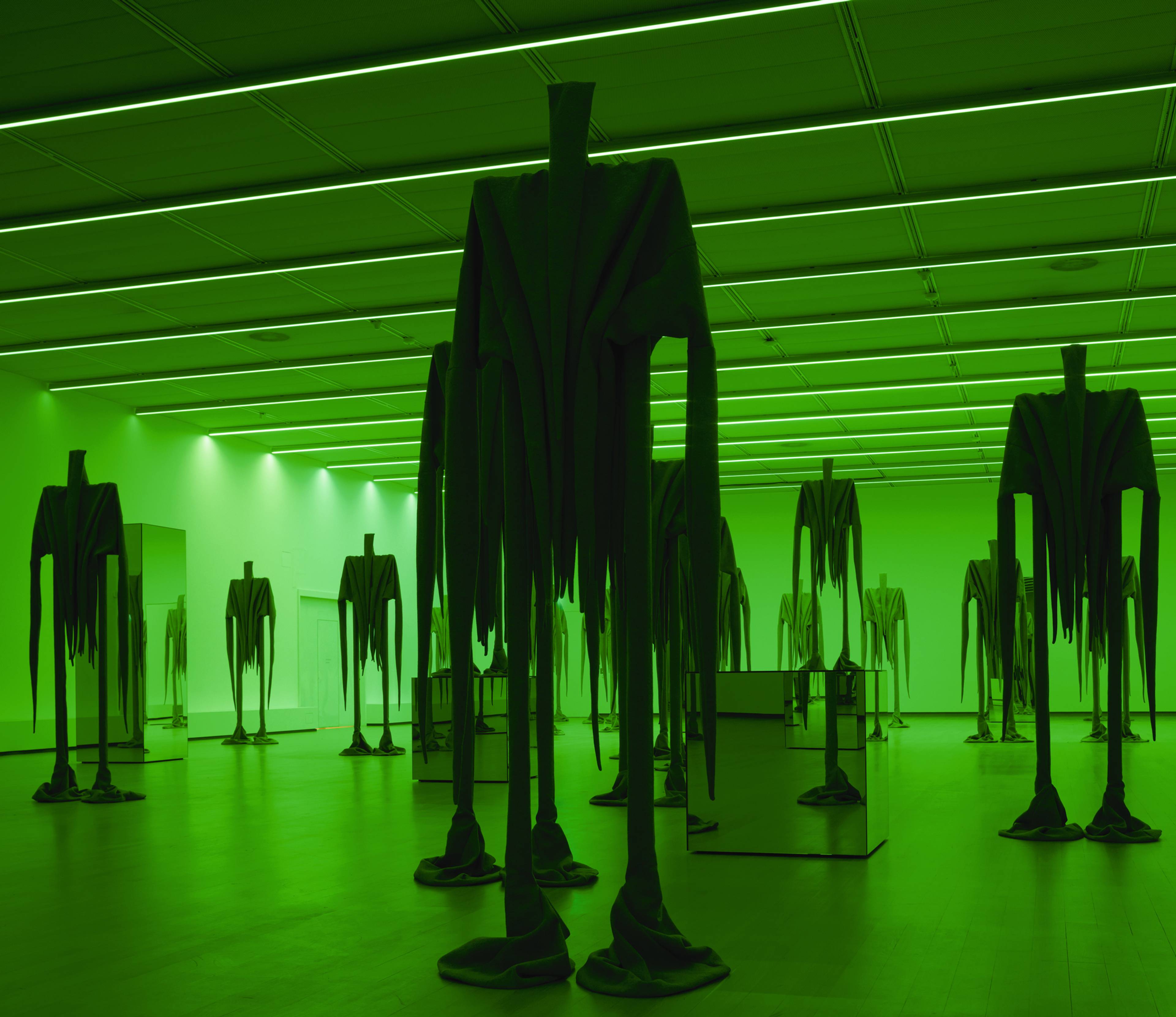
View of Sandra Mujinga, “Skin to Skin, 2025. Photo: Peter Tijhuis
Mujinga’s embrace of post-humanism, part of the special sauce that has supercharged her young career, is rooted in a rich tapestry of references from science fiction, Afrofuturism, and Black critical studies. She invokes Octavia Butler and Édouard Glissant and Fred Moten. The intellectual nexus is sexy, emancipatory, and real. Many brilliant Black thinkers subvert racist realities by imagining new ones. Mujinga is one of them. Her memorable contribution to the 59th Venice Biennale, Cecilia Alemani’s “The Milk of Dreams” (2022), positioned, in the Arsenale, a squad of similarly ominous, quasi-humanoid sculptures woven from upcycled textiles and bathed in green-screen-esque light. Another work (Flo, 2019), a larger-than-life hologram inspired by the Jamaican wrestler and female bodybuilder Midnight (Ann-Marie Crooks), reanimates the artist’s dead mother within a lineage Black literary scholar Christina Sharpe calls “wake work”; it has since been acquired by the MoMA. In Amsterdam, Mujinga has turned her attention (and fears) to the emergence of body doubles. She was particularly inspired by the horror film Us (2019), directed by Jordan Peele, and Naomi Klein’s 2023 memoir Doppelganger: A Trip into the Mirror World. Both grapple with the psychic fallout of confronting one’s clone – a vertiginous anxiety only heightened in the era of artificial intelligence and deepfakes.
While there is timely and uncommon poetry in Mujinga’s world, fueling deserved art-world acclaim – including, in 2021, Germany’s prestigious Preis der Nationalgalerie – her unsettling sea of clones in the Stedelijk basement lands like a pumped-up redux of her previous accomplishments. At the opening, museum director Rein Wolfs explained that he was looking for an artist who could transform the “challenging space” into a “total artwork.” And while the museum trumpets it as her “most ambitious work to date” – compared, say, to the four “Keepers” (2020) stood up for “Going Dark” at the Guggenheim, New York in 2023) – the new scale and difficult setting expose the vagueness of her gesture. Are these figures ignoring you, or are they themselves being surveilled? Does their maker conceive of them as digital clones? Black bodies? some far-out alien species? If illegibility is a strategy Mujinga has successfully used to subvert euro-centric and human-centric logics elsewhere, here in Amsterdam, it feels slightly gimmicky. Good art will leave you in the dark, in your imagination; but the lack of clarity around what Mujinga herself wants these sculptures to convey – spiritually and artistically – undercuts the urgency and world-building potential of the installation, a dystopia without pointed politics. A lot has changed in the world between over the last half decade, but Mujinga’s shadowy figures remain.
Sandra Mujinga
“Skin to Skin”
Stedelijk Museum, Amsterdam
13 Sep 2025 – 11 Jan 2026