
Some older digital cameras have a setting called “Kids&Pets.” It’s for quick-moving, joyful moments, where you’ll want flash, a fast shutter speed, and high ISO. Stop those kids and pets in their tracks! Capture the joy! This is the Kids&Pets biennial. Not that it’s superficial and fleeting. The opposite, actually – it wants to slow things down, pause the ruthless cycle of world events, and turn to what matters: family, friends, community. The 2026 Whitney Biennial is a snapshot. In-house curators Marcela Guerrero and Drew Sawyer have composed a smart, bright biennial. Without a title or a theme, full of abstraction and craft, it’s open to charges of conflict-avoidance. But that’s the point. To the news-addled adult, the kid and the pet have an enviable tunnel vision. What do they know of fascism or genocide? This WiBi presents not causes or doom but fragility, and asks what you’re willing to feed and protect. Is it cringe to care about kids and pets? That’s not a world I want to see.
On a literal level, the 2026 Whitney Biennial boasts a high ratio of children and animals. One of the most prominent installations, the 5th floor’s reveal off the elevators, is pitch-perfect ambivalence. Emilie Louise Gossiaux’s [*1989, New Orleans] Kong Play (2025), one hundred bulbous dog toys shaped from ceramic and painted fifty colors, spread across a low two-tiered plinth. This is a dark dog joke – the popular Kong-brand chewtoy is a thick, durable rubber meant to withstand overjoyed jaws, but these Kongs would crack a tooth. A suite of Goissiaux’s astral ballpoint pen and crayon drawings on the nearby wall echo the fantasias of US “outsider” artist Henry Darger [1892–1973]; they include Co-Shaping One Another with the Moon (2025), a cartoon of a person and a bipedal dog mystically conjoined by ropes of energy; in my favorite, The Marriage of Hand and Paw (2025), the two figures face one another: a human with rows of dog nipples, an upright dog with human breasts. It’s an ode to interspecies friendships. An elegy, actually: Gossiaux’s guide dog London, who came into their life after a traffic accident damaged their vision, crossed the rainbow bridge last year.
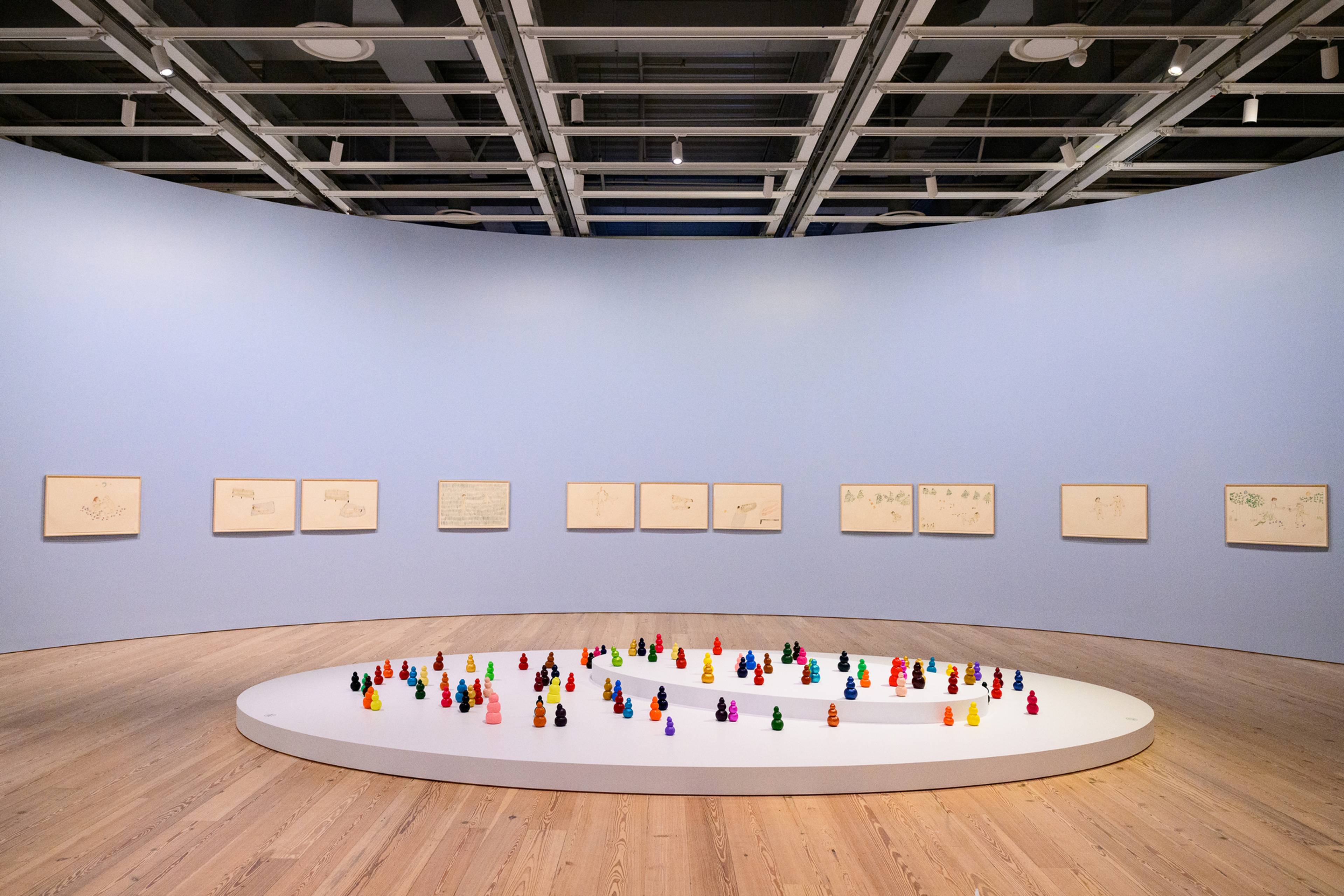
View of "Whitney Biennial 2026” (works by Emilie Louise Gossiaux), Whitney Museum of American Art, New York, 2026. © BFA 2026. Photo: Darian DiCanno/BFA.com
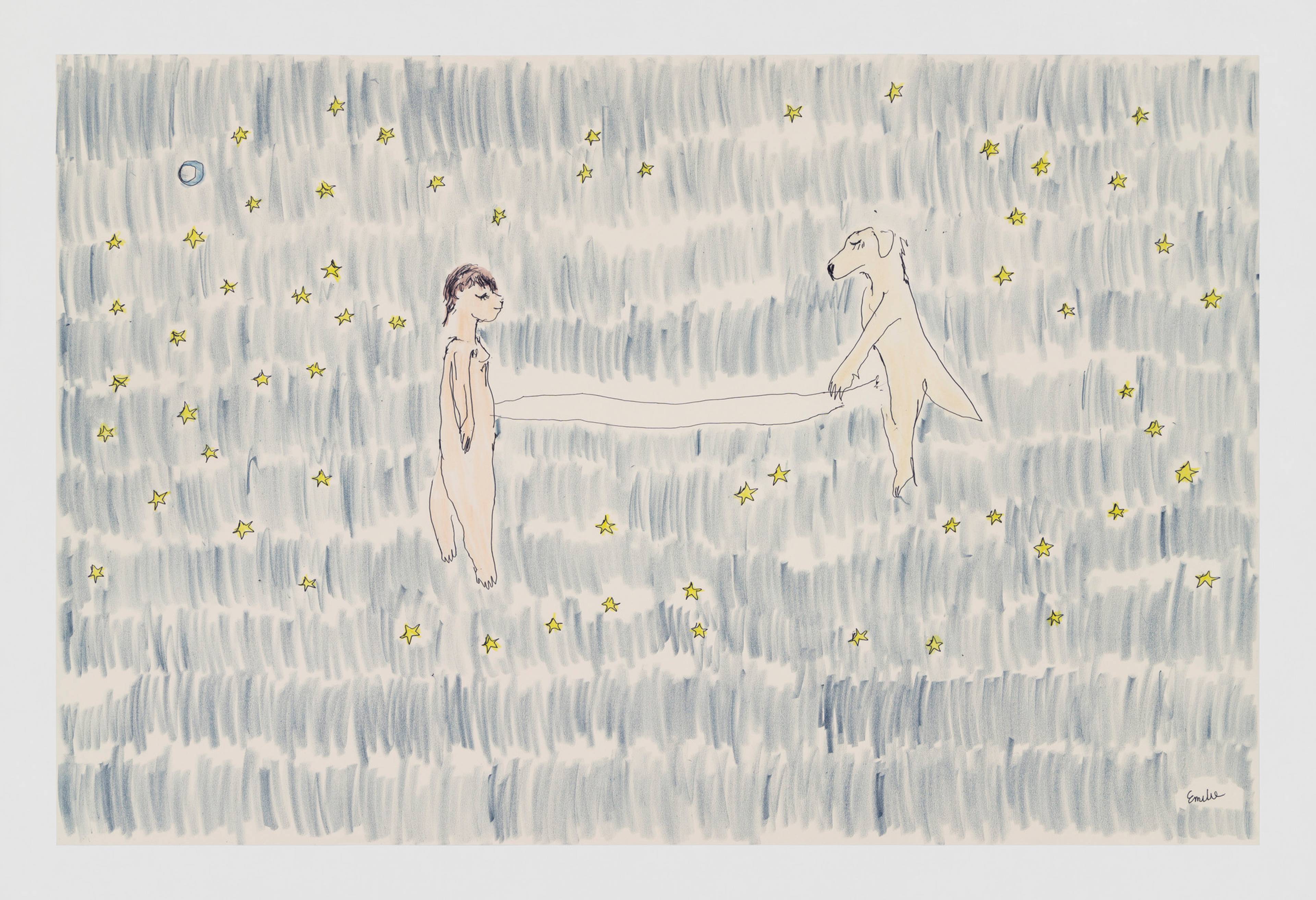
Emilie Louise Gossiaux, Co-Shaping One Another with the Moon, 2025. Ballpoint pen and crayon on paper, 58.5 x 89 cm. © Emilie Louise Gossiaux. Courtesy: the artist and David Peter Francis, New York. Photo: Charles Benton
There’s also Bunny Cam (2024), a ceramic rabbit-shaped pinhole camera by Erin Jane Nelson [*1989, Neenah, WI], and Antlers and suspenders Kimowan (n.d.), one of several photo-collage self-portraits by Kimowan Metchewais [1963–2011, Canada], in which the artist wears antlers on his head. The gory mannequins in the 2026 series Satan in America and Other Invisible Evils: Experiments in Public Sculpture by Isabelle Frances McGuire [*1994, Austin, TX] also have a certain feral energy. In all, the show wants to “become-animal,” as philosophers Deleuze and Guattari would say. Uncut becoming-animal isn’t wan ecology, it’s a thorough and frightening program of undoing the idea of humanness. But the WiBi’s more forgiving version is a start.
As for the children – they’re sprinkled throughout, too, from Taína H. Cruz’s [*1998, New York City] pouting, childsize Statue of Liberty (Rest, Cast, 2026), to a tour-de-force performance in Jordan Strafer’s [*1990, Miami] video Talk Show (2026), in which avant-garde actor Jim Fletcher urges a tearful studio audience to hold their inner child. One room in particular concentrates this theme: five monochrome, larger-than-life wax sculptures of sleeping (though worryingly purple) babies by Andrea Fraser [*1965, Billings, MT] rest on their tummies in vitrines. To one side is Nour Mobarak’s [*1985, Cairo] resin wall relief featuring her pregnant belly, plus embedded samples of blood, breast milk, and semen (Reproductive Logistics 4, 2026). To the other are hot-hued shaped panels by Carmen de Monteflores [*1933, San Juan, Puerto Rico], Fraser’s mother, depicting groovy, intermingling nudes (including Four Women, 1969). The soundtrack of this room is Mobarak’s Broad’s Cast (Montage) (2024–26), ambient recordings made from inside her vaginal canal, before and after the birth of her child. This grouping, more or less conceptually, returns the biological imperative to art’s formalist idea of making: The “green shoot” of creativity is something all organisms share with God, and which is ritualized in art. There’s also obvious material for psychoanalysis here – for instance, Fraser is one of five children. As we watch babies sleep, we imagine the common yet mystical experience of mother- or parenthood, while the inner lives of children feel remote and impossible. This is the pathos of Kids&Pets: an intimate image we can never touch.
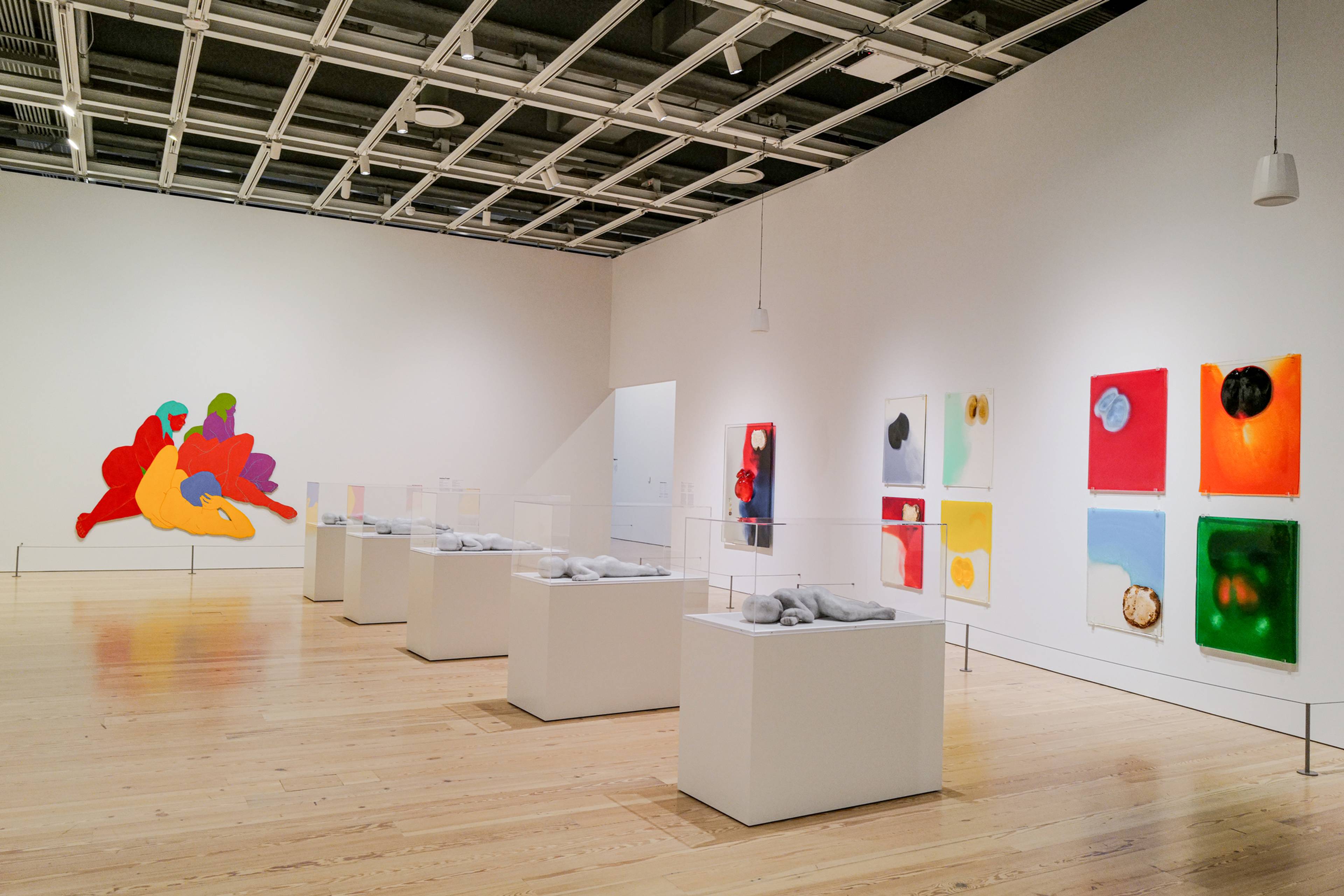
View of "Whitney Biennial 2026” (from bottom to front, works by Carmen de Monteflores, Andrea Fraser, Nour Mobarak), Whitney Museum of American Art, New York, 2026. © BFA 2026. Photo: Jason Lowrie/BFA.com
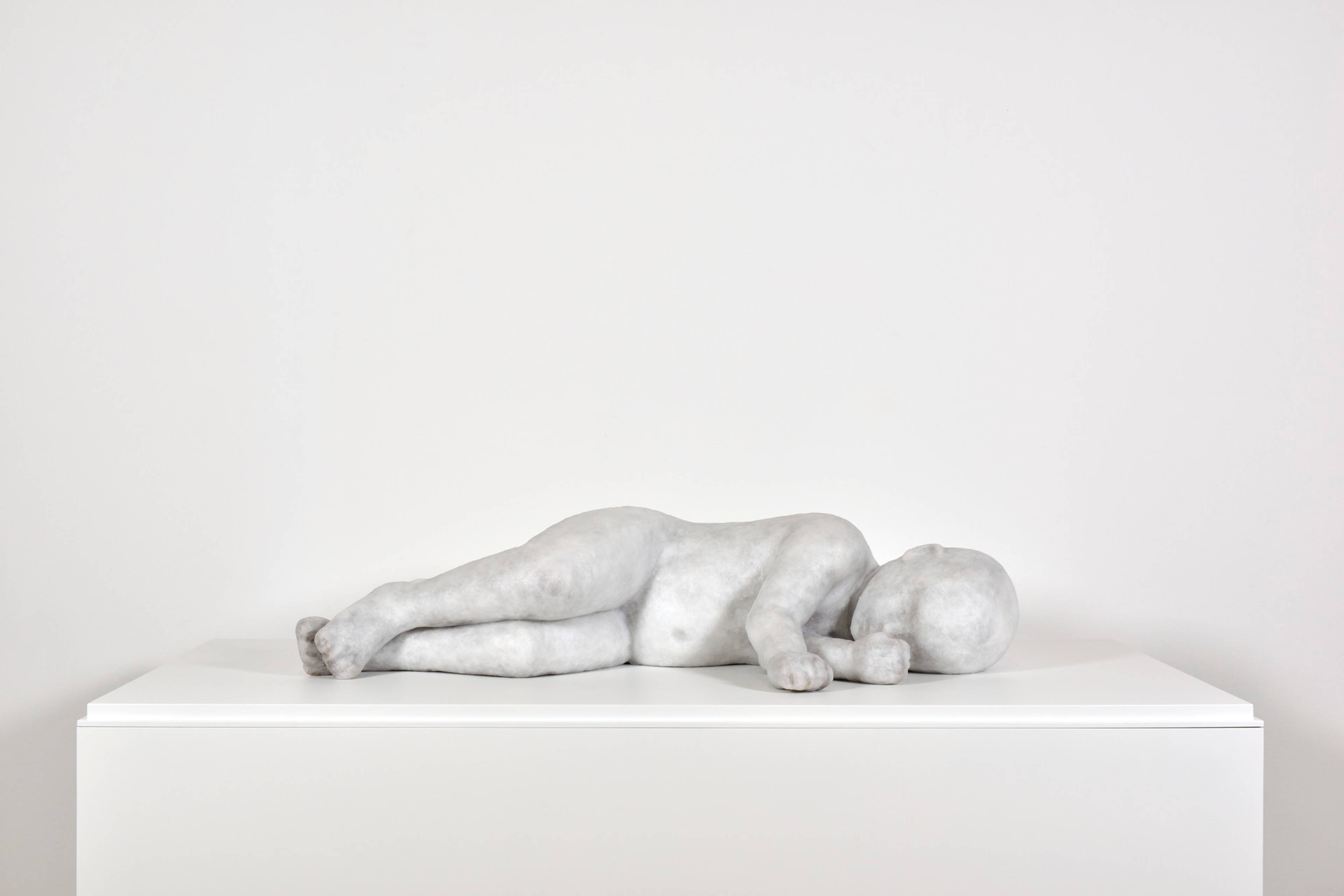
Andrea Fraser, Untitled (Object) IV, 2024 (detail). Microcrystalline wax, aluminum and steel armatures, 15 x 90 x 40 cm. © Andrea Fraser. Courtesy: the artist, Marian Goodman Gallery, and Nagel Draxler Gallery. Photo: Rebecca Fanuele
While the world comes unstitched, this Biennial seeks a narrower, more molecular view of the here and now. Much of the work on view seems to emerge from process, rather than its fabrication being a tedious means to an end. Paintings of zany systems by Akira Ikezoe [*1979, Kochi, Japan] diagram closed cycles of life, death, rebirth, manufacturing, and even art, carried out by anthropomorphized frogs and moles. (A third involves humanoid robots.) Some of that same curiosity infuses Sarah M. Rodriguez’s [*1984, Honolulu] spindly aluminum sculptures welded together from casts of organic objects like seed pods and shells. In Ash Arder’s [*1988, Muscatawing, Flint, MI] Consumables (2023), a trio of Cadillac hood ornaments cast in shea butter, butter, and chocolate stay solid inside a refrigerated display case dependent on solar power. These three works, in very different ways, try to stop decay. The pivotal piece of floor 6 is Pandemonium (2025) by Michelle Lopez [*1970, Bridgeport, CT]. Originally conceived for a planetarium, here the digital animation is a flat circle on the ceiling, depicting paper debris and American flags, newspapers and magazines and takeout bags juking through the sky, with glimpses of text but little to grab onto. It’s the Angelus Novus of our time. In Walter Benjamin’s 1940 famous ekphrasis of that 1920 Paul Klee drawing, he describes the angel of history moving forward in time but facing backward, as the rubble of civilization piles up at his feet. Here, the rubble doesn’t pile up, it swirls overhead; our angel isn’t flying backwards, nor forward, they’re fixed in place, surrounded.
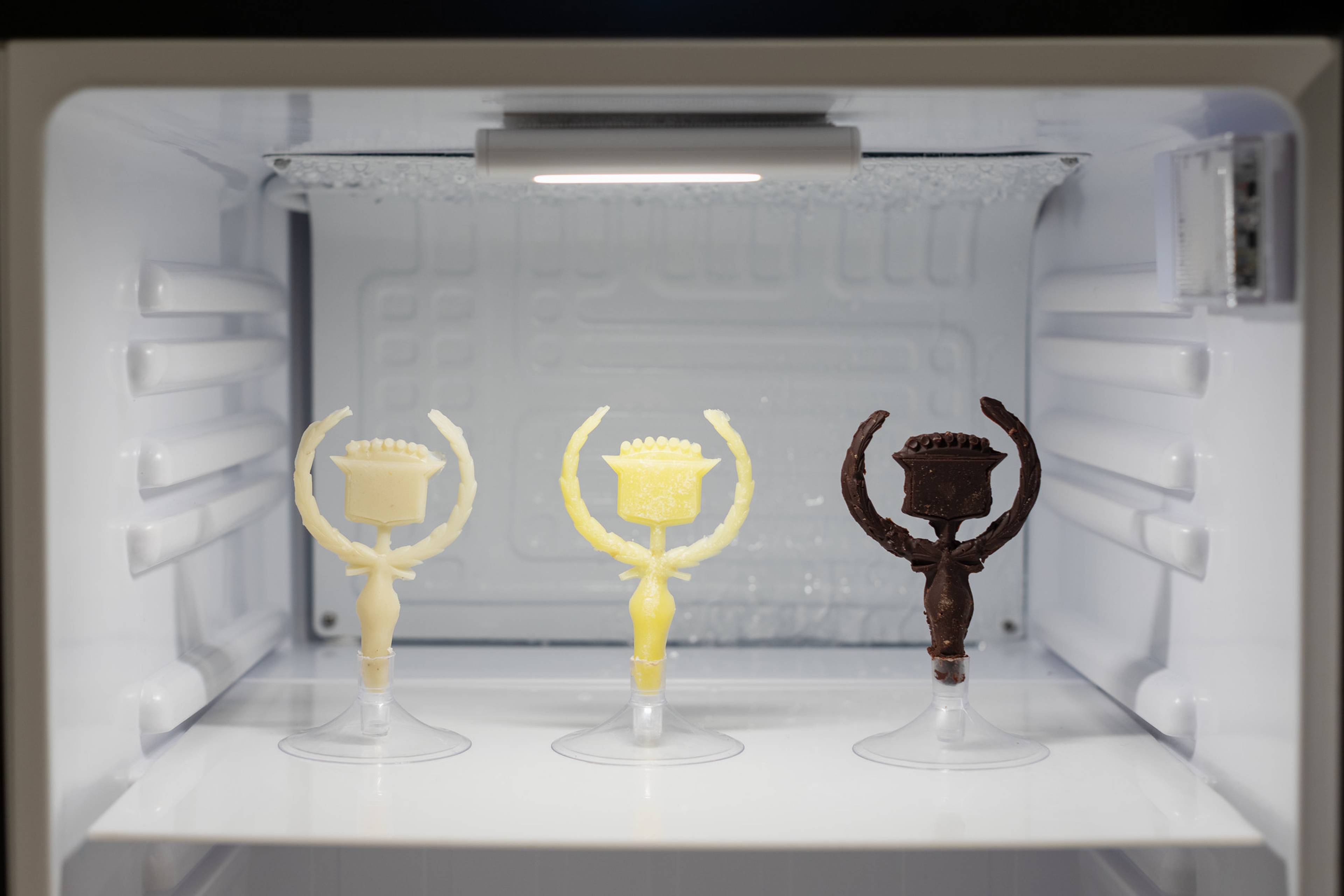
Ash Arder, Consumables, 2023 (detail). Display refrigerator, solar-powered battery storage system, shea butter, butter, chocolate, plastic, and light, 49.5 x 44 x 51 cm). Courtesy: the artist. Photo: Clare Gatto
Judging from the reviews so far, critics find the 2026 Biennial refreshing for its upbeat weirdness and political agnosticism. The way I’d phrase it: this is the least didactic Biennial at least since the museum moved to Chelsea in 2015. The 82nd WiBi spans the United States’s 250th 4th of July, which promises to be a jingoistic celebration of nationalism. People forget the whole name, but it’s the Whitney Museum of American Art, and the Biennial shares that mandate. Guerrero and Sawyer have taken this idea of “Americanness” so literally that Trumpists wouldn’t recognize it. Participating artist Mao Ishikawa was born in Okinawa, Japan, in 1953, when it was under US occupation; José Maceda was born in the Philippines in 1917 while it was a US colony, and died there in 2004. Other artists come from Chile, Iran, Iraq, and the Cree, Caddo, and Navajo nations. In other words, this definition of American highlights the extent of US hard power since its founding. The way the Biennial addresses Palestine is similarly oblique. A multichannel video installation by Basel Abbas [*1983, Nicosia, Cyprus] and Ruanne Abou-Rahme [*1983, Boston] includes a poetic rumination on erased Palestinian villages and the cacti that remain (Until we became fire and fire us, 2023–). This succulent becomes an ambiguous symbol of generational survival, which feels bitter and unsatisfying – like a cactus. Other poignant anti-war works are more abstract still: a series of geometric video “paintings” from the 1980s, some with titles like Land and Bread, by Palestinian-born New York artist Samia Halaby [*1936, Palestine]. They bleep and bark, sweeping ecstatic pixels around their screens, in a way you could describe as defiant, if pressed. Halaby is also an activist – but that work is somewhere else.
You could fairly ask how a national biennial should respond to the crimes that that nation continues to commit. A focus on children, lineage, memory, materiality, joy, and the rest of what war severs feels appropriate.
So this Biennial avoids more than gracenotes of foreign slaughter and domestic collapse. You could fairly ask how a national biennial should respond to the crimes that that nation continues to commit. A focus on children, lineage, memory, materiality, joy, and the rest of what war severs feels appropriate. After all, this Biennial is a snapshot. Whatever it depicts or inspires happens elsewhere. Two featured artists in particular move past the limits of art. Joshua Citarella [*1987, New York City] represents a cohort, if not a generation, of post-internet artists who have sidestepped the art industry. He still makes museum-style work – charts and flags drawn from his research into online political subcultures – but his main project now is the politics-and-culture podcast Doomscroll, and that’s what’s in the WiBi: He’ll film two episodes live in the Whitney’s theater. Likewise, the series Rule (2024–), by David L. Johnson [*1993, New York City], engages a quirk of New York urbanism, the Privately Owned Public Space. (Zuccotti Park, cradle of Occupy Wall Street, is one example.) On the walls of the Whitney are a couple dozen plaques, detailing codes of conduct, that the artist has pried from such lobbies and plazas at his legal peril. If the rules aren’t posted, they aren’t enforceable‚ which makes this a gesture at once symbolic and practical. A metaphor with concrete effects? That’s the modest magic of Kids&Pets.
“Whitney Biennial 2026”
Whitney Museum of American Art
8 Mar – 23 Aug 2026
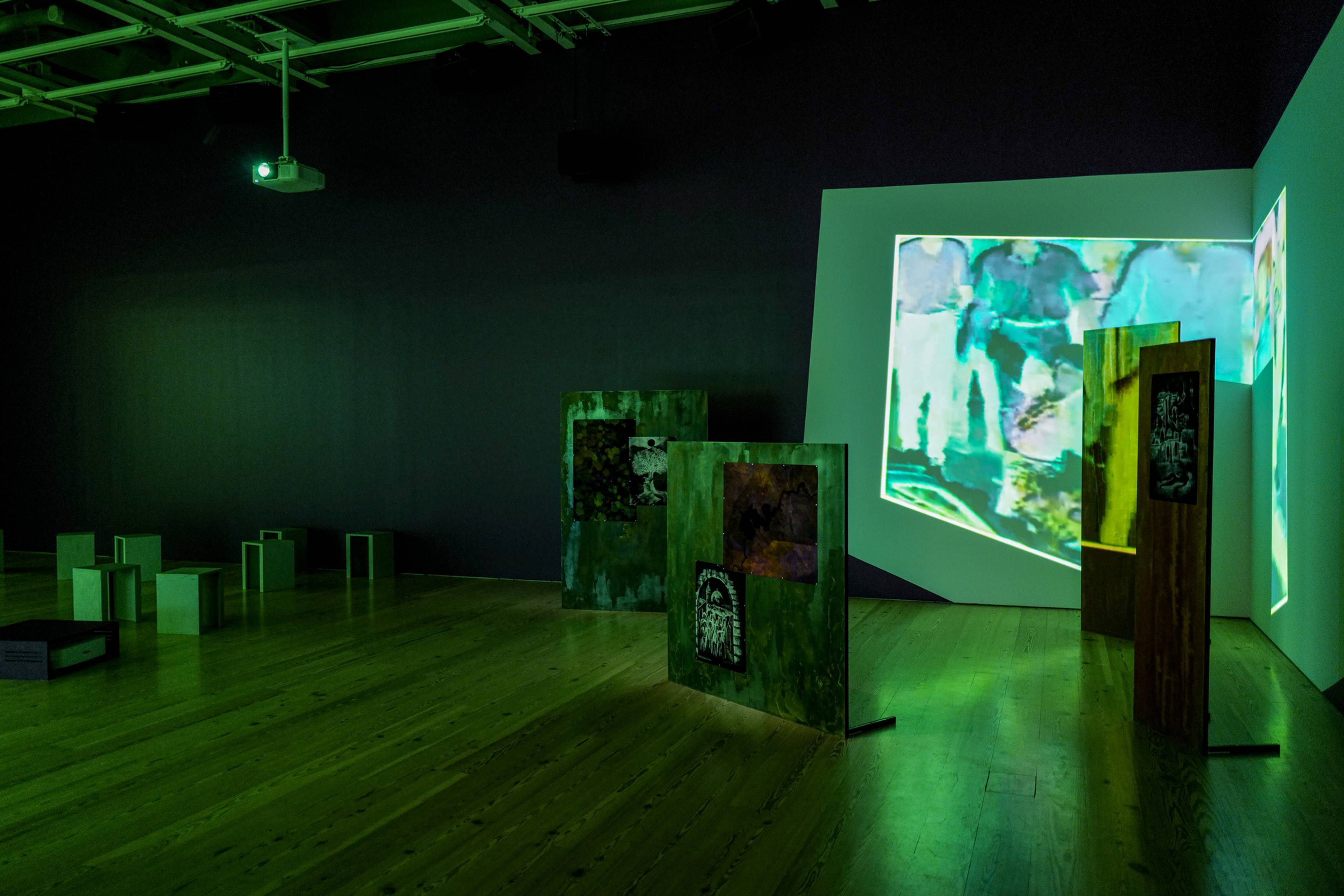
View of "Whitney Biennial 2026,” Whitney Museum of American Art, New York, 2026. © BFA 2026. Photo: Jason Lowrie/BFA.com
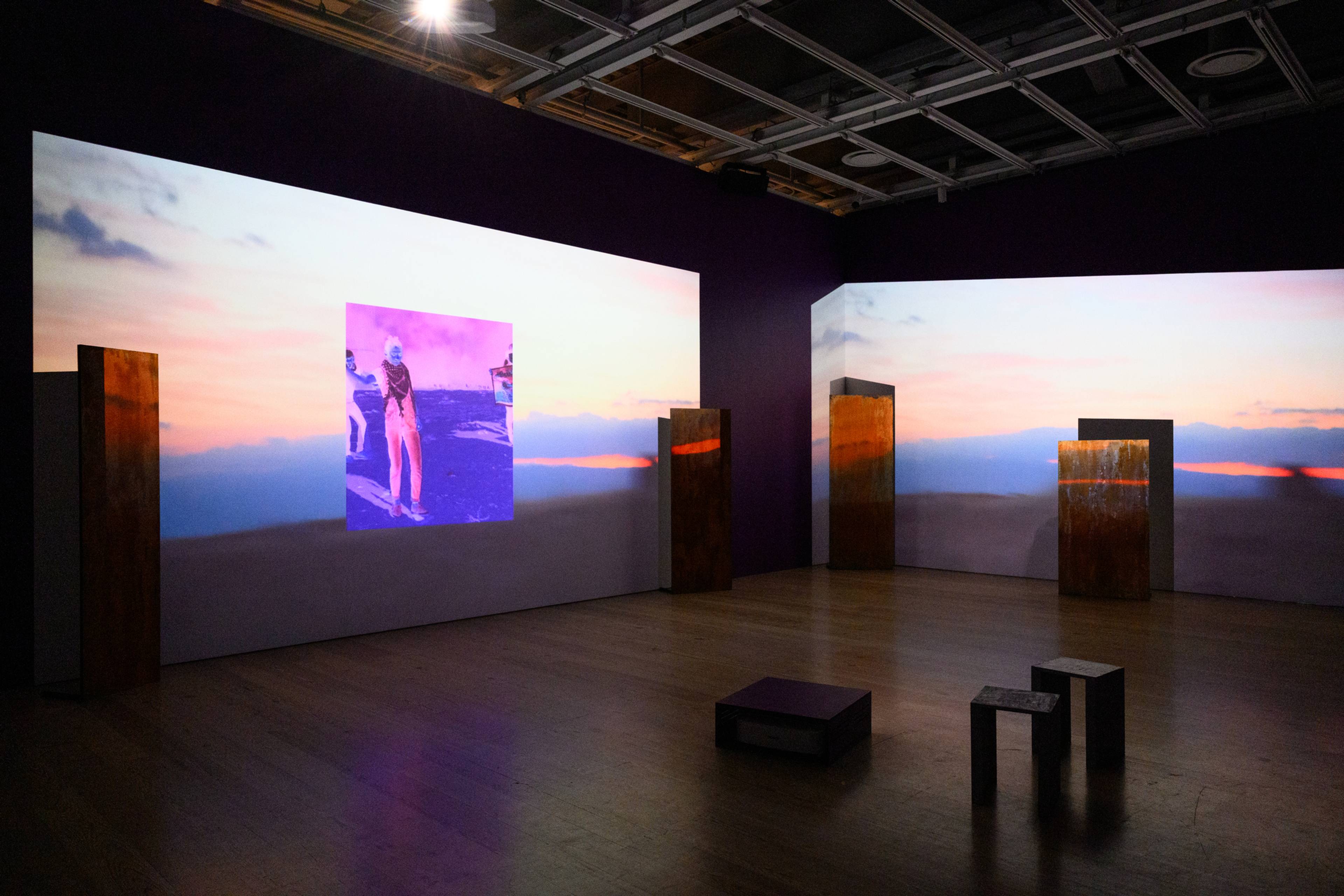
View of "Whitney Biennial 2026,” Whitney Museum of American Art, New York, 2026. © BFA 2026. Photo: Darian DiCanno/BFA.com
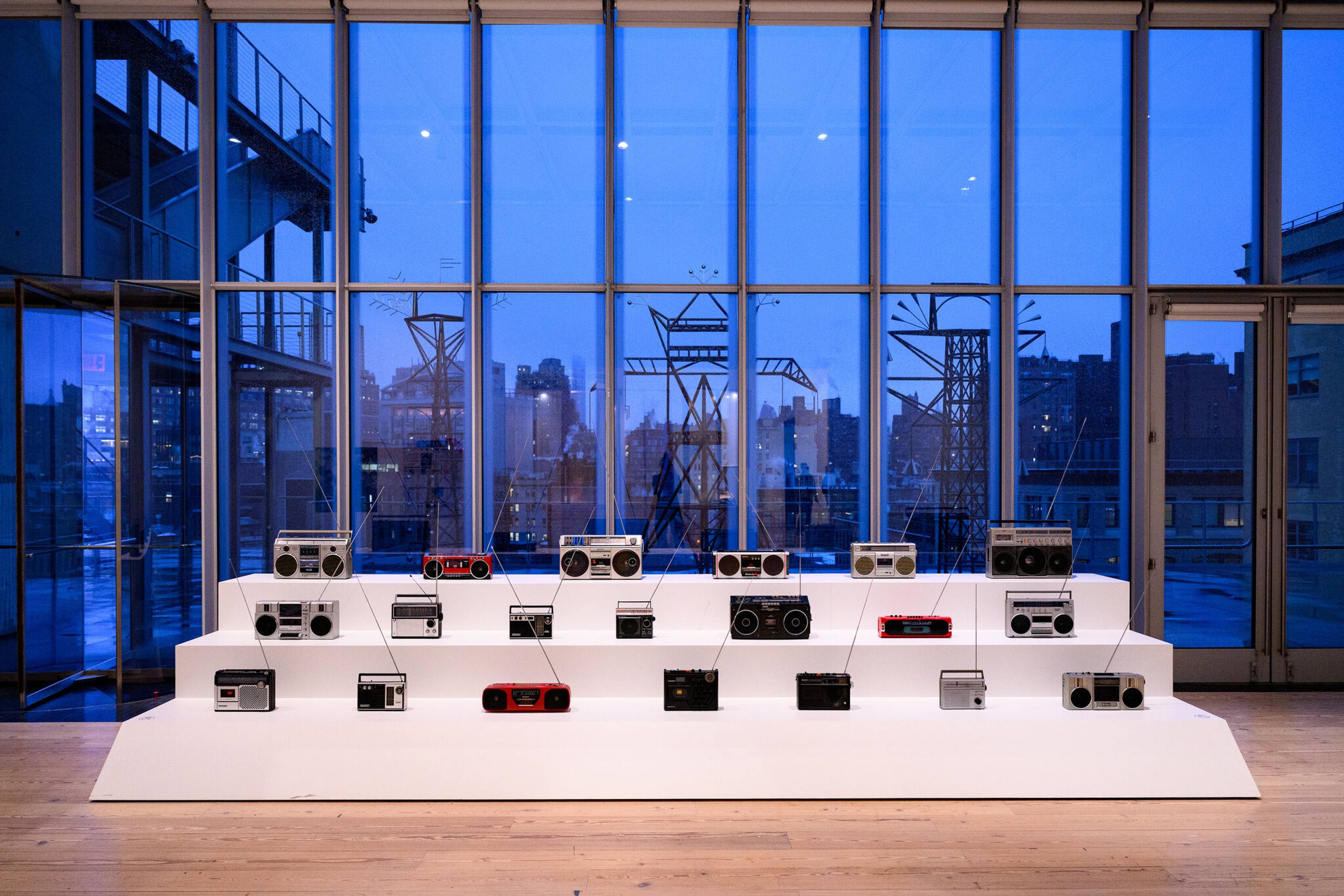
José Maceda & Aki Onda, Ugnayan, 1974/2026. Multichannel sound installation; 51 min., dimensions variable. © BFA 2026. Photo: Darian DiCanno/BFA.com
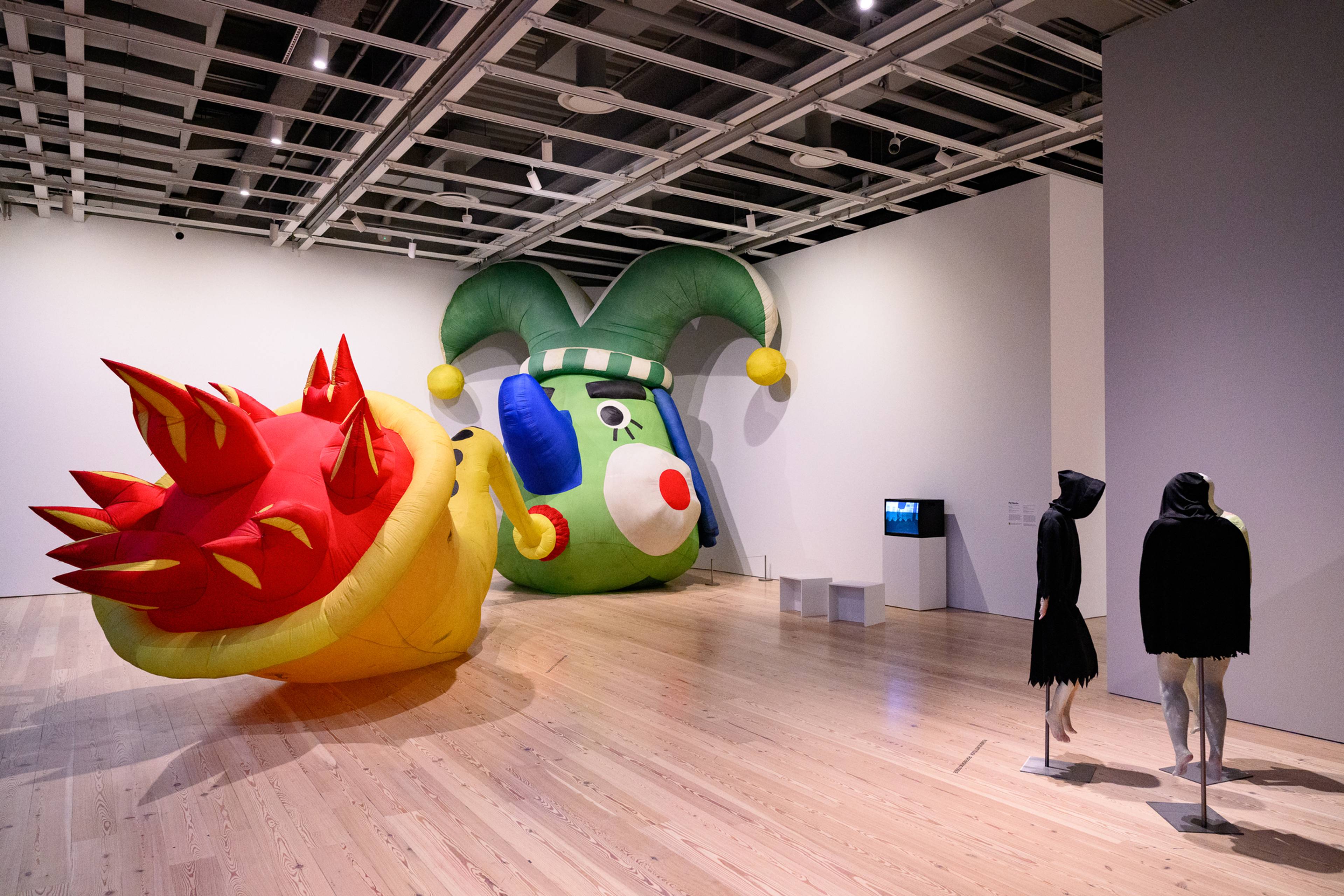
View of "Whitney Biennial 2026,” Whitney Museum of American Art, New York, 2026. © BFA 2026. Photo: Darian DiCanno/BFA.com
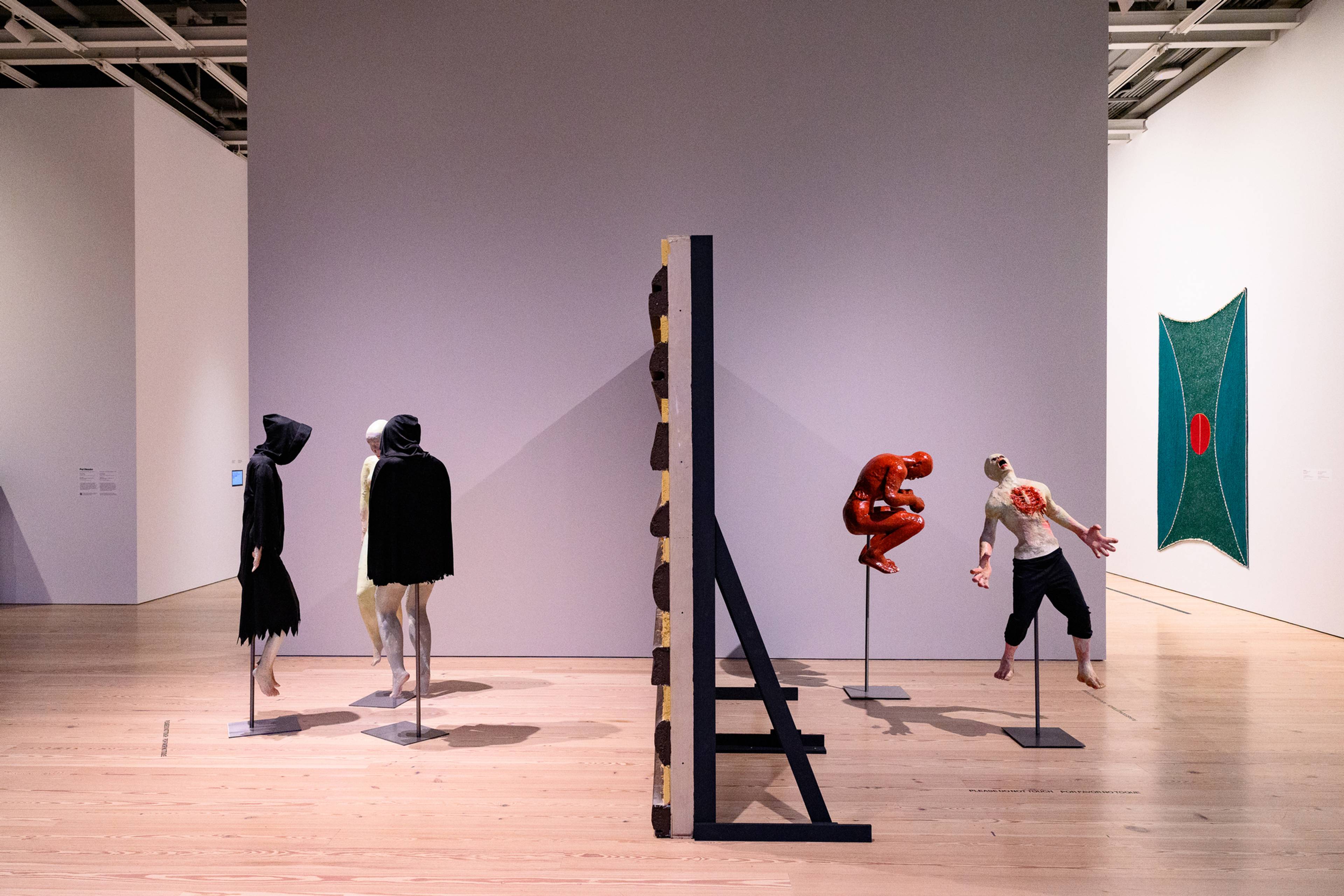
View of "Whitney Biennial 2026” (works by Isabelle Frances McGuire), Whitney Museum of American Art, New York, 2026. © BFA 2026. Photo: Darian DiCanno/BFA.com