


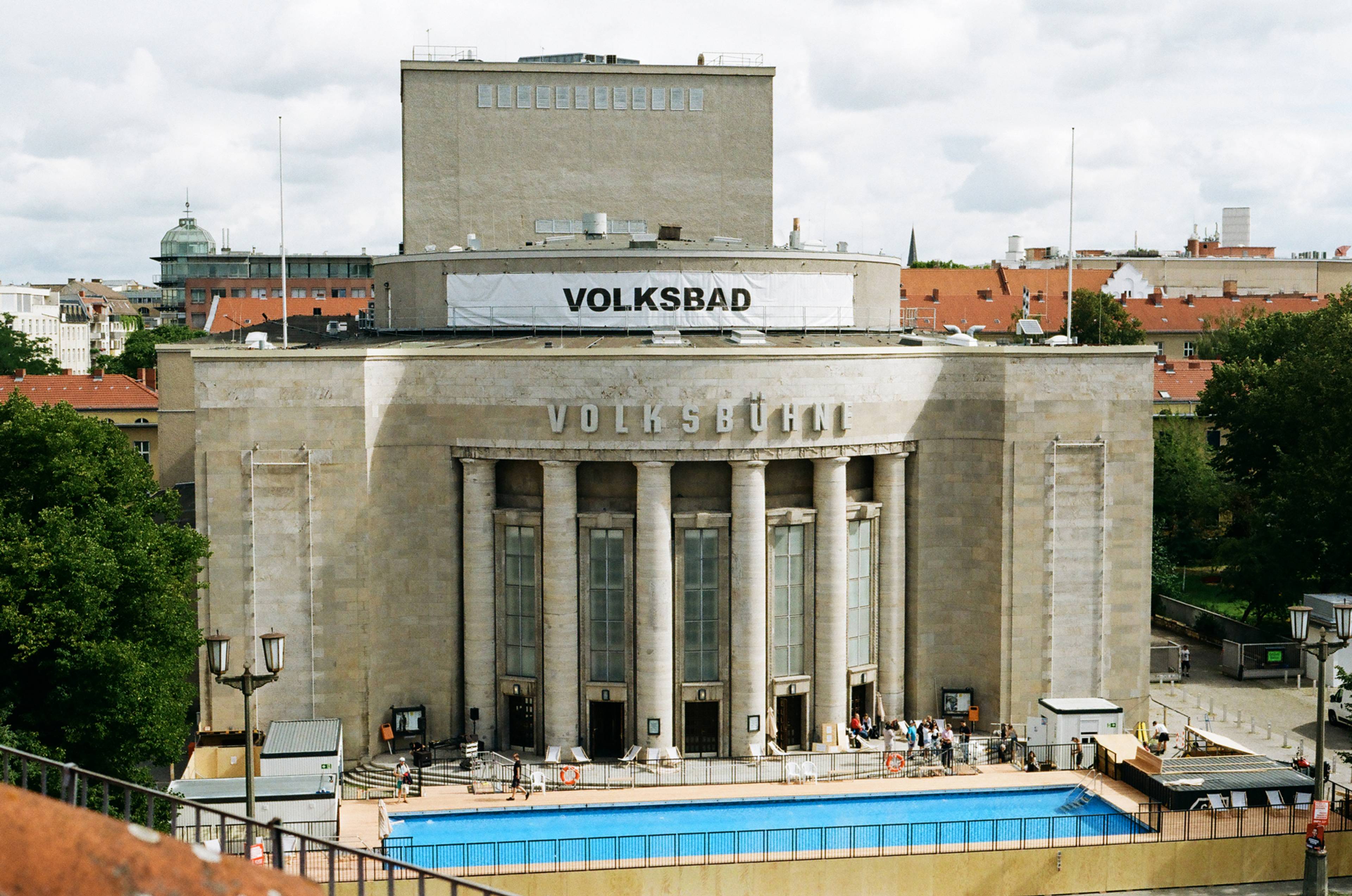
The performative element, says Matthias Lilienthal, the Volksbühne’s artistic director, over lunch, is naturally the body – partly naked. It is a Tuesday in early August; a few days earlier, the Berlin theater had opened its season with “Volksbad,” and the media coverage has not stopped since. I, too, was meant to go swimming today, to file a ethological piece on this first production under the new leadership. But the showers are broken and, for reasons of hygiene, the pool remains closed for now. On Friday, there will be an unhappy incident: a day reserved for Black children and teenagers will be cancelled, after a right-wing social media campaign stirs up threats of racist violence. But none of us knows that yet.
After a plate of pasta, Lilienthal and I walk over to the Volksbad anyway, past security, who are gently turning away a bunch of curious spectators. Shoes off, up onto the rim of the raised pool: a simple, vinyl-lined swimming basin like those used at festivals, rented for the occasion.
It’s summer in Berlin. A municipal election is underway; the city and its temper both run hot. The newsrooms are on holiday, their editorial calendars bare; one is grateful for every event that fills the summer slump. It must have been a strange kind of opening: press colleagues swimming together in order to write about it, the premiere doubling as press conference. Elif Eralp, leading candidate of Die Linke (Germany’s Left Party), who hopes this autumn to become the capital’s next mayor, was there too, in a red bathing suit. So these, then, were the performing bodies.
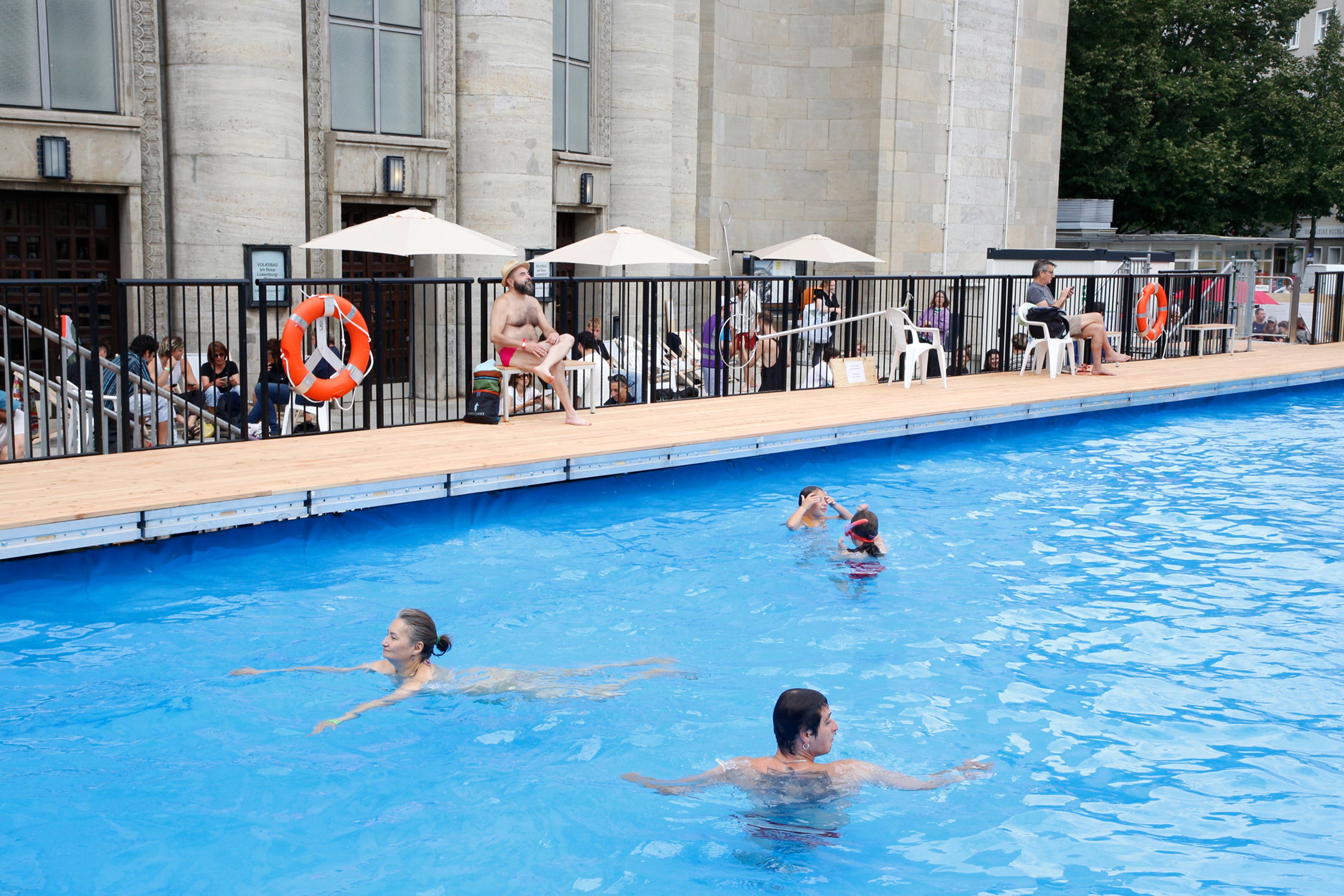
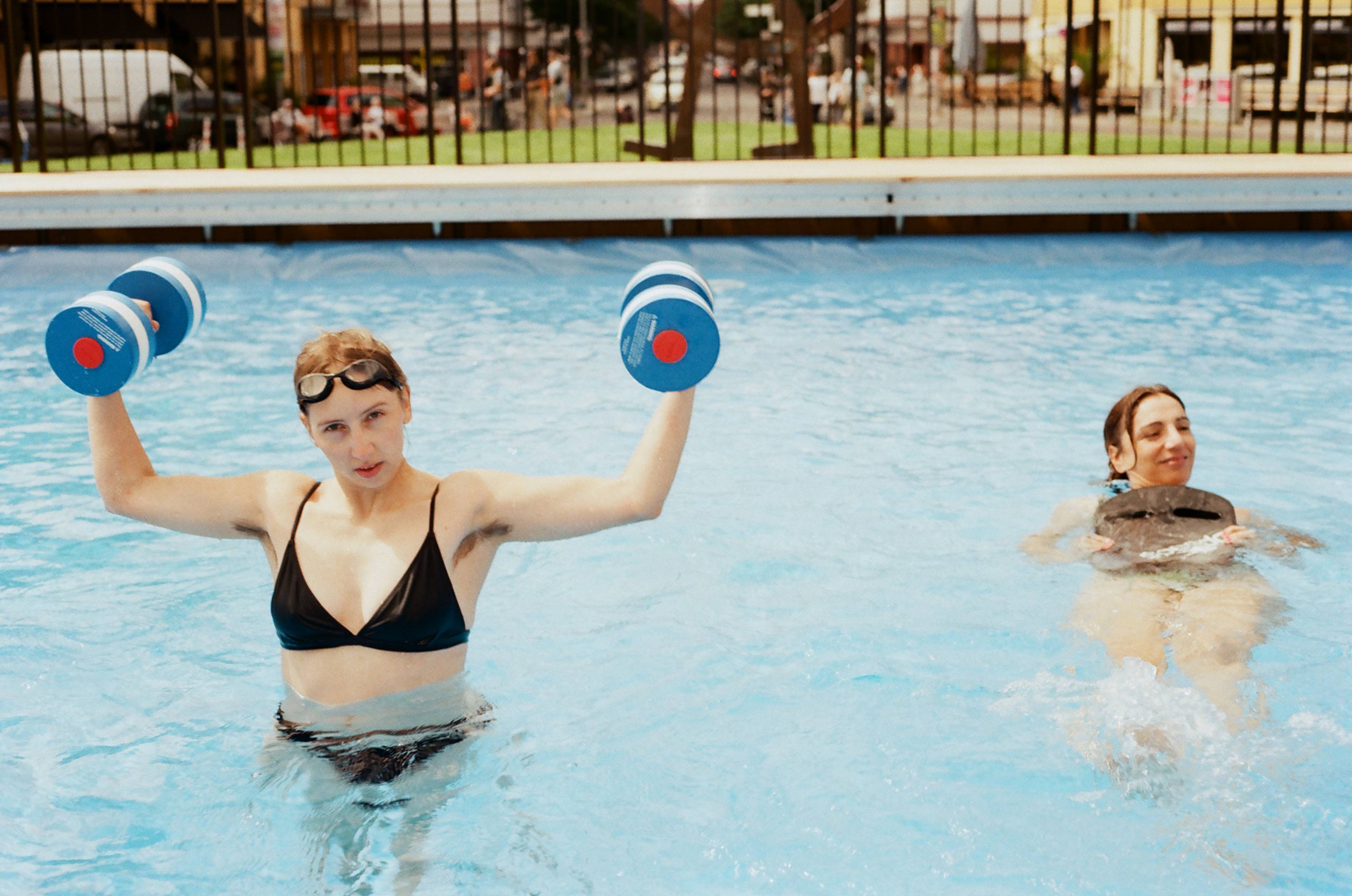
Perched at the edge of the empty pool, raised above Rosa-Luxemburg-Platz, one finds oneself watched by the curious gathered on the lawn below, as though one were standing on a stage oneself, even on a cloudy Tuesday before the to-be-cancelled event. Sun and Sea (Marina), the opera by Rugilė Barzdžiukaitė, Vaiva Grainytė, and Lina Lapelytė that won the Golden Lion at the 2019 Venice Biennale, comes to mind – except that, here, there is no music, no artists, no trained performers. There’s only Berlin’s civic body performing itself – one pandemic, several ruinous wars, the advent of artificial intelligence, and many cuts to public cultural funding later.
It is therefore hardly surprising that press, politicians, and opinion makers of those early days refuse to discuss the play itself – let alone from an aesthetic perspective – and instead prefer to play the role of diligent supporting actors, pouncing on every spark that flares up in their vicinity and fueling a debate that Friedrich Dürrenmatt, the post-War Swiss dramatist, himself could not have imagined more dramatically. As he noted in his remarks on Die Physiker (The Physicists, 1962), a play is only fully thought through to the end when it has taken the worst possible turn.
Act One
Can swimming, and French fries, really be theater? Is the whole thing merely a polemic against a city in decline? A great spectacle? The eventization of culture? So the outraged ask. One Social Democratic politician’s inquiry forces the production’s budget into the open: three hundred thousand euros, a sum almost comically modest by the standards of a major European theater house, especially set against the water-fire-and-air-intensive works of Florentina Holzinger, member of the artistic advisory board of Volksbühne, who might equally be called this project’s patron saint and muse. Instead, there’s outrage: tax money! What about the independent scene? The young people? But this misreads the accounting: the amount comes from the Volksbühne’s own annual production budget. And since the stage machinery inside is currently being renovated, the main theater won’t reopen until October. In addition, visitors who are diligent enough to book a slot online or to arrive before capacity is reached can visit the Volksbad for free, while admission must still be paid for regular productions – just as it is for public swimming pools, as everyone knows.
It seems that even Lilienthal himself had underestimated the sheer force of body politics, and the shamelessness of debate, in the year 2026.
But the pool isn’t deep enough to properly swim in, someone writes (one can’t help but wonder about this colleague’s swimming style); and what’s about the pool “wasting” water in a summer of drought? Both complaints feel oddly small-bore next to the fact that the Soho House’s private pool, two hundred meters away, goes entirely unremarked. One might read this as a symptom: disdain for the poor remains, even in polite society, a reliable form of social distinction, and business is good.
Act Two
And so it went, as it had to go. Included in the Volksbad’s production was that, on certain days, it would be handed over to associations shaping the city’s civic life. That Friday, it was meant to be Each One Teach One e.V., a community group working for the education and empowerment of Black, African, and Afro-diasporic people in Berlin, which had planned to open the pool exclusively to Black children and teenagers. The plan was denounced, and swiftly inflated into scandal, by a video from a pitiful local CDU politician invoking, absurdly, “racism against white people.” Driven on by an online mob, the event was ultimately cancelled: the threat of racist violence was judged to have grown too great.
Act Three
Once more, the politicians and the feuilletons fall over themselves analyzing the safe space and what it says about the state of society – Meron Mendel, Alice Hasters, and others all exhaling their opinions into the ether, while theater director Angela Richter invokes, in a fit of wild speculation the spirit of Christoph Schlingensief, that shrewd provocateur with whom Lilienthal once worked so closely, and what he would’ve done – or not.
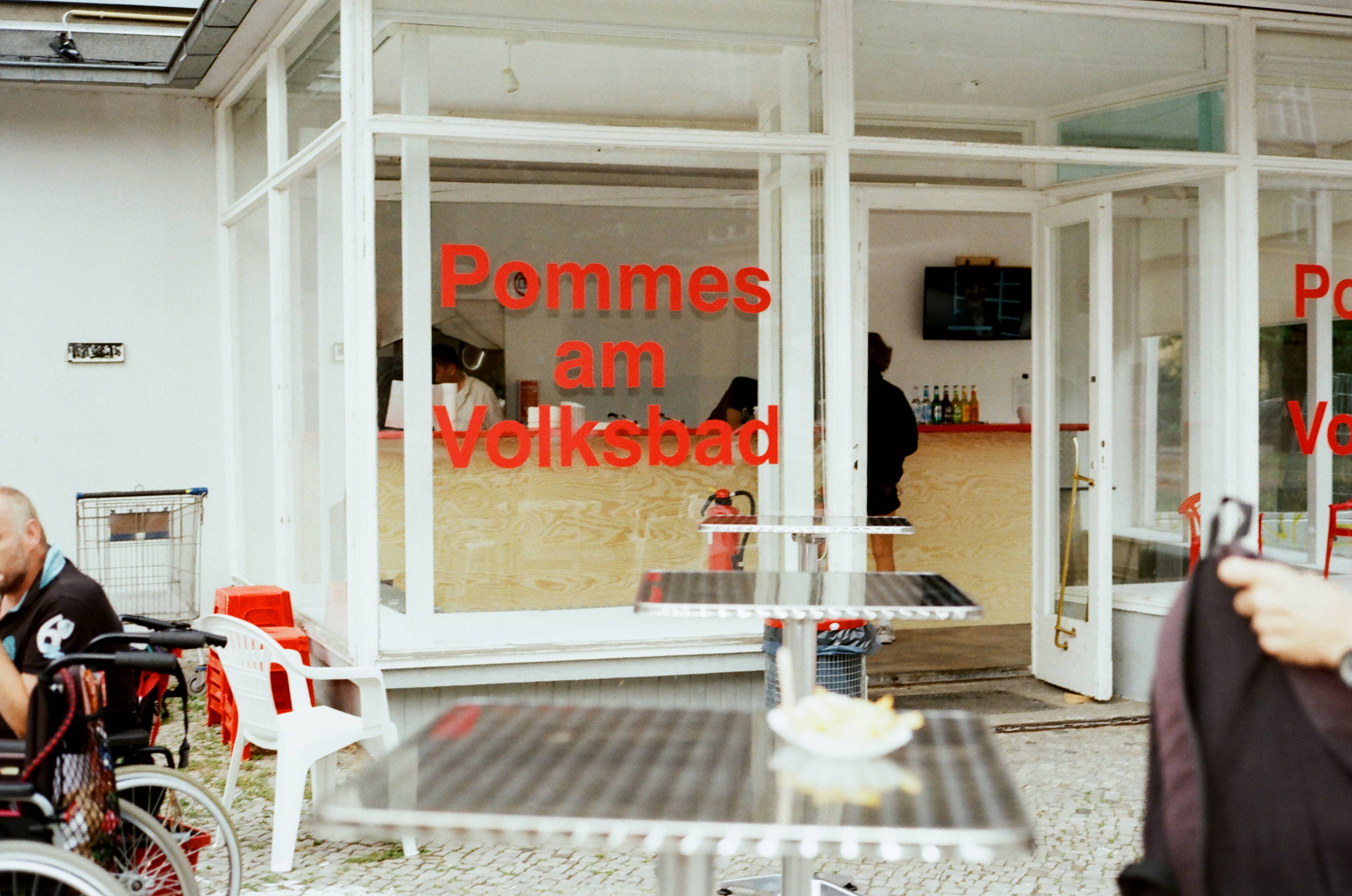
If, at the press conference announcing the production, one had wondered whether the act of spraying water at one another could really constitute theater, it now seems that even Lilienthal himself had underestimated the sheer force of body politics, and the shamelessness of debate, in the year 2026. How else to explain why the production tried to fold in children who were already marginalized, and in so doing, handed them over to the rabble? A banner bearing the entirely bodily instruction “FiCKT EUCH!” (Fuck you!) appeared at the Volksbad for the time of the cancelled event. Instead, the Volksbad invited everyone for an open discussion – but the press was explicitly not welcome. A clear refusal to take part in the manufactured debate at all.
For a week now, the Volksbad has again been open to bathers. Their presence quickly diverts attention from one’s own role in the trouble. But lean over the edge of the still, empty pool outside opening hours, and what one sees, quite clearly, is only oneself.
VOLKSBAD
Volksbühne am Rosa-Luxemburg-Platz, Berlin
7 Aug – 1 Oct 2026