


Clavicular Clavicular Clavicular. Once in a while, a memetic fragment proliferates in the general cyberorganism so intensely that even casual prosumers of social media catch the infection. Such was the week Clavicular, a twenty-year-old mononymous, non-monogamous male beauty influencer and livestreamer, came to New York City. The psychic flak was dense. Clavicular, chatting on the leftist comic Adam Friedland Show podcast; Clavicular, walking the runway for edgelord designer Elena Velez in a white button-down shirt, co-branded by the edgelord NFT collective Remilia Corporation, seemingly stiffened with cum. The feed was saturated. His gravity bent AFK conversations his direction. Somehow, inexorably, the word would be uttered: Clavicular.
The art world looked on with awe. Who was this great white beefcake, seemingly unburdened by political awareness, dropping racial slurs and pissing upstream from culture? 90% of the Substacks I follow unpacked him, the New York Times profiled him. At ArtCenter in Pasadena, a comedian representing the anon art account Diva Corp addressed a panel of professional critics: “You guys don’t know what’s going on with the world. Do you know anything about looksmaxxing, Isabelle [Graw, founding editor of Texte zur Kunst]?Do you even know who Clavicular is?”
Clavicular is an alpha of the looksmaxxing subculture, an outgrowth of incel forums where young men, some young teens, put physical beauty above all else, taking hormones before their balls drop and, if you believe the hype, shaping their jawlines with hammers. Their ancestors, the pickup artists of the early 2000s, were men with names like Style and Extramask who donned fedoras and hit “target-rich environments” such as nightclubs and museums. This is male bonding at female expense. They are Players of The Game.


@aura_maxing000
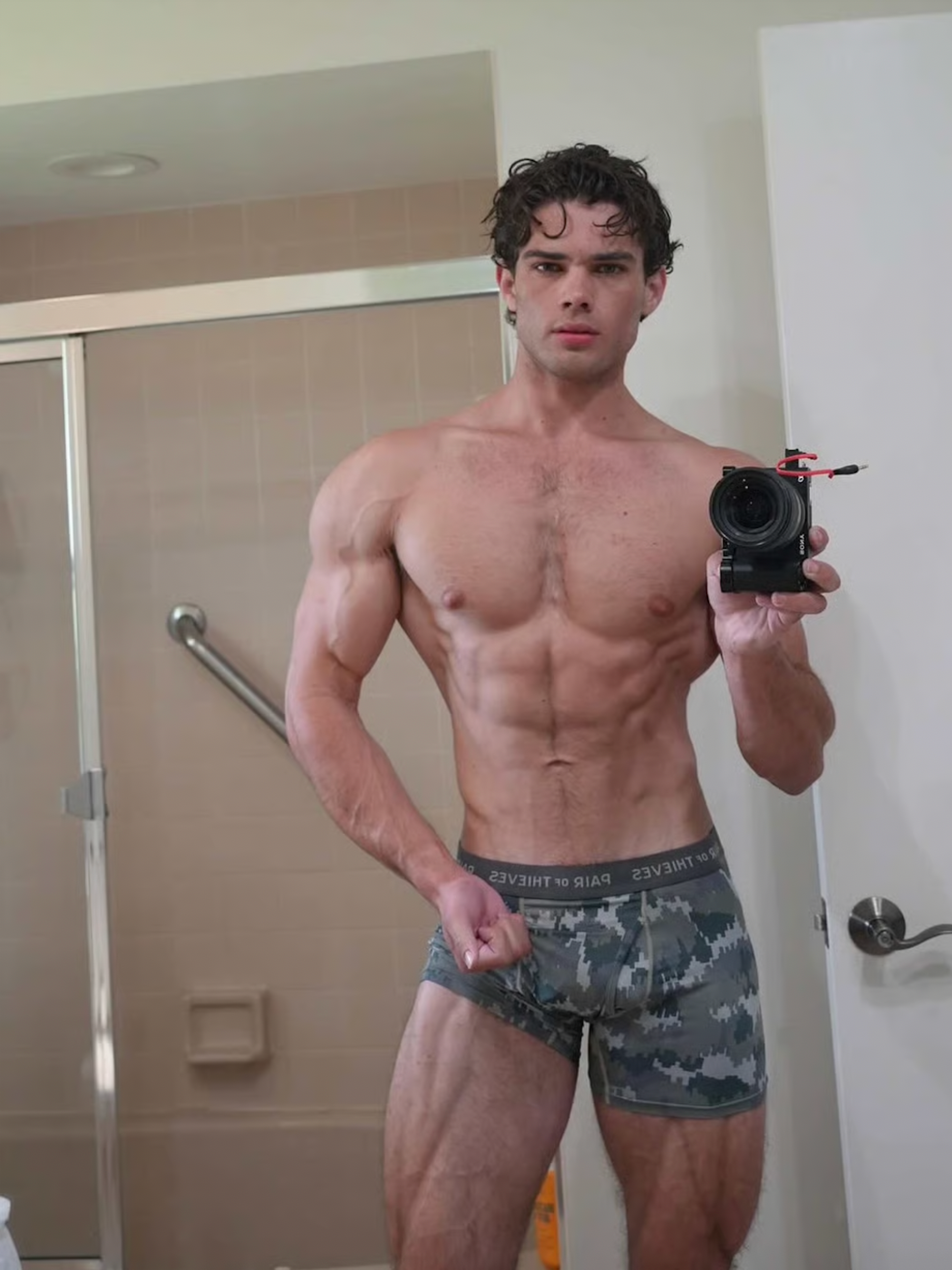
Art recoils, almost jealously, from such a mechanistic view of human interaction. Clav’s incessant livestreaming peaks art’s ambivalence towards the attention economy, at a time when Fine Art proper feels more infertile than a guy who’s been shooting testosterone since age fifteen. Is Clav’s schtick performance art? It is becoming-meme. Clavicular! His name is a germ, its viral force nurtured by the agar of the internet. “Trump” is like that. “Musk” too. Like viruses digital and corporeal, they don’t ask permission. They filter into your body and multiply.
The metaphor of infection and defense is a classical, reductive worldview. Musk might be its present alpha. A merciless new book by historian Quinn Slobodian and technologist Ben Tarnoff, titled Muskism: A Guide for the Perplexed (2026), emphasizes a key moment in the logorrheic tweeting of the world’s richest man, the awkward declaration that “I am become meme.” Cute. But, the authors argue, a desire to merge with the machine runs throughout Musk’s seemingly disparate enterprises. This machine can be AI, or a government, or a social network – in any case, the goal is survival of the fittest (in his mind, him).
This dovetails with one of Musk’s spookiest quirks: he claims to believe “a billion to one” that we’re living in a simulation. As Slobodian and Tarnoff write, “Treating life like a game had its own ethos and its own philosophers. In a theory often cited by Musk, [philosopher] Nick Bostrom speculates that we may be living in a simulation running on a mainframe in the future. Further, many of the people around us may not be human beings but computer programs: what Bostrom calls ‘shadow-people,’ convincing imitations that lack interiority. The ethical consequences are significant.” Musk calls empathy an “exploit” – in the lingo of software engineers, a weakness in the code.
As artists know, it’s possible to inhabit the bowels of capital without losing your humanity.
Whether or not Musk is correct is secondary to the effect this belief has on his behavior. The game he’s playing, and trying to “debug” (all dehumanizing language intended), is Western Civilization. The Muskism authors remind us that Musk grew up in apartheid South Africa, and his fear of “white genocide” remains strong. His sense of persecution is that of the settler: as if an invading virus, subsumed by antibodies, declares itself the victim. In the short term, he’s personally fathered fourteen children, eleven of them male. Ultimately, he’d like to clean up the white Christian world’s backend by offloading all the groups he finds undesirable – immigrants, mostly, and those infected by the “woke mind virus.” He thinks wokeness is a literal virus.
The reactionary right likes to pretend they take accelerationist cybernetic philosopher Nick Land undiluted when he argues that capitalism is a natural law, like gravity. I prefer the subtler accelerationism described by philosopher Steven Shaviro; his model is a science fiction story in which giant planet-sized aliens appear and consume the entire Earth. Most of humanity dies, but the ones who survive don’t merge with these monsters – they hack their own genetics and become parasites within them. They’re born, reproduce, and die in quick generations, but they keep culture going in the form of math and music. Not an ideal scenario, but realistic. Even beautiful.
If art wants to compete in this Manichaean attention economy, its options seem stark: become-meme or die. Memes are vectors, like viruses – they’re a form, and their content matters. As Muskists want to merge with the alien body of capitalism, they treat brutal competition as the imperative of that conquest, even as they work to bring it about. This is a failure of imagination, and a self-serving one. I won’t say art isn’t competitive or that it shouldn’t adapt to life inside such a body. But, as artists know, it’s possible to inhabit the bowels of capital without losing your humanity. The Cuban-born US artist Félix González-Torres famously said he wanted to be like a virus, with the art establishment as his unwitting host. This is a brutal metaphor, even if you don’t know the artist died of AIDS. His work’s almost cheerful abstraction helped it slip past the white blood cells of the institution, so to speak – the conservative or bigoted gatekeepers – and into the system, where it could unfurl its politics. The readiest example is “Untitled” (Portrait of Ross in LA), 1991, a pile of candy whose weight is commonly taken to correspond to Ross Laycock’s body weight, the artist’s partner who died of AIDS-related complications that year. You can take a piece. Each cellophane-wrapped bonbon is a zygote of undying love. A non-Manichaean virus.
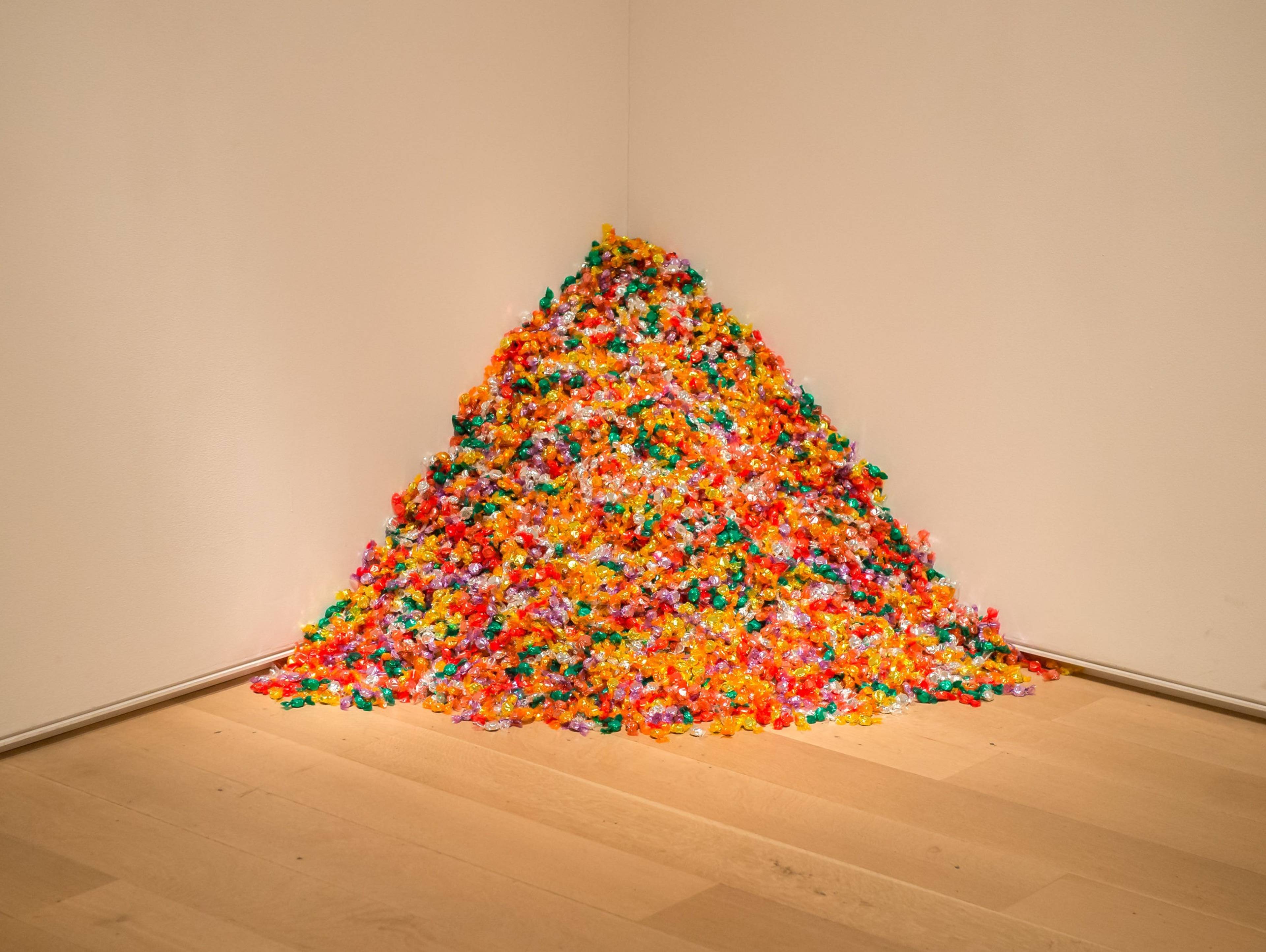
Felix Gonzalez-Torres, “Untitled” (Portrait of Ross in L.A.), 1991, candies individually wrapped, endless supply, dimensions vary with installation, ideal weight 79.4 kg. Installation view, The Art Institute of Chicago. © The Felix Gonzalez-Torres Foundation. Photo: CC by mark6mauno