


The last good year for disaster movies was 2009. It started with KNOW1NG, Alex Proyas’s creepy sci-fi thriller starring Nicolas Cage, which I can still remember watching in a friend’s basement. 9/11 and Hurricane Katrina featured prominently as portents in a child’s prophetic visions of apocalypse, which turn out to be transmissions from an angelic alien race. In the lead-up to humanity’s extinction event (a massive solar storm), only a few innocent souls get spirited away by the ETs. Later that year, gas-station rental kiosks were stuffed with 2012, Roland Emmerich’s cataclysmic blockbuster, which made use of popular superstitions surrounding the ancient Mayan calendar to induce a series of calamities – including a tsunami crashing over the Himalayas – before several mega-arks built through international cooperation manage to ferry a chosen few into post-apocalyptic paradise. A suggestible preteen at the time, I absorbed both these movies with nightmare-inducing earnestness.
Was it just a coincidence that Hollywood cranked these films out during a year of true disaster, albeit of a far less cinematic kind? In 2009, global GDP contracted for the first time since World War II, after an asset bubble of predatory, “subprime” mortgages popped in the US (and evicted 2.8 million Americans along the way). 2009 also marked the collapse of international cooperation on climate management, as the US, Japan, Russia, and Canada refused to legally commit to limiting global emissions to 2°C above the preindustrial average. Indeed, two of the other highest-grossing films of that year, Avatar and Ice Age: Dawn of the Dinosaurs, both featured characters struggling to adapt to altered climates.
If, like me, you believe that movies have a way of distilling the zeitgeist, then 2025 inaugurated a new era of apocalypse. There was Bugonia, a film that, directed by Yorgos Lanthimos, reintroduces the concept of all-powerful aliens weighing the merits of our deeply imperfect species; and Kathryn Bigelow’s white-knuckle political thriller A House of Dynamite, which stages an ultra-realistic scenario of nuclear attack on the US. These films, to pick the best of several millenarian plots I saw this year (including Oliver Laxe’s Sirāt, Bi Gan’s Resurrection, and Julia Ducournau’s Alpha) imagine global crises at vastly different scales, as experienced by characters with very different levels of agency. But their message is the same: Call your loved ones and make peace with your god. There is no redemption in store for humanity.
Disaster movies like these frame the unimaginable without fully exploring it, with the implicit hope that, perhaps, it’s not too late to change our ways.
It doesn’t take a psychic to speculate on what’s driving the doomer mood. If anything, there are too many causes, as too many reasons to question the logic of hope. This year’s global climate data won’t be synthesized until January, but there’s every indication that it’s been the hottest on record, just as 2024 and 2023 were before it. America’s year began with wildfires ravaging southern California, and is ending with torrential floods in Washington State. And yet, climate catastrophe has never felt less topical, the slow impending doom of seismic emissions trends constantly upstaged by breaking news of transgressions in American military adventurism, judicial overreach, and the abject mistreatment of migrants. A second Trump administration has woven unrestrained polycrisis into the fabric of daily life, with consequences that seem designed to upend business as usual in every corner of the globe.
The egregious amorality of this new paradigm already appears to have changed the way we tell stories. One of the most disturbing commonalities of the very different films described above is their lack of a trustworthy protagonist. Unlike the disaster movies of yesteryear, today’s crises don’t breed heroes, just additional villains.
Bugonia pits its struggle for civilization on individualistic terms, while keeping you in the dark over which side to root for. Yorgos Lanthimos’s film introduces us to Teddy (Jesse Plemons), a conspiracy-minded beekeeper whose quest to save his collapsing hives leads him to kidnap and torture Michelle Fuller (Emma Stone), the CEO of Big Pharma corp Auxolith. For reasons that are never quite explained, Teddy believes Michelle is an alien from the Andromeda Galaxy; that she is capable of contacting her extraterrestrial brood through her hair; and that she is responsible not just for his honeybees’ ill health, but also his generation’s plugged-in numbness (a condition critical theorist Mark Fisher described in Capitalist Realism [2009] as “depressive hedonia”). After waking to find herself chained up in his basement, Michelle deploys all her leadership skills to disabuse him of these notions, so that she can get back to work.




Stills from Bugonia, dir. Yorgos Lanthimos, 2025, 119 min. All © Focus Features
Lanthimos’s film, which recycles its premise from a South Korean comedy from 2003 (Save the Green Planet!), is brutal and wantonly cruel. But its battle of irrupting perspectives, staged between archetypes recognizable to our present political sensibilities – the cracked-up conspiracist versus the unflappable girlboss – makes it worth watching. Their separate truths cannot coexist, and the film wrings out genuine intrigue by pushing each narrative past its reasonable limits and into a modern allegory of political schizophrenia. All of which is somewhat ruined when, in the film’s big twist, Teddy is proven to be 100% correct. Reality is just as crazy as he said it was, and shame on you, the viewer, for not believing him sooner.
No such satisfying certainties await us in A House of Dynamite, despite the apparent benevolence of every character we encounter. Bigelow’s film eschews a single protagonist in its effort to raise everyone onscreen to that level (in the bland sense that everyone who serves their country is heroic), but this storytelling method is also curiously backhanded, since no one’s efforts are enough to stave off doom. Written by former NBC News executive Noah Oppenheim, A House of Dynamite tracks an unattributed nuclear missile flying in from the Pacific Rim across at least five federal crisis-response centers, which prognosticate on its provenance and impact in head-spinning flurries of jargon. There is no conflict in this film; instead, Bigelow devotes two hours to the guardians of the US government learning how fucked we all are. Every character, from the lowliest corporal officer to the president himself (Idris Elba), is framed in Bigelow’s mockumentary-style camerawork as doing their duty to the best of their abilities, and everyone has just enough screen time to reference the breakup, engagement, ball game, or other personal event that they’d rather be attending, if only this missile wasn’t coming to kill them.
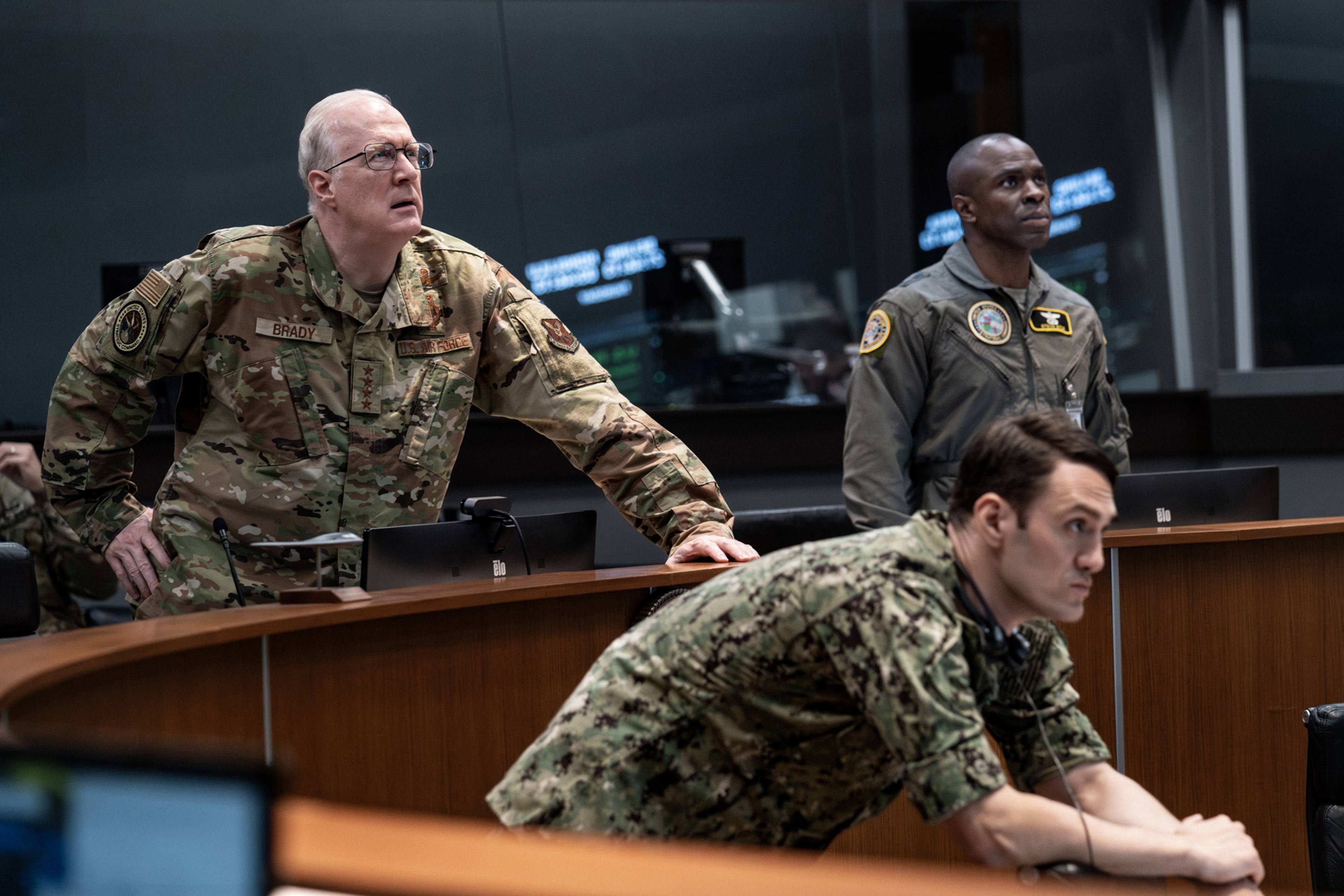


While I found the sprinkling of backstories distracting, Bigelow’s ping-ponging plot ultimately makes for a shrewdly impersonal film, one that mesmerizes on a sheer procedural level as protocol dissolves into ambient terror. Eventually, everything that can be done to stop the ballistic has been, and none of it comes close to eliminating the threat. Notably, the one course of action remaining is retaliation, even if it’s unclear against whom – all but ensuring a global descent into nuclear winter. (That’s one way to stop global warming.) Focusing solely on American lives, the film frames this petulant escalation as an afterthought. But the very unknowability of the aggressor feels apt for a moment when all of the United States’ traditional alliances and enmities seem to be in flux, oscillating daily on the whims of an unstable president (not Idris Elba).
Is it possible to jolt ourselves into positions of such urgency outside the movie theater? What would it take for us to feel that the stakes are actually this high? A House of Dynamite cuts to black before impact (or not?), which is a shame. Disaster movies like these frame the unimaginable without fully exploring it, with the implicit hope that, perhaps, it’s not too late to change our ways. My favorite part of Bugonia was its epilogue, after the atmosphere of our planet is popped like a soap bubble. Lanthimos finishes with an extended sequence, set to Marlene Dietrich’s rendition of Pete Seeger’s “Where Have All the Flowers Gone?,” of corpses splayed out in colorful t-shirts, or floating facedown at exclusive resorts. All the stress and caustic fury of the past two hours is gone, and (as a moment with a golden retriever makes clear) the catastrophic consequences did not lead to the end of life itself, but only of sapient life on our once-green planet. Done away with in a painless instant like that, one could almost consider it a happy ending.