
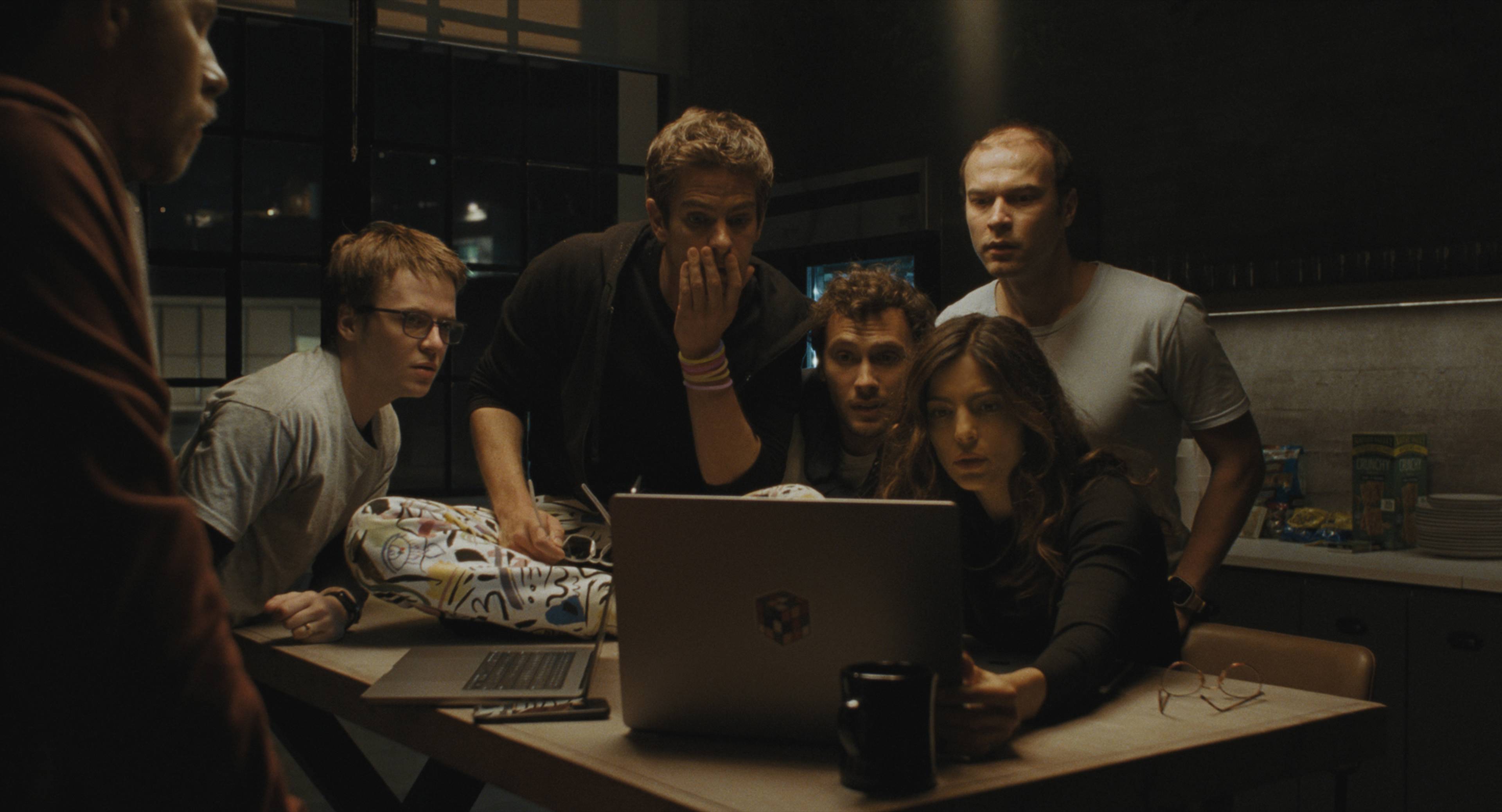
If Luca Guadagnino had been born during the Renaissance, he would have worked in fresco. Decisive strokes, painted onto wet plaster, preserve momentary ideas (and mistakes) for centuries to come, and require a true stylist’s bravado to carry them off. His latest picture is a kind of fucked up Last Supper (c. 1495–98): the final moment when the gang’s all together, in celebration just before calamity. Like Leonardo’s mural of that scene, it hangs on a pivotal moment, the words “One of you will betray me” still ringing in the ears of the disciples, who look at one another as if sorting out the sides before a battle. The items on the table before them will soon be transformed into vessels for their communion with God.
This is the most generous reading I can give to Artificial (2026), a film that lacks both the science and the philosophy required to convince its audience that the technological revolution at the heart of its story can come anywhere close to living up to its hype. Instead, Guadagnino brings us into the Bay Area microcosm where artificial intelligence’s claims of (unspecified) civilizational upheaval are simply self-evident, with each principal character granted at least one opportunity to monologue over AI’s capacity to remake the world as they’d like it to be, potentiality incarnate. It’s no coincidence that the film conjures religious associations. And yet, even as orthodoxy, it falls flat, since Guadagnino is far too much of a sensualist to tell the story straight. For his idea of satire is more perversion than critique: Judas and Jesus in unrequited love. The result is a movie that will please no one remotely opinionated about tech politics today, too irreverent for any of AI’s true believers, too credulous for any of its skeptics. But if you’ve just woken up from a coma and want to learn the basics about Silicon Valley’s souped-up chatbots and their criminally negligent carnival barkers, Artificial provides an entertaining primer.
Guadagnino seems oblivious to the inherent comedy of a bunch of tech bros sitting around and asking a chatbot they just created for advice.
Artificial has been described as a biopic of Sam Altman, the CEO of OpenAI, but that’s not exactly right. Deliciously, Guadagnino tells his tale from the Judas perspective. The film opens circa 2003 on the offices of Geoffrey Hinton (Mark Rylance), the leading authority in what is, at the time, an extremely unpromising branch of computer science: neural networks. In bursts Ilya Sutskever (Yura Borisov), an already-balding seventeen-year-old math whizz, who begins erasing formulas off the Godfather of AI’s whiteboard to suggest his own improvements. Played by Borisov with a holy fool’s earnestness, Sutskever is a straightforward, sensitive genius: As he notes several times throughout the film, he believes himself “incapable of lying.” He’s also depicted, a little conveniently, as the golden child of machine learning, the missing piece in every project he joins, from Alex Krizhevsky’s computer-vision concept AlexNet to the earliest iterations of ChatGPT. Gliding rather lightly over the abstruse science and tedious labor required to get its story off the ground, Artificial has no problem simplifying the messy, intergenerational work into a character study of its brightest few stars. Important figures in the development of AI, like Dario Amodei of Anthropic and former Meta AI scientist Yann LeCun, hang around the margins of the frame, waiting in vain for the film to introduce them.
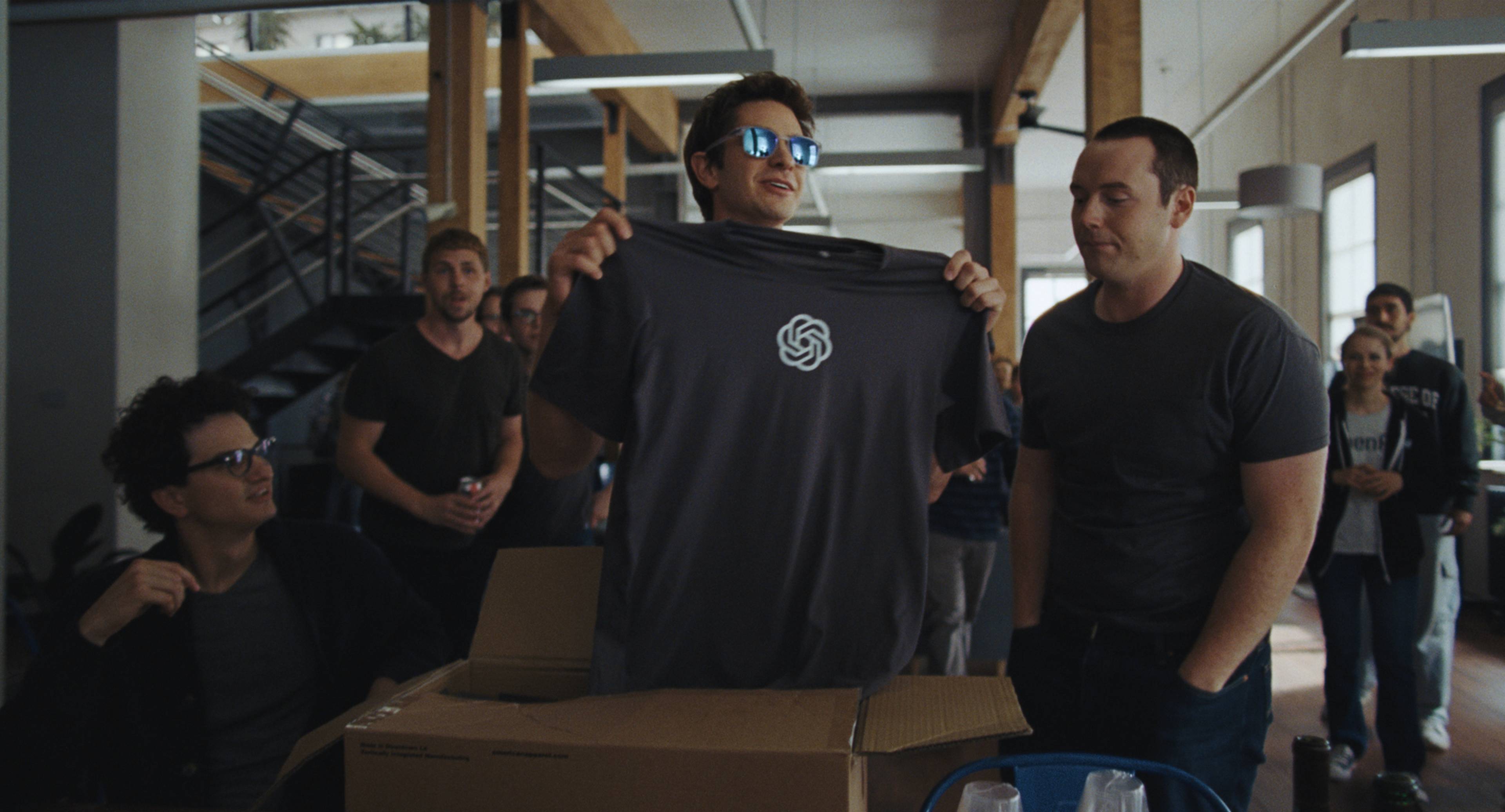
In Artificial’s first few minutes, a decade has passed, and Hinton, Sutskever, and Krizhevsky have moved from a derelict back office at the University of Toronto to fielding offers in the tens of millions of dollars from Bay Area big tech. Enter Altman (Andrew Garfield), still at the startup accelerator Y Combinator, who watches the feeding frenzy from the sidelines of a San Francisco café, debating the value of Hinton’s research with his pal Elon Musk (a fully slapstick Ike Barinholtz). They agree it’s worth something several orders of magnitude higher than Google’s $44 million purchasing price. It’s the closest the film gets to depicting OpenAI’s conception, substituting a casual chat over green juice for the now-infamous 2015 email Altman wrote Musk about “start[ing] a Manhattan Project for AI … via some sort of nonprofit.” At Y Combinator, it was Altman’s job to sniff value out of promising tech, and he believes software that can teach itself image recognition will soon be able to teach itself pretty much anything. No sooner have Sutskever and Hinton arrived at Google than Altman starts sidling up to the wunderkind. Soon, he will introduce Sutskever to Musk, and a champagne-spraying party of speculative investment will ensue.
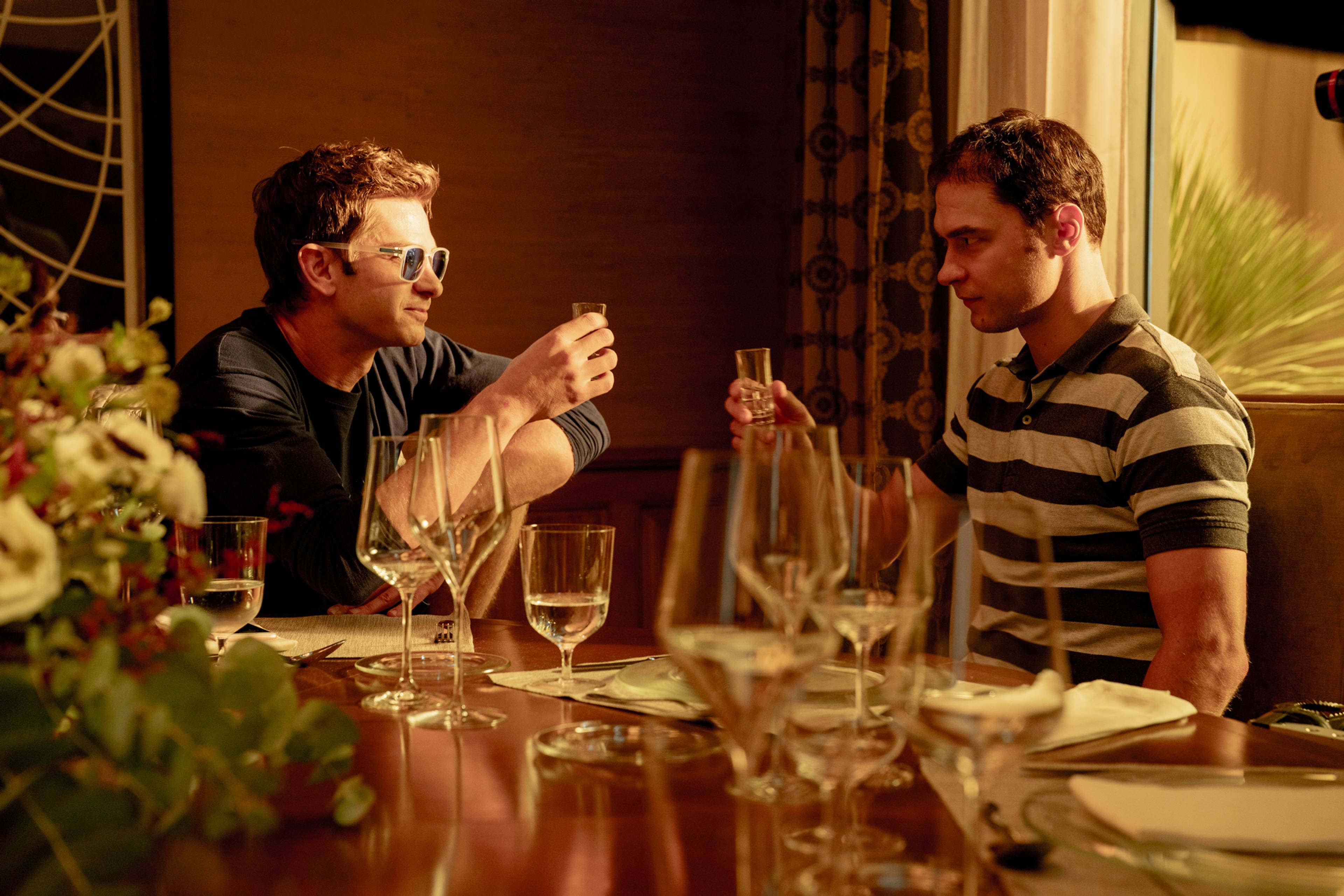
If you’ve ever seen that meme of High School Musical-era Zac Efron giddily shrugging, you can glean a good sense of Garfield’s performance. While Artificial’s producer has noted that “Everything that we say in the film … could be proven and double-proven,” it’s the narrative’s nonverbal parts that may be the most libelous. Staring trancelike into the camera through shiny colored contacts, walking on the balls of his feet, and generally contorting his body like a willow in a storm, the film portrays Altman as a fey twink of terror, feigning empathy for everyone to get what he wants. For Musk, already queasily self-regarding back in 2013, Altman dutifully performs the role of a fan. For Sutskever – a hastily sketched character in this frantically paced film, but broadly legible to audiences as a geek and a loser – Altman tenderly takes up the role of best friend. Sutskever is Altman’s entré to real power, and, in a performance that constantly teeters between brilliant and tasteless, Garfield creates the impression of being secretly smitten with his dopey chief scientist. It shouldn’t be surprising that Guadagnino has tried to turn a sexless saga about software and corporate maneuvering into a covertly queer love story – the filmmaker has employed everything from cannibalism to tennis to demonstrate desire. But Garfield’s over-the top performance makes it difficult to grasp the vicissitudes of Altman’s character, which becomes important when the film tries to give us the inside track on the CEO’s attempted ouster and swift reinstatement at the helm of OpenAI in 2023, in a market-roiling incident now known as “the Blip.”
If Sutskever is incapable of lying, Altman seems equally incapable of telling the truth; Garfield delivers every line with a roll of the head, as though shaking off several less convenient alternatives. Guadagnino has described the film as “about someone who wants to play God,” but also “about the physical body language of these people, the way they walk.” This focus on physicality becomes the film’s awkward way of reconciling the story of desire and frustration that Guadagnino wants to tell with Simon Rich’s boring, legally watertight script.
It shouldn’t be surprising that Guadagnino has tried to turn a sexless saga about software and corporate maneuvering into a covertly queer love story.
This brings us face-to-face with the shortcomings of Artificial’s story: namely, that it is still being played out in real time by a small group of insiders, who only reveal information when forced. The film is limited to what it can prove; that a single step into the realm of speculation would have resulted in lawsuits seems to everyone a foregone conclusion. Even after a corporate legal team rigorously vetted the final cut, and reportedly toned down Garfield’s performance in scenes it deemed “hyperbolic,” Amazon MGM still decided to drop the film, after Amazon Web Services invested $50 billion in OpenAI’s digital infrastructure. Compared to the lengths people went to try and prevent Artificial from reaching an audience, the film itself feels slight, both whimsical and restrained. The few scenes when ChatGPT appears as a “character” or plot device are thin, and Guadagnino seems oblivious to the inherent comedy of a bunch of tech bros sitting around and asking a chatbot they just created for advice. In one scene, Sutskever breathlessly asks his computer to help him solve the problem of alignment – a term for the thorny issue of getting AI agents to accomplish tasks while adhering to our unspoken ethical imperatives – and the machine responds by cracking a joke. This scene is made both funnier and more chilling by the slew of recent “rogue agent” incidents.
Artificial is easily one of the most topical movies ever made, retelling a story that has been basically impossible to ignore for the past three years – at least, for those of us damned to consume podcasts. Other than Garfield’s salacious performance, it adds no new information or twist. Yet, I couldn’t help but feel that the most positive – and critical – aspect of Guadagnino’s film was the way it became a kind of investment in the future, its troubled production and distribution a meta-narrative that fits nicely into the story’s exploration of contingency itself. Nobody knows for sure what is going to happen with AI, but given that its supporters and detractors alike tend toward millenarian language, we can be sure that quite a few of them will be proven wrong in the next couple of years. Singularity or bubble, labor-erasing wizard or redundant enterprise software: the full reach of artificial intelligence will become known to us in the not-so-distant future. At that point, it might be fun to look back at Artificial, a film that faithfully, if foolishly, captures whatever we think it is now.
Artificial premiered at the New York Film Festival on 5 Oct 2026 and opens in limited release in the US on 25 Dec 2026.