

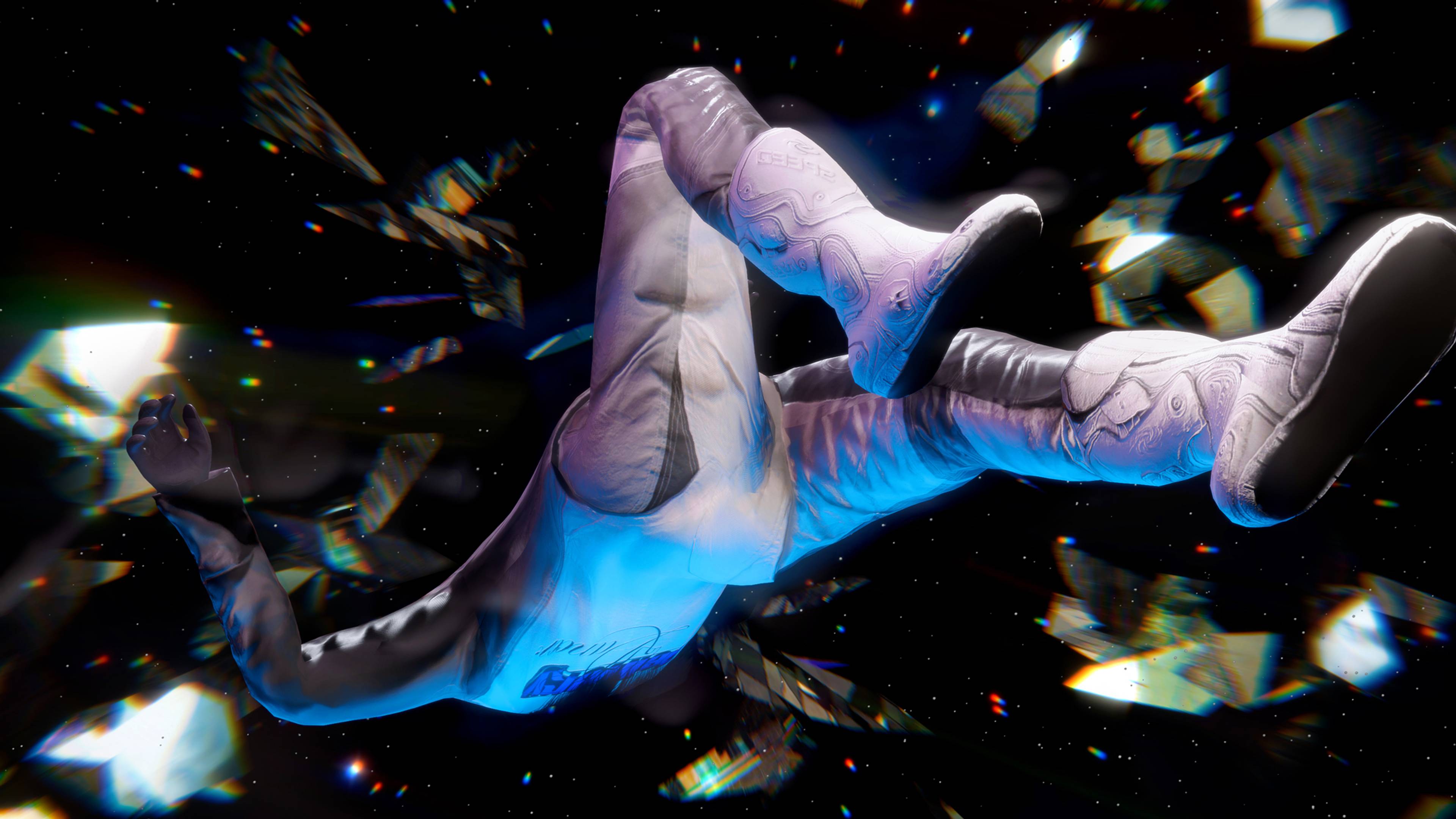
Surely, we’re living in the century of American humiliation, I think, approaching the twenty-minute mark while queuing for a recent Beeple opening. It’s a beautiful late April evening in Palo Alto, where a line around the block is common for something like a “pop-up concept café” and unthinkable for an art vernissage. It’s the most Balenciaga I’ve seen in this corner of the Bay Area, though the ratio of fleece vests and down jackets to designer threads is giving moneyed degen. Killing time as the line inches along, I ask the gentleman ahead of me if he’s a Beeple fan. He gushes with affection for the artist’s practice, enumerating virtues that are really quite moving. Art for the people. Emotional honesty. Searing social critique. And so on. That is, until he starts to rave about the artist’s anonymity and his affinity for spray paint and I realize that he thinks we’re here for Banksy.
“INFINITE_LOOP,” billed as Beeple’s first mid-career survey, is a Nam June Paik-ish, or maybe Times Square-ish, concatenation of screens filling NODE’s 1100 square-meter warehouse, the sophomore show mounted in the digital art nonprofit’s newly permanent space. The first was a display of one thousand CryptoPunks NFTs. At Beeple’s opening, I’m on a date with an employee of [redacted AI company] who likes to quip that his job is to abolish human image-making. As we traverse a forest of glowing monitors, he makes a sort of tsk-tsk sound as he gauges that the AI-generated videos on view were not made with his model. (He could tell by the look of the flowers.) One room bears a ceiling cutout, à la James Turrell, inlaid with Heaven and Hell (2023), a dizzying rotation of digitally generated images of damnation. I crave a Dramamine.
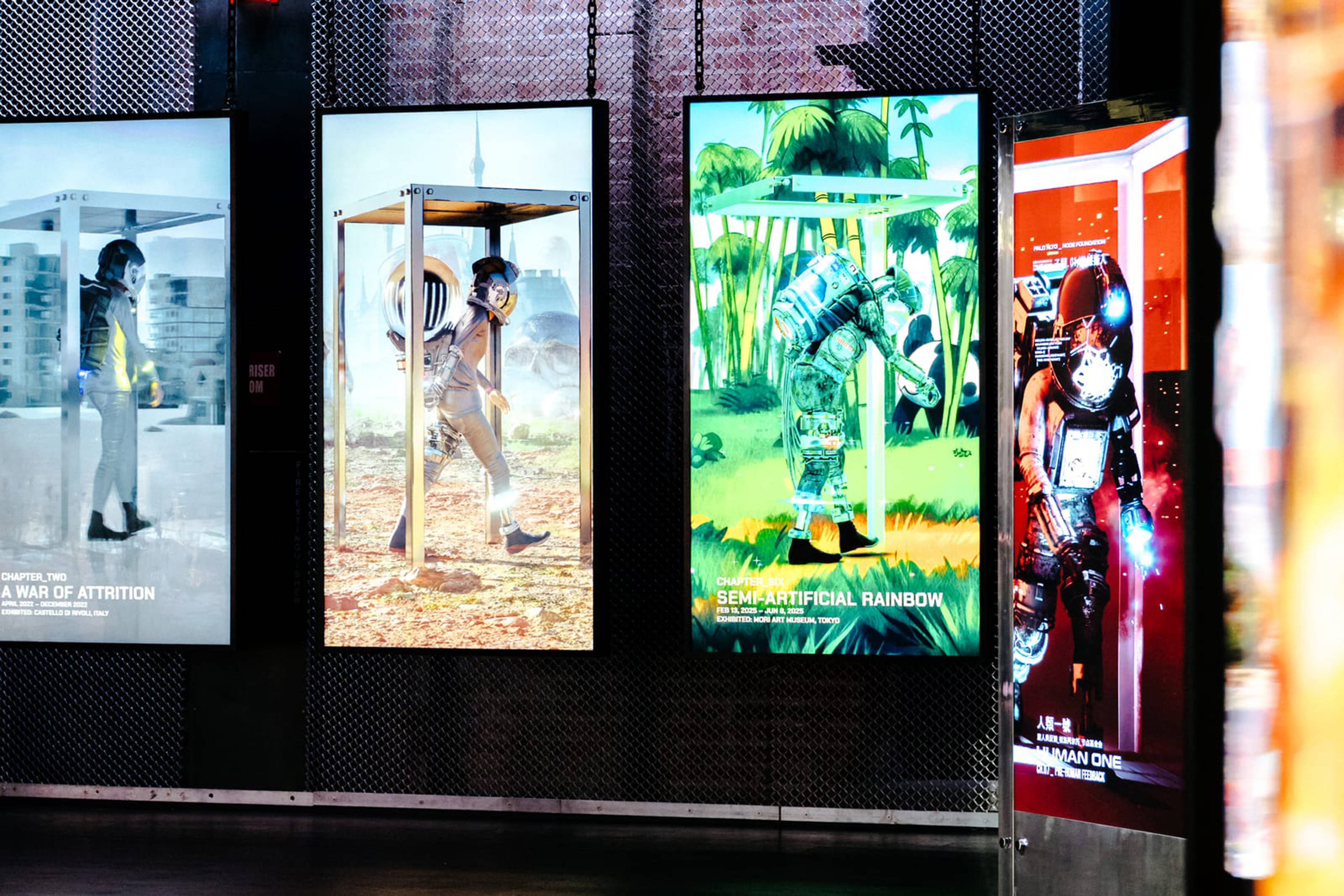
Beeple, Human One, 2021–. Installation view, NODE, Palo Alto, 2026
A crowd is assembled in a back room, beyond a bar dispensing Bud Light tallboys and adult Lunchables of pre-packed charcuterie. Peering over the shoulder of a man in a Bored Ape Yacht Club jacket, I see a litter of Boston Dynamics-esque (Unitree) robot dogs skittering around, painted the color of raw chicken, bearing human heads belonging to, variously, Jeff Bezos, Mark Zuckerberg, Elon Musk, Andy Warhol, and Beeple himself. Actually, there are two Beeples. Is he exercising something like the jester’s privilege, I wonder, enacting critique by doubling himself? Or is he cheapening his own image by inserting it twice? An artist known for selling NFTs should know as well as anyone: in an era of infinite reproducibility, value still resides in insisting, however ham-fistedly, that something is one-of-a-kind.
The first of the “TEN COMMANDMENTS” guiding NODE’s mission is: “Never midcurve.” As in, stick to the poles of the bell-curve meme, the drooling idiot or the mega-brain genius. Digital art seems to be cohering around those antinomies right now: sloptimism on the one hand; academicized attempts to define new art-historical categories on the other. An exhibition about protocol art titled “Strange Rules” just opened alongside the Biennale in Venice, defining a more intellectually robust province for new media art. Curated by Hans Ulrich Obrist and artists Holly Herndon and Mat Dryhurst, “Strange Rules” offers a counterpoint to the screen-based spectacle that passes for art in Palo Alto. The definition of protocol art that they sketch hews closer to what artist and writer Jack Burnham, in curating the Jewish Museum’s 1970 exhibition “Software,” coined “systems art.” Emphasis here on the underlying infrastructure: codes, in both the social and technical sense, that constrain and sustain.
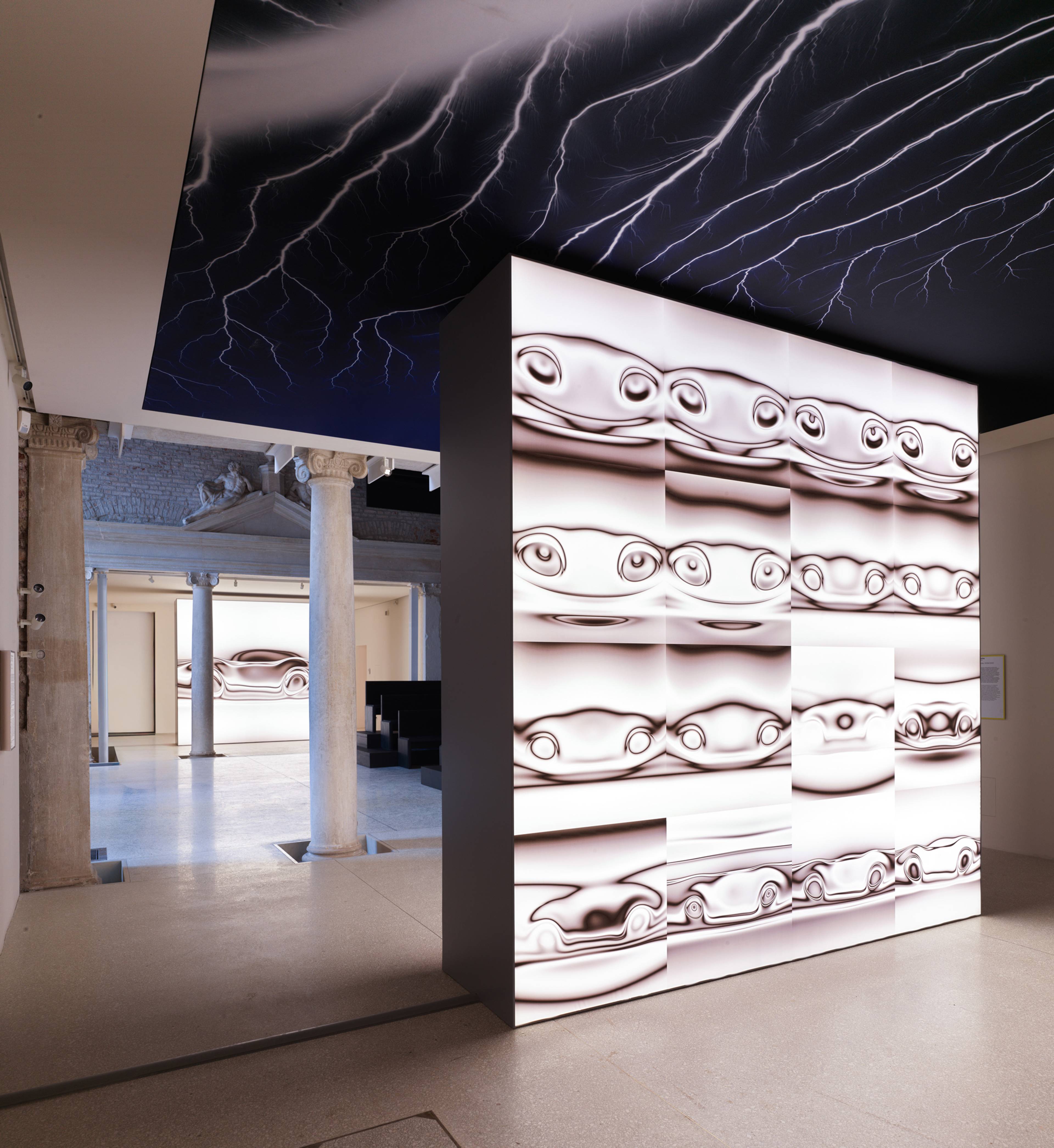
Ken Stanley, Picbreeder, 2008–20. Installation view, “Strange Rules,” Palazzo Diedo Berggruen Arts & Culture, Venice, 2026. Photo: Joan Porcel
Burnham’s “Software” show has come to be regarded as seminal, but was panned by critics in its time. Grace Glueck, writing for the New York Times, called it “confusing,” situating the show somewhere between fine-art exhibition and industry-backed tech demo. Like AI art at present, the technical themes and substrates were bleeding-edge – at that point, the very idea of software was so unfamiliar to the common reader that Glueck’s review included an explainer. The critical establishment was apparently displeased that blatantly commercial products, mere tech novelty show-offery, had so much floor-space in the exhibition. Nicholas Negroponte, the founder of the MIT Media Lab, contributed a self-organizing architectural sculpture featuring live gerbils (which the paper of record also felt the need to demystify, describing them as “small hamster-like animals”). The debate over whether this sort of thing should be in a museum feels at once contemporary and utterly small-c conservative. Post-Bretton Woods as much as post-internet, hasn’t contemporary art become, if not exactly a commercial product, the financial instrument par excellence?
The technological-novelty wow-factor is certainly an animating thrust behind much digital art today, even if Beeple’s robot dogs struck me as kind of démodé. Consensus on X (I finally gave in and stopped calling it Twitter) is that those Boston Dynamics-looking dogs are inferior to anything being made in Shenzhen right now. Designer Alexander Wang was hip to as much, sending an AgiBot – a Chinese-made competitor – to the Met Gala. Although his robot got stuck in an elevator; so, ambiguities endure. It’s unclear whether Beeple means to clown on American Dynamism by gesturing to our shitty homegrown robots. This ability to hedge, to signify as alternately celebratory or critical, is surely central to the artist’s appeal. It seems like he’s heading towards world takeover. I met him in Berlin a few days later, where he was exhibiting at the Mies van der Rohe-designed Neue Nationalgalerie (talk about the ends of the bell curve). He was lovely – more gracious than he had any reason to be when I first asked him for a selfie, then told him that the selfie was “just for my dad,” masking my genuine enthusiasm behind the accidental insinuation that he was mostly exciting to boomers.
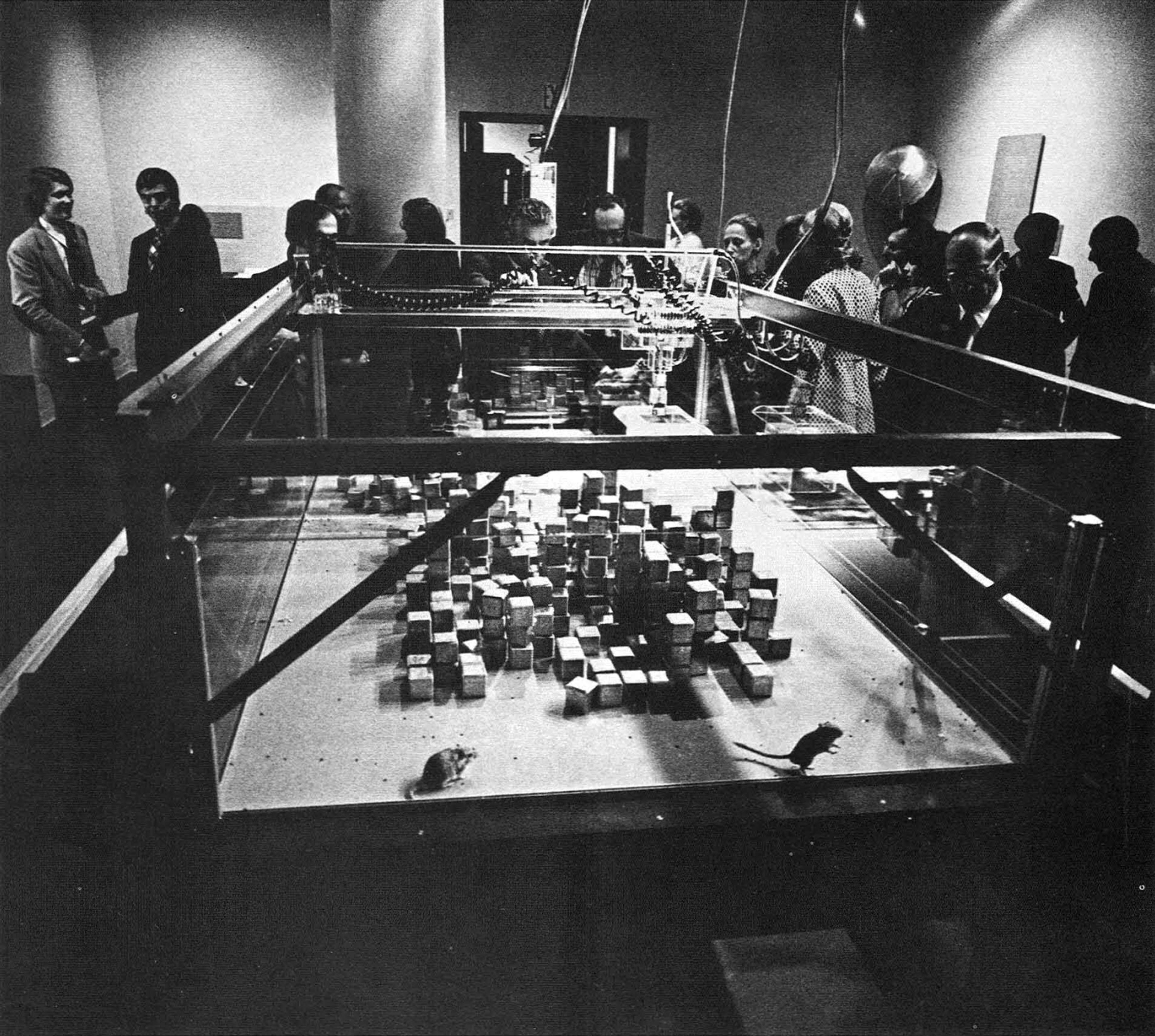
The Architecture Machine Group, M.I.T., Seek, 1969–70. Installation view, “Software,” the Jewish Museum, New York, 1970
I’ve been walking around this city where I used to live, back when I was still optimistic about the democratizing potential of cryptocurrency, listening to an AI deepfake of Gwyneth Paltrow read aloud from Zeros + Ones, a cyberfeminist retelling of tech’s origin myths written in 1997 by CCRU co-founder Sadie Plant. Meandering around Mitte, all the fast-fashion stores are showing flimsy going-out tops made from plastic-derived fibers that look uncannily close to computer renders, like they were printed directly from Pinterest. Cycles of desire, coded and cultivated by algorithmic feeds, are manifesting throughout the material world with the thinness of mirage. I make awkward eye contact with an influencer holding a leashed Dalmatian with one hand and a hyperlink-blue coffee cup in the other, shooting content outside a new coffee chain called Life Among People (LAP). Their storefronts, spreading like an invasive species, feature automated milk-steamers to stabilize the rising cost of a cappuccino. For this, LAP is – uncommonly for a Berlin-based hospitality brand – attracting venture capital, and the chain’s expansion has been a flashpoint in the city. It is unc to walk around Berlin pointing out how things were different for the better when you moved there X years ago. It is likewise unc to state that the physical world seems to be growing more and more synthetic. But Zeros + Ones is older than I am, and it worries me to hear myself say things like, remember the time before everything felt like a VC-backed hallucination?
There is one version of democratization that entails redistributing power, and there is another which just consists of making things possible for more people to buy. It’s not always as obvious as it should be which one is operative, or being sold to us by a novel technology. Sometimes, I feel like a gerbil in Negroponte’s maze, the possibility space for unprogrammed action seemingly so constrained. I’m not sure how to parse the claim that Beeple is populist. Apparently, the 2021 Christie’s sale of his Everydays: The First 5000 Days and the resulting PR flurry pumped the Ethereum market so much that the work’s buyer, Metakovan, recouped the €58 million outlay via the resulting increase in value of their remaining cryptocurrency holdings. Is that good for the people? Which people? Social practice, or even social critique, it most certainly is not. But there is something conceptually staggering about it, some kind of artistic sublimity to that gesture. In the ultimate work of systems art, the market itself becomes the medium.