
I got hit, in the first few weeks of the new year, with a grotesque flu and an even worse case of techno-optimist derangement syndrome. Living in the beating heart of Silicon Valley makes you vulnerable to a particular kind of myopia: spend enough time around people with professional faith in tech products, and respiratory viruses aren’t the only contagion you’ll risk contracting. I wrote last November that the AI industry looked like an economic bubble – a handful of companies with astronomical valuations despite comparatively small earnings and dubious evidence that their products do much of anything useful. It would take a breakthrough, a serious boost to AI adoption, to turn that situation around.
Well, by some accounts, this deus ex machina arrived right on schedule. Deliriously fluish and extremely online, I scrolled through posts gurgling up from the geekiest depths proclaiming that February 2026 was a month of AI revolution. Something called Clawdbot, then Moltbot (to avoid Anthropic’s legal ire), then again rebranded as OpenClaw – I half-comprehended this chameleonic entity as Microsoft Clippy on steroids or something. Posters proclaimed that the singularity was imminent in this, the arrival of of “AI agents,” from beloved OpenClaw to Anthropic’s Claude Code and OpenAI’s Codex.
These tools, which have recently become commercially and technically viable at scale, promise something audacious: artificial intelligence that can execute real-world tasks, at least to the extent that these tasks happen on your computer. While chatbots are fun but ultimately passive, agents make things happen. They can automate complex, multi-step processes: Where an LLM could draft an email for you, an agent can actually send it. Not only can they make decisions, they can enlist other agents in executing them – agents running small armies of other agents set on side quests, searching the internet, running code, 10xing or maybe 100xing your productivity (but not yet tucking you in at night). Their utility for programmers is major, and as they enter into widespread use, their normie benefits – like automatically filing tax receipts or checking you in for a flight – are drawing attention, too.
Notably, OpenClaw is an open-source project. Anyone can download it online and get it set up in an afternoon. It’s lightweight enough to work on a Mac Mini. Users run it locally instead of in some faraway datacenter. There are no corporate shareholders; no exorbitant subscription costs; no looming sense that your chat history is helping train models that will be snapped up by the Department of War. Uncanny feats of automation made available to the masses, propelled by what looks in certain ways like a grassroots revolution. In six weeks, OpenClaw became one of the most starred projects in the code-sharing platform GitHub’s history. Only for its developer, the Austrian programmer Peter Steinberger, to accept a job offer from OpenAI. So much for being a free agent.
Amid the growing hype, I put out an Instagram story asking if anyone who follows me actually uses them. I was shocked by the number of responses. I got swept up in FOMO. It seems like everyone (n=my homies) is already kitted out with their own virtual labor force. I briefly suspected that it was not the homies, but their agents, who had responded to my query. I daydreamed about the walk I could be taking if an auto-Adina were triaging my DMs instead of answering Instagram messages solo, trapped under a communicative avalanche of my own making.
The promise of “labor-saving technology” is an inexhaustible marketing strategy in a world rife with human exhaustion.
The programmers I chatted with cited massive boosts to their coding productivity – devs completing solo projects in a month that previously required teams and years. A designer told me he drafted a client brief in “an evening and a cheeky smoke break.” A friend enlisted his OpenClaw to resolve a tiff with a pal who felt dismissed when he replied “woooo” to an important text. He was adamant that “woooo” was a common exclamation in their shared vernacular, and had the agent scan his iMessage history and create a leaderboard of who said “woooo” the most in his text conversations to prove it.
The future of executive functioning has crash-landed in the form of a cartoon lobster. (Don’t Deleuze and Guattari say something in Capitalism and Schizophrenia about how Professor Challenger deterritorialized too fast and turned into a lobster?) In this future, relieved of the banalities of our email jobs, perhaps we’ll all be owning the “woooo” leaderboards by unleashing bots that text our friends’ bots with our favorite exclamations; raking in returns on the software we vibecoded via voice-note; swimming in more precious down time than we could possibly dream of filling with the treasured pastimes of gambling and watching shortform video content. We are approaching, if you’ll forgive me the vulgarity, Slavoj Zizek’s famous “sex toys copulating with each other while their owners sit nearby and have a coffee” levels of gadget-based outsourcing.

Or maybe we’re getting ahead of ourselves. Agentic AI might be new, but the fantasy of a technological solution to engineer away the limits of “the human motor” isn’t. With the ever-deferred arrival of Fully Automated Luxury Communism, the prospect of market-based solutions to the toils of labor is losing its luster. Previously, I made the case that LLMs were a prime example of what the writer Astra Taylor has called “fauxtomation”: apparently relieving us of one form of labor only to demand of us another. Each new generation of AI promises to eliminate this human backstage work, while in reality just fragmenting it, precaritizing it, and shunting it out of view. The promise of “labor-saving technology” is an inexhaustible marketing strategy in a world rife with human exhaustion.
The extent to which AI agents make good on this promise is an open question. While they do demonstrably increase output in certain kinds of work, they also engender different demands in turn, from the crafting of elaborate prompts to fact-checking and supervising output. These systems are error-prone and fraught with security risks; precisely because they can do real things, not just yap, their slip-ups are higher-stakes than LLM hallucinations. Granting OpenClaw access to your credit card might streamline your weekly online grocery order, but any time saved there is spent down the line, auditing the monthly account statement, lest things devolve into a Random Darknet Shopper type of situation.
We are made to buy into the belief that AI agents can successfully LARP as humans, but equally, we’d do well to ask how humans are incentivized to perform as bots.
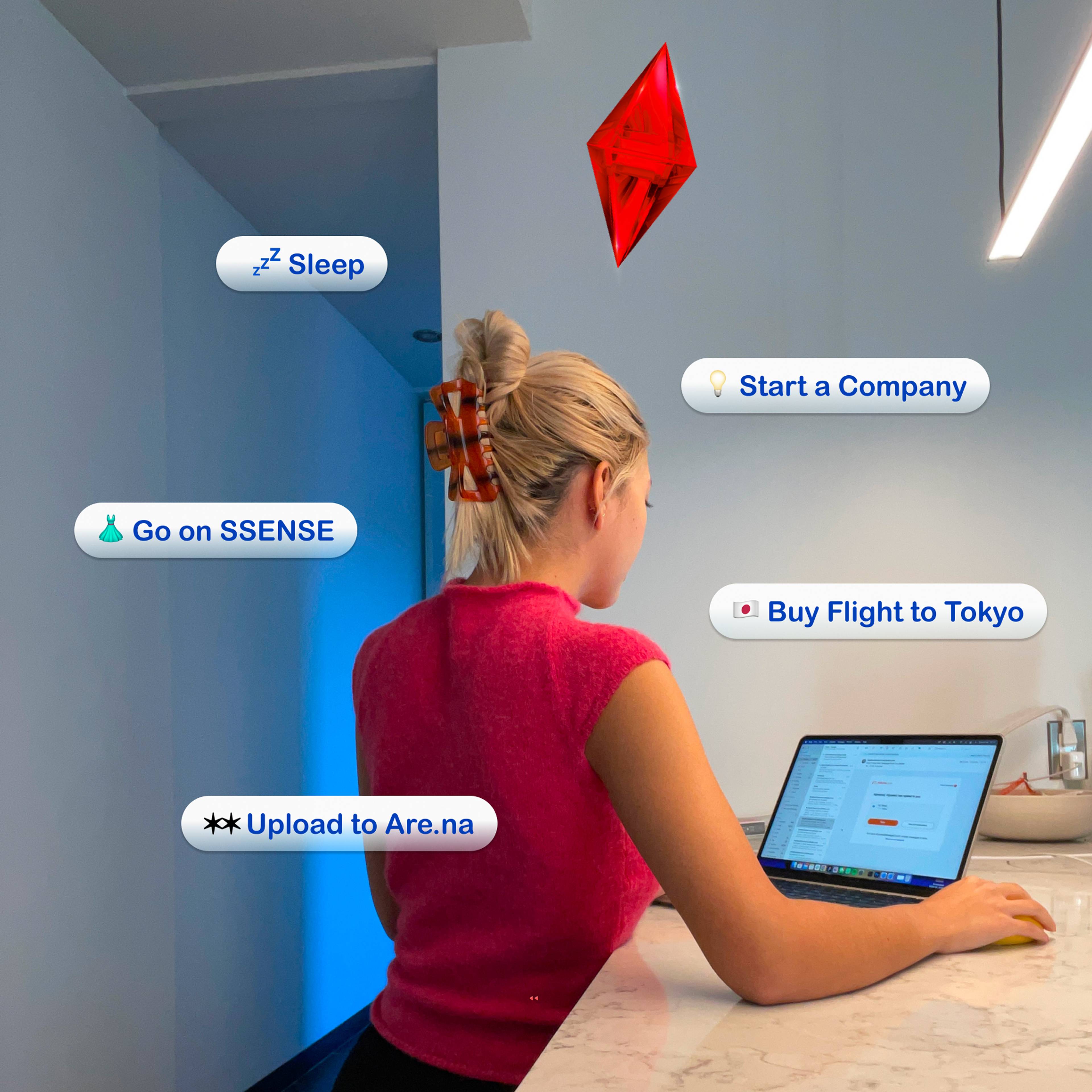
The fantasy pushed by the AI industry is that agents elevate anyone to the position of CEO. In practice, they conscript us into being bot babysitters; middle managers; bureaucrats correcting the mistakes of other bureaucrats. In so doing, we subtly conform our subjectivities, learning to think as these systems think, to speak in a language they find legible, just as they are trained to sound and act like us. There’s a queasy slippage of autonomy, here: who is the agent, and who is the bot?
There are already lurid examples of this blurring, from the Moltbook debacle to anxieties about “dead internet theory” dating back to the mid-2010s. We are made to buy into the belief that AI agents can successfully LARP as humans, but equally, we’d do well to ask how humans are incentivized to perform as bots. Back in 2023, which feels like an eternity ago, NPC streamers like Pinkydoll captured the internet’s attention by vacating her subjectivity for TikTok viewers, popping popcorn with a hair-straightener, incanting “ice cream so good” and “gang gang” on command in exchange for virtual tokens. She claimed her persona was based on the non-playable background characters in Grand Theft Auto. That curious era of content-creation now seems prophetic. Were NPC streamers rehearsing for a future where people ape bots as readily as bots impersonate humans? “Ice cream so good” becomes “agent performance so good,” a ritual affirmation of technological progress masking a stirring sense that, at the cost of the next great innovation, something inside us has started to wither.